4 Chair Exercises That Restore Leg Strength Faster Than Squats After 65
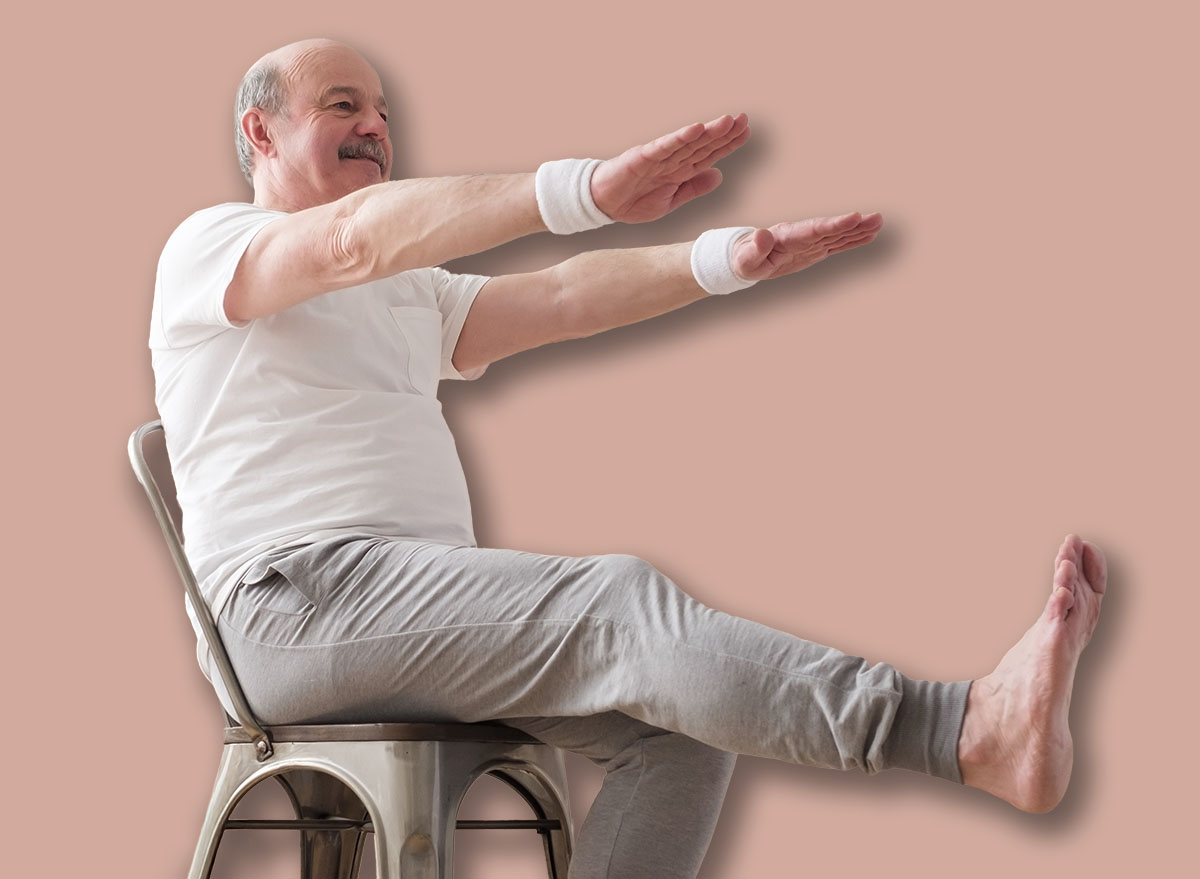

Including squats in your workout routine is an incredible way to build strength—especially when it comes to your quads, hamstrings, and glutes. They help boost balance, mobility, and flexibility. But we’re here to share a little secret: We spoke with Felicia Hernandez, NASM-certified personal trainer and community engagement lead at Eden Health Club, and learned four chair exercises that can restore leg strength even quicker than squats after 65.
Chair exercises are extremely beneficial when it comes to strengthening your legs—and since they’re low-impact, they’re joint-friendly as well. Chair exercises are controlled movements that will not only build strength in this area; they’ll also improve mobility, balance, and daily function.
According to Hernandez, you don’t need to be standing in order to build leg strength.
“Chair exercises remove the fear factor that stops adults from exercising at all. When you are holding onto something, you feel safe—[and] that safety gives you confidence,” Hernandez points out. “The chair holds you while still making]the muscles work hard. When I do a chair squat, I sit down, stand up, and I lift my whole body weight against gravity. That is resistance training, not a version. The important thing is that chair exercises teach the movements we need for daily life.”
Supported Chair Squats
“Chair squats are an ultra-effective exercise for adults. I have watched older adults use chair squats to get off the toilet, out of the car, and up from the sofa,” Hernandez tells us. “This movement works the quadriceps, glutes, and hamstrings at the same time. [Additionally,] chair squats are safer than squats because the chair controls the descent and helps with balance.”
- Begin seated with your feet flat on the ground, hip-distance apart. Your knees should be roughly over your angles and not pressing forward.
- Place your hands on your thighs, or cross them in front of your chest.
- Lean forward just a bit from the hips without rounding your back.
- Push through your feet to stand up tall.
- Lower with control without dropping into the chair.
- Lightly tap your glutes to the seat and immediately rise back up.
- Start using your hands to push off your thighs for added support, aiming to eventually stand up without the assistance.
Seated Leg Extensions
Seated leg extensions are stellar for isolating the quads—essential muscles used for walking, stair climbing, and controlling your descent when sitting down.
“After age 65, weak quadriceps are a cause of falls because the landing cannot be controlled. Leg extensions rebuild quadriceps strength without stressing the knees or needing balance,” Hernandez points out.
- Begin sitting tall with your back supported against the chair.
- Place your feet flat on the floor.
- Hold the sides of the chair for added stability.
- Straighten your left leg out in front of you until your knee is completely extended. For max quad engagement, keep your toes flexed toward your shin the entire time.
- Hold for 2 seconds at the top before lowering.
- Then, straighten your right leg out in front of you until your knee is completely extended, holding for 2 seconds at the top of the movement. Lower with control.
- Perform 3 sets of 12 to 15 reps on each leg, completing all reps on one side before switching over to the other.
Assisted Step-ups
“Step-ups mimic stair climbing, which is one of the most challenging daily activities for older adults,” Hernandez explains. “They build functional leg strength while improving balance and coordination. Unlike floor exercises, step-ups from a seated position give you stability at the start of the movement, when you’re most vulnerable.”
- Stand tall, facing a sturdy chair with your feet shoulder-width apart.
- Then, place one foot on the seat of the chair.
- If needed, place your hands on your thighs.
- Press through the heel of the foot that’s on the chair.
- Lift your body until your standing leg is completely straight. Don’t allow your knee to collapse inward as you rise.
- Hold for a moment at the top.
- Use control to lower.
- Complete all reps on one side before switching over to the other.
- Perform 3 sets of 8 to 10 reps on each leg.
Seated Heel Raises
“Strong calves help you keep your balance and walk. This exercise matters because calf strength determines the ability to catch yourself when you stumble,” Hernandez tells us. “Weak calves cause you to not push off effectively. That is why many older adults have trouble with the stairs or quick moves. I have watched older adults struggle with the stairs when their calves are weak.”
- Sit tall in the chair with your feet flat on the ground and knees bent to 90 degrees.
- Hold onto the sides of the chair for support.
- Lift both heels off the ground, rising onto the balls of your feet. Go as high as possible—picturing reaching the sky with your toes.
- Hold at the top for 2 seconds.
- Lower your heels back to the start position.
- Perform 3 sets of 15 to 20 reps.