If You Can Hold These 3 Bed Positions After 60, Your Core Is Stronger Than 90% of Peers

Did you know that you can crush a solid workout from the comfort of your bed? In fact, you can test your core strength by performing a few essential moves. We spoke with Dr. Tom Walters, Board-Certified Orthopedic Physical Therapist, Certified Strength and Conditioning Specialist, and bestselling author of “Rehab Science: How to Overcome Pain and Heal from Injury,” who breaks down three exercises that signal top-tier core strength after 60.
“Core strength tends to decline with age primarily because of sarcopenia, reduced physical activity, and changes in neuromuscular coordination,” explains Dr. Walters. “Beginning in midlife and accelerating after about age 60, skeletal muscle mass and strength gradually decrease. At the same time, people often move less, which further reduces the mechanical loading required to maintain trunk muscle capacity.”
In functional terms, the core serves as a “stability system” for both the pelvis and spine as you move. When the muscles encompassing your trunk lose endurance or strength, several things can happen, impacting your posture, mobility, and balance.
“The trunk plays a major role in controlling the body’s center of mass. Reduced trunk strength or endurance can make it harder to correct small balance disturbances,” Dr. Walters says. “In addition, weakness or poor endurance of trunk muscles can contribute to greater spinal flexion or a forward-leaning posture, particularly during prolonged standing or walking.”
It’s important to note that these changes aren’t inevitable. Dr. Walters says research indicates that the trunk muscles stay very responsive to strength exercises—even among the older adult population.
What Makes Bed-Based Exercises Effective
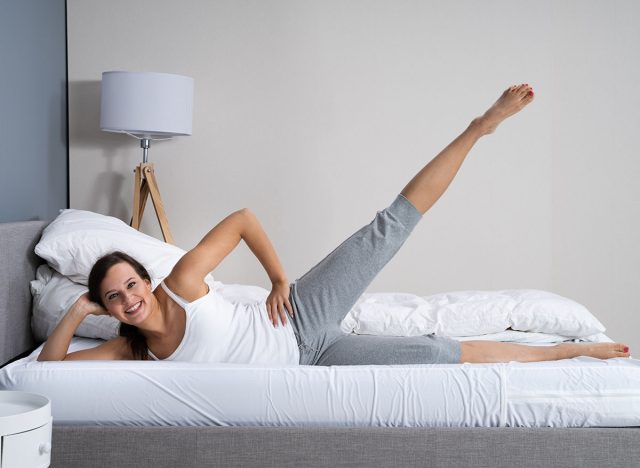
Doing exercises from bed can be surprisingly productive because they reduce hurdles that may be holding you back from exercise.
“Many older adults avoid floor exercises due to joint pain, mobility limitations, or difficulty getting down to and up from the floor,” Dr. Walters explains. “From a biomechanical standpoint, bed-based exercises still challenge the core because they require the trunk to stabilize the spine and pelvis against gravity. Even subtle movements, such as lifting the legs or maintaining a stable trunk while the limbs move, can create meaningful activation of abdominal and spinal muscles.”
Supine Dead Bug Hold
In the supine dead bug hold, you will lie flat on your back with your hips and knees bent to roughly 90 degrees while keeping your lower back pressed into the mattress.
“This exercise engages the deep abdominal muscles—particularly the transverse abdominis, trains the core to stabilize while the limbs move, [and] mimics the coordination needed for walking and daily movement,” Dr. Walters says.
Glute Bridge Isometric
In the glute bridge isometric, you’ll lie flat on your back with bent knees and lift your hips until your body forms a straight line from your knees to your shoulders.
“This exercise activates the posterior chain, including the glutes and spinal extensors, challenges the trunk to stabilize the pelvis, [and] supports posture and walking mechanics,” Dr. Walters tells us.
Side-Lying Plank
In the side-lying plank, you’ll lie on your side with bent knees and support your body on your forearm while lifting the hips slightly off the mattress.
“This exercise targets the obliques and lateral trunk stabilizers, improves side-to-side trunk stability, which is important for balance, [and] addresses a plane of movement often neglected in traditional exercises,” Dr. Walters notes.