5 Dumbbell Exercises Men Over 55 Should Do Each Morning to Build Muscle

Morning training has a way of setting the tone for the entire day, especially when your goal is to build and maintain muscle after 55. Strength work early in the day helps wake up your nervous system, reinforces solid movement patterns, and gives your metabolism a productive push right out of the gate. With the right exercise selection, even a short dumbbell session can deliver meaningful results. I’ve programmed plenty of morning routines for men in this age group, and the ones that stick are always simple, focused, and repeatable.
The key is choosing movements that train multiple muscle groups simultaneously while remaining joint-friendly. Compound dumbbell exercises check every box. They challenge strength, coordination, and stability without requiring complicated setups or long gym sessions. When done consistently, these lifts help preserve lean muscle, support healthy metabolism, and keep everyday movement feeling strong and capable.
The five exercises below form a powerful morning strength circuit that targets your entire body. All you need is a pair of dumbbells and about 20 minutes of focused effort. Here’s exactly how to perform each move for the best muscle-building return.
Goblet Squat
The goblet squat builds lower body strength while reinforcing strong posture and core engagement. Holding the dumbbell in front helps you stay upright and keeps the movement joint-friendly for the hips and knees. I like starting morning sessions here because it wakes up the largest muscle groups quickly and efficiently. Over time, consistent squatting supports leg strength, mobility, and overall muscle maintenance.
Muscles Trained: Quadriceps, glutes, hamstrings, and core.
How to Do It:
- Hold one dumbbell vertically at chest height.
- Stand with your feet about shoulder-width apart.
- Brace your core and keep your chest tall.
- Push your hips back and bend your knees to squat down.
- Lower until your thighs approach parallel to the floor.
- Drive through your heels to stand back up.
- Repeat for the target reps.
Recommended Sets and Reps: Perform 3 sets of 8 to 12 reps. Rest for 60 to 75 seconds between each set.
Best Variations: Tempo goblet squat, box goblet squat, heel-elevated goblet squat.
Form Tip: Keep the dumbbell close to your chest to stay upright.
Dumbbell Romanian Deadlift
The dumbbell RDL strengthens the posterior chain, which includes the hamstrings and glutes that often weaken with age. This movement improves hip hinge mechanics and supports better posture and lifting capacity in daily life. I program RDLs often because they build powerful hips while staying friendly on the knees. Consistent hinge work also supports back health and overall lower body muscle retention.
Muscles Trained: Hamstrings, glutes, lower back, and core.
How to Do It:
- Hold a pair of dumbbells at your sides.
- Stand tall with feet hip width apart.
- Brace your core and soften your knees slightly.
- Push your hips back while lowering the dumbbells along your thighs.
- Keep your back flat as you hinge forward.
- Drive your hips forward to return to standing.
- Repeat for the target reps.
Recommended Sets and Reps: Perform 3 sets of 8 to 12 reps. Rest for 60 to 75 seconds between each set.
Best Variations: Single-leg RDL, tempo RDL, staggered stance RDL.
Form Tip: Think of your hips back first, not bending forward.
Half-Kneeling Shoulder Press
The half-kneeling press builds shoulder strength while challenging your core and hip stability. The kneeling position helps limit lower back compensation and encourages better pressing mechanics. I use this variation often because it teaches full-body tension while still developing strong, capable shoulders. Over time, this translates into stronger overhead strength and improved upper-body control.
Muscles Trained: Shoulders, triceps, upper chest, and core.
How to Do It:
- Kneel on one knee with the opposite foot planted forward.
- Hold a dumbbell at shoulder height on the same side as your forward leg.
- Brace your core and keep your torso tall.
- Press the dumbbell overhead in a controlled motion.
- Pause briefly at the top.
- Lower the weight back to shoulder height.
- Complete reps, then switch sides.
Recommended Sets and Reps: Perform 3 sets of 6 to 10 reps per side. Rest for 60 seconds between each set.
Best Variations: Alternating press, neutral grip press, and slower tempo press.
Form Tip: Squeeze your glute on the down knee to stay stable.
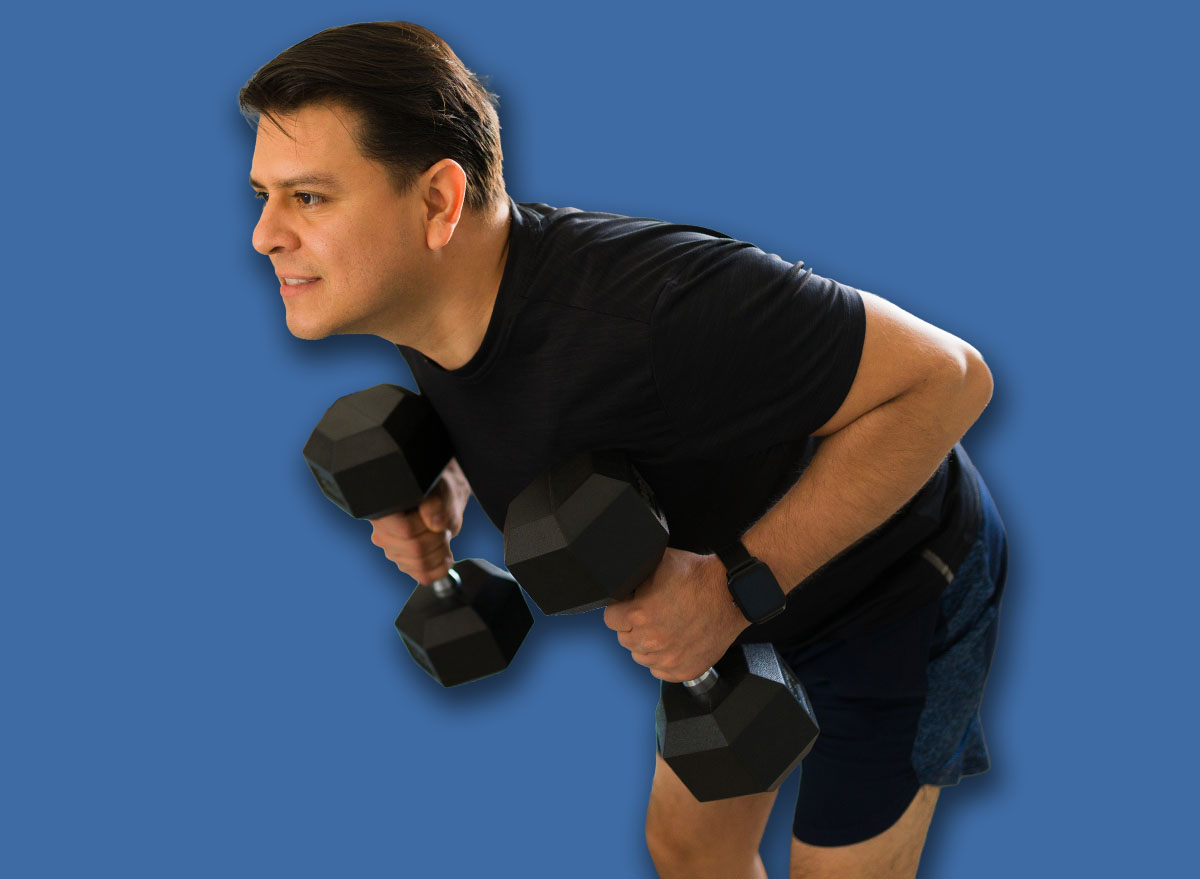
Bent-Over Row
The bent-over row strengthens the upper back muscles that support posture and pulling strength. Stronger back muscles help counteract the forward rounding many men develop over time. I prioritize rows in morning programs because they quickly activate the upper body and reinforce solid shoulder mechanics. Consistent rowing supports both muscle growth and better daily posture.
Muscles Trained: Lats, rhomboids, rear deltoids, and biceps.
How to Do It:
- Hold a pair of dumbbells with palms facing each other.
- Hinge forward at the hips with a flat back.
- Let the dumbbells hang below your shoulders.
- Pull the weights toward your lower ribs.
- Squeeze your shoulder blades together at the top.
- Lower the dumbbells with control.
- Repeat for the target reps.
Recommended Sets and Reps: Perform 3 sets of 8 to 12 reps. Rest for 60 seconds between each set.
Best Variations: Single-arm row, tempo row, supported row.
Form Tip: Keep your neck neutral and avoid shrugging.
Half-Kneeling Dumbbell Chops
Half-kneeling chops build rotational core strength while integrating the shoulders and hips. This pattern improves how your body transfers force across the midsection, which supports athletic movement and everyday tasks. I include chops frequently because they train the core dynamically and functionally. Over time, stronger rotational control supports greater total-body strength and coordination.
Muscles Trained: Core, obliques, shoulders, and hips.
How to Do It:
- Kneel on one knee with the opposite foot forward.
- Hold one dumbbell with both hands near your outside hip.
- Brace your core and keep your chest tall.
- Lift the dumbbell diagonally across your body.
- Finish with the weight above your opposite shoulder.
- Reverse the motion with control.
- Complete reps, then switch sides.
Recommended Sets and Reps: Perform 3 sets of 8 to 10 reps per side. Rest for 45 to 60 seconds between each set.
Best Variations: Low-to-high chop, high-to-low chop, and slower-tempo chops.
Form Tip: Rotate through your torso while keeping your hips steady.
Best Morning Habits to Build Muscle After 55

Building muscle after 55 works best when your training routine pairs with supportive daily habits. Strength sessions provide the stimulus, but recovery, nutrition, and consistency drive the long-term results. In my coaching experience, men who make steady progress usually focus on a few key behaviors they can repeat every morning. Small wins stack quickly when your routine stays simple and structured. Stay consistent with your lifting and support it with the habits below.
- Start your day with protein: Aim for 25 to 35 grams at breakfast to support muscle repair.
- Train most mornings each week: Frequent exposure helps maintain strength and coordination.
- Focus on controlled reps: Quality movement builds more muscle than rushing through sets.
- Stay hydrated early in the day: Proper hydration supports performance and recovery.
- Progress your dumbbell loads gradually: Small weight increases keep muscle adapting.
- Prioritize quality sleep at night: Recovery drives muscle growth and hormone balance.
Stick with these five dumbbell exercises and supportive habits, and many men over 55 begin to notice stronger movement, better muscle tone, and improved energy throughout the day.
References
- Schumacher, Leah M et al. “Consistent Morning Exercise May Be Beneficial for Individuals With Obesity.” Exercise and sport sciences reviews vol. 48,4 (2020): 201-208. doi:10.1249/JES.0000000000000226
- Gentil, Paulo et al. “Single vs. Multi-Joint Resistance Exercises: Effects on Muscle Strength and Hypertrophy.” Asian journal of sports medicine vol. 6,2 (2015): e24057. doi:10.5812/asjsm.24057