4 Home Exercises That Rebuild Arm Strength Faster Than Weight Training After 55

After 55, keeping your arms strong and toned is all about training consistently and in a way that you can actually stick with. But between work, family, and everything else competing for your time, driving to a gym to train your upper body often falls to the wayside. Fortunately, rebuilding real arm strength can take just a few minutes and be done at home with almost no equipment.
Studies show that strength training exercises using equipment like resistance bands (or even just your body weight) can lead to significant increases in strength and physical function in older adults, which means these simple, consistent sessions can add up over time and help you rebuild arm strength at any age.
To learn more, we spoke with James Bickerstaff, CPT, a personal trainer at OriGym, who says the tools you already have at home are more than enough. “The following exercises will strengthen your chest, shoulders, triceps and core simultaneously,” explains Bickerstaff.
Read on for Bickerstaff’s four best home exercises designed specifically to rebuild arm strength faster than weight training after 55. Then, when you’re finished, be sure to check out these 5 Standing Exercises That Firm Sagging Arms Faster Than Dumbbell Curls After 60.
Wall Push-ups
“Wall push-ups are one of the safest and most effective ways to rebuild upper body strength after 55,” says Bickerstaff. “Plus, you can adjust the difficulty simply by moving your feet closer to or further away from the wall.”
How to do it:
- Stand facing a wall with your hands slightly wider than shoulder-width apart.
- Walk your feet back until your body forms a straight line.
- Bend your elbows to lower your chest toward the wall.
- Press back to the starting position.
- Keep your core engaged throughout the movement and breathe through your nose.
- Complete two to three sets of 15 to 20 reps. Rest for 60 to 90 seconds between sets.
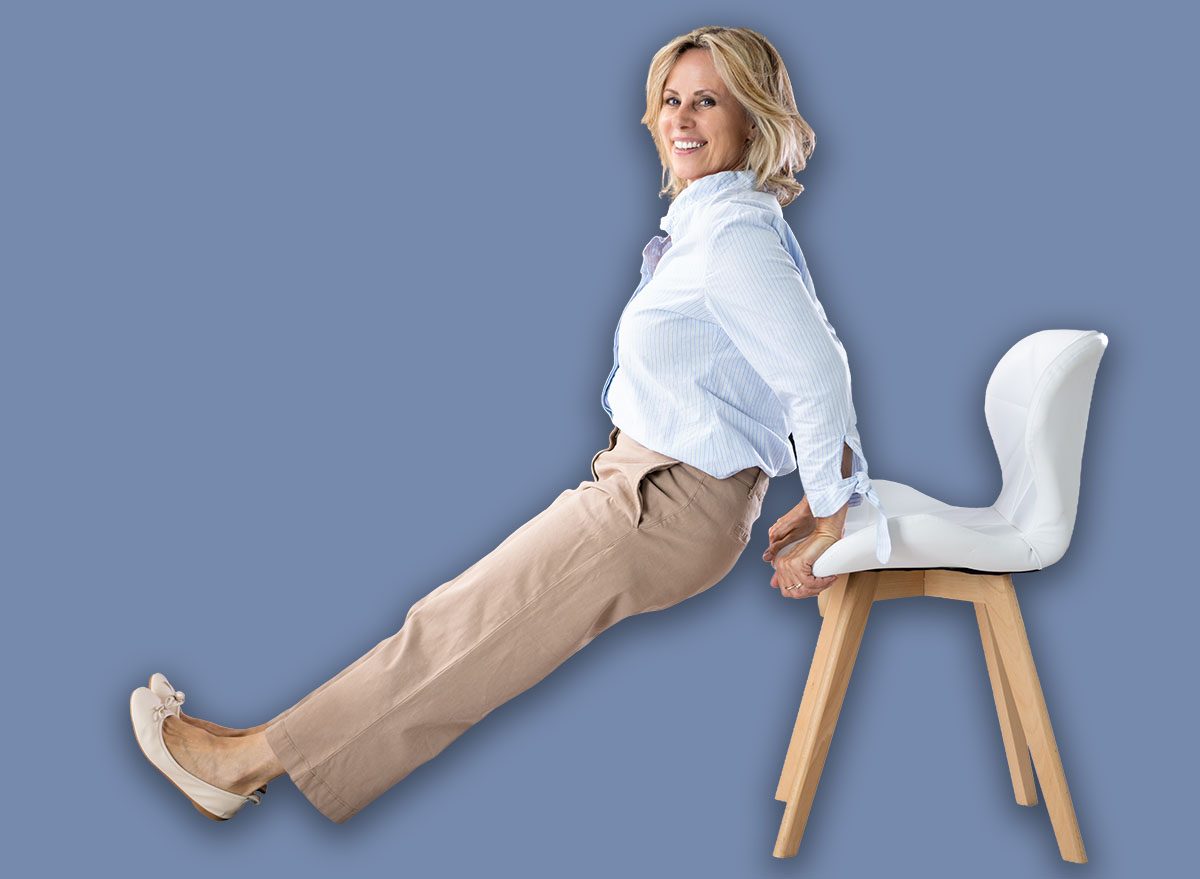
Chair Tricep Dips
Your triceps do more heavy lifting in daily life than most people realize. “The triceps make up around two-thirds of your upper arm, so strengthening them can have a noticeable impact on arm function and definition,” says Bickerstaff. “Chair dips are excellent for rebuilding pushing strength needed for everyday tasks like getting out of a chair or pushing open heavy doors.”
How to do it:
- Sit on the edge of a sturdy chair with your hands beside your hips.
- Slide your hips just off the seat with your knees bent and feet flat on the floor.
- Lower yourself a short distance by bending your elbows.
- Press back up.
- Keep the movement controlled, and avoid dropping too low if you experience shoulder discomfort.
- Perform two to three sets of 10 to 12 reps, resting for 60 to 90 seconds between sets.
Resistance Band Bicep Curls
Swapping dumbbells or a barbell for resistance bands is a much joint-friendlier way to build the same arm strength. “Resistance bands provide constant tension throughout the movement, making them an excellent alternative to dumbbells,” explains Bickerstaff. “They’re particularly joint-friendly and allow you to strengthen the biceps without placing unnecessary strain on the wrists or elbows.”
How to do it:
- Stand in the middle of a resistance band with your feet hip-width apart.
- Hold one end of the band in each hand (keep your palms facing forward).
- Keeping your elbows close to your sides, curl your hands toward your shoulders.
- Lower slowly under control.
- Aim for two to three sets of 12 to 15 reps. Rest for 45 to 60 seconds between sets.
Standing Shoulder Press With Resistance Band
This final move targets a muscle group Bickerstaff says is easy to neglect but is non-negotiable for healthy aging. “Strong shoulders are essential for maintaining independence as you age, whether that’s reaching overhead cupboards or carrying shopping bags,” says Bickerstaff. “Using a resistance band challenges your shoulder muscles while also requiring your core to stabilize the body throughout the exercise.”
How to do it:
- Stand on the center of a resistance band while holding the ends at shoulder height.
- Press your hands overhead until your arms are almost straight.
- Slowly lower back to shoulder height.
- Avoid arching your lower back.
- Complete two to three sets of 10 to 12 reps, resting for 45 to 60 seconds between sets.