5 Standing Exercises That Firm Sagging Arms Faster Than Dumbbell Curls After 60
Firming the arms after 60 usually works best when the upper body gets trained as a unit. Dumbbell curls can strengthen the biceps, but the shape and strength of the arms also depend on the triceps, shoulders, upper back, and chest doing their share of the work.
Standing exercises make that process feel more active. You have to control your posture, brace lightly through your midsection, and keep the reps smooth while your arms move against resistance. That gives the workout more value than a few isolated curls at the end of the day.
When I coach older adults, I’m looking for upper-body exercises that build strength without making the shoulders feel cranky. Rows help improve pulling strength, wall pushups train the pressing muscles, and band work helps the shoulders stay better organized. Once those pieces improve, direct arm work tends to feel stronger and cleaner.
Use these five standing exercises two to four days per week. Keep the resistance light enough to control, move through a comfortable range, and focus on making each rep feel strong from start to finish.
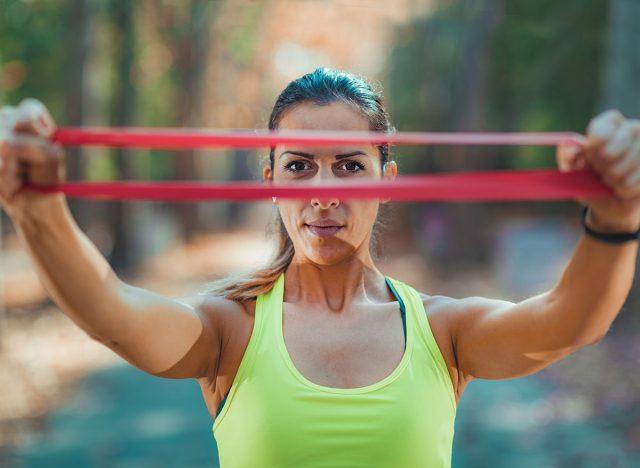
Standing Band Row
Standing band rows train the upper back, biceps, and shoulders while helping you build a stronger posture. The movement gives your arms a useful pulling pattern and helps balance all the pressing and reaching you do during the day. Keep the pull smooth and pause briefly when your elbows reach your sides.
Muscles Trained: Upper back, lats, rear delts, biceps, core.
How to Do It:
- Anchor a resistance band at chest height.
- Stand tall and hold one handle or end of the band in each hand.
- Step back until the band has light tension.
- Brace your core and keep your shoulders relaxed.
- Pull your elbows back toward your sides.
- Pause, then return your arms forward with control.
Recommended Sets and Reps: Perform 3 sets of 10 to 15 reps. Rest for 30 to 45 seconds between sets.
Best Variations: Seated band rows, single-arm band rows, slow-tempo band rows.
Form Tip: Pull with your elbows and avoid shrugging your shoulders toward your ears.
Dumbbell Overhead Triceps Extension
The triceps make up a large part of the upper arm, so they deserve direct attention in any arm-firming routine. The overhead triceps extension trains the back of the arm through a long range, and the standing position asks your core to stay steady while the weight moves. Start light and keep the elbows pointing forward as much as your shoulders allow.
Muscles Trained: Triceps, shoulders, core.
How to Do It:
- Stand tall with your feet about hip-width apart.
- Hold one dumbbell with both hands.
- Press the dumbbell overhead.
- Bend your elbows and lower the weight behind your head.
- Extend your arms to lift the dumbbell back overhead.
- Repeat with steady control.
Recommended Sets and Reps: Perform 3 sets of 8 to 12 reps. Rest for 30 to 45 seconds between sets.
Best Variations: Single-dumbbell triceps extensions, band overhead triceps extensions, seated triceps extensions.
Form Tip: Keep your ribs down and use a lighter weight if your lower back starts to arch.
Wall Pushup
Wall pushups are a friendly way to train the chest, shoulders, and triceps. They let you build pressing strength without needing to get down to the floor, and you can adjust the challenge by changing your foot position. The farther your feet are from the wall, the harder the exercise becomes.
Muscles Trained: Chest, shoulders, triceps, core.
How to Do It:
- Stand facing a wall with your hands at chest height.
- Place your palms slightly wider than shoulder-width apart.
- Step your feet back until your body forms a straight line.
- Bend your elbows and lower your chest toward the wall.
- Press through your palms to return to the starting position.
- Repeat with smooth control.
Recommended Sets and Reps: Perform 3 sets of 10 to 15 reps. Rest for 30 to 45 seconds between sets.
Best Variations: Counter pushups, slow-tempo wall pushups, close-grip wall pushups.
Form Tip: Keep your body long and let your elbows angle slightly back as you lower.
Band Pull-Apart
Band pull-aparts strengthen the upper back and rear shoulders, which helps the arms look and feel stronger from the top down. This move also helps improve shoulder position, especially if you spend a lot of time sitting, driving, or working with your arms in front of you. Use a light band and make the movement crisp.
Muscles Trained: Rear delts, upper back, mid-back, shoulders.
How to Do It:
- Stand tall and hold a resistance band with both hands at chest height.
- Set your hands about shoulder-width apart.
- Brace your core and keep your arms mostly straight.
- Pull the band apart until your hands move out toward your sides.
- Pause briefly when the band reaches your chest.
- Return to the starting position with control.
Recommended Sets and Reps: Perform 3 sets of 10 to 15 reps. Rest for 30 to 45 seconds between sets.
Best Variations: Wider-grip pull-aparts, diagonal pull-aparts, slow-tempo pull-aparts.
Form Tip: Keep your shoulders down and avoid leaning backward as you pull.
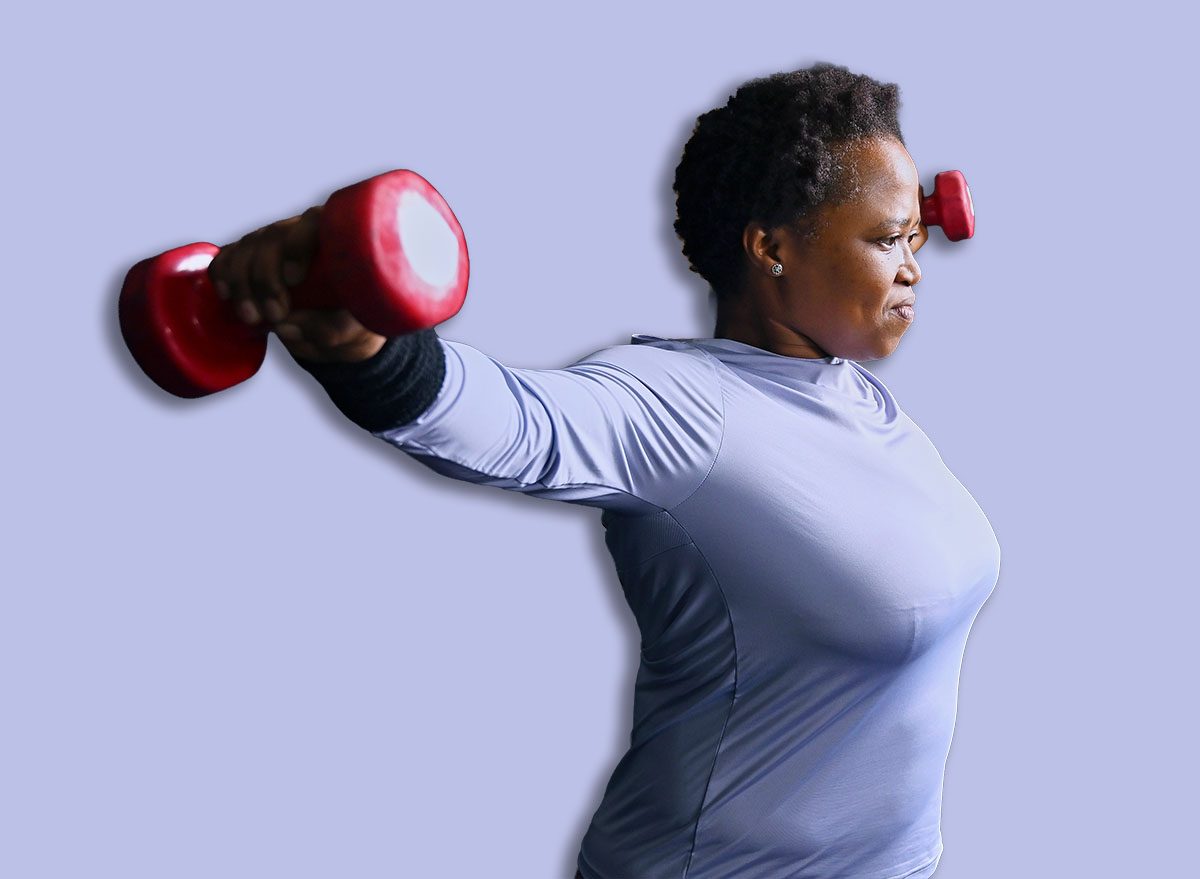
Lateral Dumbbell Raise
Lateral dumbbell raises train the sides of the shoulders, which can help the upper arms look more defined and supported. The movement works best with lighter weights and clean control. Lift only as high as your shoulders feel comfortable, then lower slowly.
Muscles Trained: Side delts, upper traps, core.
How to Do It:
- Stand tall with a dumbbell in each hand.
- Keep your arms at your sides with your palms facing in.
- Brace your core and soften your elbows.
- Raise the dumbbells out to your sides.
- Stop around shoulder height or slightly below.
- Lower the weights with control and repeat.
Recommended Sets and Reps: Perform 3 sets of 8 to 12 reps. Rest for 30 to 45 seconds between sets.
Best Variations: One-arm lateral raises, partial-range lateral raises, slow-tempo lateral raises.
Form Tip: Lead with your elbows and keep the weights light enough to avoid swinging.
How to Use These Standing Exercises After 60
Use these exercises as an upper-body circuit. Complete one set of each move in order, rest for 60 to 90 seconds, then repeat for two to three total rounds.
- Start with posture: Stand tall, keep your ribs stacked over your hips, and let your arms move from a steady base.
- Choose manageable resistance: The final few reps should feel challenging while your form stays clean.
- Train both push and pull: Rows, pull-aparts, pushups, extensions, and raises give your arms more complete work than curls alone.
- Control the lowering phase: Slowing the return makes each rep more effective and helps you avoid swinging.
- Build gradually: Add reps first, then move to a slightly stronger band or heavier dumbbells once the routine feels solid.
Curls can still fit into an arm routine, but they’re only one piece. Train the back of the arms, shoulders, chest, and upper back together, and your arms have a better chance to feel stronger, firmer, and more capable.
References
- Lee-Confer, Jonathan. “Strength in arms: empowering older adults against the risk of slipping and falling-a theoretical perspective.” Frontiers in sports and active living vol. 6 1371730. 8 Mar. 2024, doi:10.3389/fspor.2024.1371730
- Hidayat, Rahmat et al. “Enhancing physical fitness in older adults: a six-month medium intensity training intervention yields significant improvements.” BMC sports science, medicine & rehabilitation vol. 17,1 338. 17 Nov. 2025, doi:10.1186/s13102-025-01401-1