If You Can Do This Many Squats After 55, Your Lower Body Strength Is Exceptional


Lower body strength tells a deeper story than most people realize. It reflects how well your muscles, joints, and nervous system work together to produce force, absorb load, and keep you moving with confidence. After age 55, coordination matters even more because it supports everyday activities such as climbing stairs, getting up from a chair, and maintaining balance on uneven ground.
Squats offer one of the clearest snapshots of lower-body capability. They demand strength from your quads and glutes, stability from your hips and core, and mobility from your ankles and knees. When you repeat that movement with good form, your body reveals how resilient and well-trained it really is. That is why squat performance often better reflects real-world strength than isolated gym tests.
In this article, you’ll learn how to perform a clean bodyweight squat, exactly how many reps signal exceptional lower body strength after 55, and the most effective ways to improve your squat endurance over time. If you want a simple benchmark that delivers honest feedback and a clear path forward, this test provides.
How to Perform a Bodyweight Squat
A squat only tells the truth when the movement stays honest. Depth, posture, and control determine whether each rep builds strength or simply adds wear and tear. Minor technical errors can inflate your numbers while quietly reducing the test’s value.
Performing a clean bodyweight squat helps ensure your muscles absorb the load evenly and your joints move through healthy ranges. When each rep looks the same from start to finish, your score reflects lower-body capacity rather than momentum or shortcuts. Use the steps below to lock in your form before testing your squat endurance.
How to Do It:
- Stand tall with your feet about shoulder width apart, and your toes pointed slightly outward
- Brace your core as if you are preparing to lift something off the floor
- Push your hips back and bend your knees at the same time
- Lower your body until your thighs are at least parallel to the floor
- Keep your chest tall and your weight centered over your midfoot
- Drive through your heels and squeeze your glutes to return to standing
- Repeat each rep with the same depth and control.
Squat Strength Rankings After 55
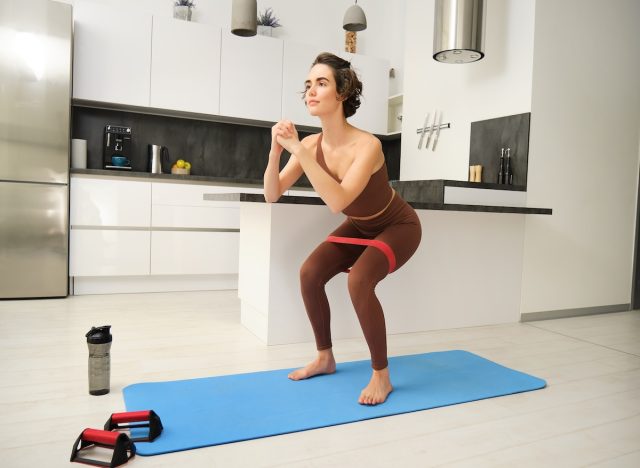
This squat test uses controlled, full-range reps to measure how well your lower body produces force, maintains posture, and resists fatigue. Each performance tier reflects a meaningful difference in strength, endurance, and joint resilience, not just how fast you can move. Use your result as a baseline to show where your lower-body capacity stands today and how much potential you have to build with consistent training.
- Below Average: Fewer than 15 squats
- Average: 15 to 24 squats
- Above Average: 25 to 34 squats
- Exceptional: 35 or more squats
Reaching the exceptional range suggests strong legs, resilient joints, and the endurance to maintain quality movement under fatigue. That level of performance often reflects years of consistent activity and strength-focused routines.
The Best Tips for Improving Your Squat Endurance After 55

Improving squat endurance does not require marathon workouts or extreme volume. It comes from practicing quality movement, building supportive strength, and allowing enough recovery to adapt. With the right approach, progress often shows up faster than expected.
- Train squats two to three times per week: Frequent exposure reinforces technique and builds endurance without overwhelming your joints.
- Use tempo control: Lower for three seconds and stand up smoothly to increase time under tension and improve strength through the full range.
- Build single-leg strength: Split squats and step-ups address side-to-side imbalances that often limit squat endurance.
- Strengthen your glutes and hips: Exercises such as glute bridges and lateral walks reduce knee stress and improve power from the bottom.
- Rest with intention: One to two days of recovery between squat-focused sessions helps your muscles rebuild stronger.
- Track your reps: Testing your max squat set every four to six weeks keeps you motivated and highlights real progress.
Consistent training, clean reps, and patience do the heavy lifting. Stack those habits, and your squat numbers will climb along with your confidence and lower-body resilience.
References
- García-Hermoso, Antonio et al. “Muscular Strength as a Predictor of All-Cause Mortality in an Apparently Healthy Population: A Systematic Review and Meta-Analysis of Data From Approximately 2 Million Men and Women.” Archives of physical medicine and rehabilitation vol. 99,10 (2018): 2100-2113.e5. doi:10.1016/j.apmr.2018.01.008