5 Daily Exercises That Restore Leg Muscle Faster Than Weight Training After 50
Muscular legs open the door to staying active, confident, and independent as the years roll on. They help you move through daily life with ease, whether you’re climbing stairs, carrying groceries, or heading out for a long walk. The body still responds incredibly well to strength training after 50, especially when the exercises target the movements your legs use most often. With the right approach, restoring muscle can feel surprisingly natural and rewarding.
Over the years, working as a strength coach, I’ve seen how quickly the lower body can rebound when people start moving well again. Many clients arrive thinking their best-strength days are behind them, then discover that their legs respond almost immediately once the right exercises are in place. Controlled bodyweight movements often work especially well because they reinforce balance, coordination, and joint stability while rebuilding muscle.
The five exercises below focus on simple patterns that wake up the quads, glutes, and hips while reinforcing the strength your body relies on every day. Perform them consistently, and your legs will start to feel stronger, steadier, and more capable. Let’s walk through five daily exercises that help restore leg muscle after 50.
Pause Bodyweight Squat
The pause bodyweight squat teaches your legs to generate strength from the bottom of the movement, where many people feel weakest. Holding the pause forces your muscles to stay engaged instead of relying on momentum. That pause also builds joint stability in your hips, knees, and ankles. Over time, your legs learn to stay strong and controlled throughout the entire squat pattern. It’s a simple tweak that makes a basic squat dramatically more effective.
Muscles Trained: Quads, glutes, hamstrings, and core.
How to Do It:
- Stand with your feet about shoulder-width apart, bracing your core.
- Push your hips back and bend your knees to lower into a squat.
- Pause at the bottom position for two to three seconds.
- Keep your chest tall and your knees tracking over your toes.
- Drive through your heels and stand back up to the starting position.
Recommended Sets and Reps: Perform 3 sets of 10 to 12 reps. Rest for 45 seconds between each set.
Best Variations: Goblet pause squat, box pause squat, tempo squat.
Form Tip: Sit back into your hips and keep your heels pressed firmly into the floor.
Glute Bridge
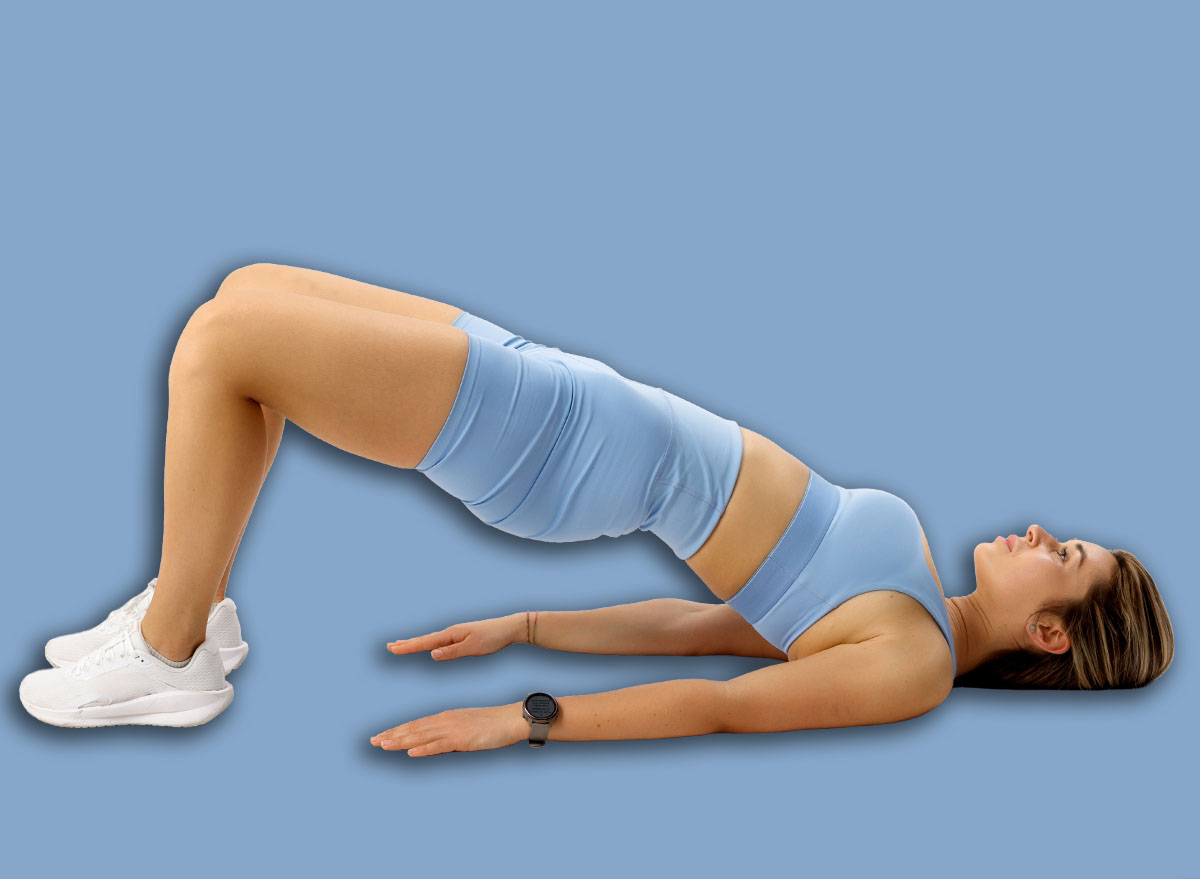
The glute bridge brings your glutes back online, which plays a huge role in rebuilding lower-body strength. Many adults spend long hours sitting, which can make the glutes lazy during movement. This exercise restores proper hip extension and teaches your glutes to drive movement again. Strong glutes also support the lower back and reduce strain on the knees. Once the glutes start firing properly, the entire lower body begins working more efficiently.
Muscles Trained: Glutes, hamstrings, core, and lower back stabilizers.
How to Do It:
- Lie on your back with your knees bent and your feet flat on the floor.
- Place your arms at your sides with your palms facing down.
- Press through your heels and lift your hips toward the ceiling.
- Squeeze your glutes at the top while keeping your ribs down.
- Lower your hips slowly back to the floor.
Recommended Sets and Reps: Perform 3 sets of 12 to 15 reps. Rest for 45 seconds between each set.
Best Variations: Single-leg glute bridge, glute bridge with pause, glute bridge march.
Form Tip: Drive through your heels and focus on squeezing your glutes at the top of each rep.
Split Squats
Split squats train each leg independently, helping restore balance and strength between the two sides of the body. Many people develop small differences in strength between their legs over time. This movement forces each leg to work independently, helping rebuild stability in the hips and knees. It also challenges your balance and coordination, which becomes increasingly important with age. The result is stronger, more capable legs that move confidently during everyday tasks.
Muscles Trained: Quads, glutes, hamstrings, and hip stabilizers.
How to Do It:
- Stand in a staggered stance with one foot forward and one foot behind you.
- Keep your torso upright and your core braced.
- Bend both knees and lower your back knee toward the floor.
- Keep your front heel planted firmly on the ground.
- Push through your front foot to return to the starting position.
Recommended Sets and Reps: Perform 3 sets of 8 to 10 reps per leg. Rest for 60 seconds between each set.
Best Variations: Bulgarian split squat, front foot elevated split squat, goblet split squat.
Form Tip: Keep your weight centered over your front foot as you lower and rise.
Reverse Lunge
The reverse lunge strengthens the legs while reducing stress on the knees. Stepping backward naturally encourages better hip engagement and control. This movement also improves balance and coordination while strengthening the quads and glutes. Many people find the reverse lunge easier to control than forward lunges, which helps reinforce good mechanics. Over time, this exercise helps restore confidence in single-leg movement.
Muscles Trained: Quads, glutes, hamstrings, and calves.
How to Do It:
- Stand tall with your feet hip-width apart and your core engaged.
- Step one leg backward into a lunge position.
- Lower your back knee toward the floor with control.
- Keep your front knee stacked over your ankle.
- Push through your front foot and return to standing.
Recommended Sets and Reps: Perform 3 sets of 8 to 10 reps per leg. Rest for 60 seconds between each set.
Best Variations: Dumbbell reverse lunge, alternating reverse lunge, reverse lunge with knee drive.
Form Tip: Step back far enough so your front shin stays nearly vertical.
Jump Squats
Jump squats bring power back into your lower body. Fast, explosive movements stimulate muscle fibers that often become underused with age. This type of training helps improve coordination, reaction time, and overall athletic ability. Jump squats also train your legs to absorb force safely when landing. With consistent practice, your legs regain the spring and responsiveness that make movement feel easier and more confident.
Muscles Trained: Quads, glutes, hamstrings, and calves.
How to Do It:
- Stand with your feet shoulder-width apart and brace your core.
- Lower into a squat position while keeping your chest tall.
- Drive through your feet and jump straight upward.
- Land softly with your knees slightly bent.
- Reset your stance and repeat the movement.
Recommended Sets and Reps: Perform 3 sets of 6 to 8 reps. Rest for 60 seconds between each set.
Best Variations: Squat jumps to box, pause squat jump, low-impact squat pop.
Form Tip: Land softly and absorb the impact by bending your hips and knees.
Best Daily Strength Tips for Restoring Leg Muscle After 50
Restoring leg muscle after 50 comes down to consistency, smart exercise selection, and giving your body enough recovery to adapt. Daily movement helps maintain joint mobility and muscle activation, while strength exercises stimulate the muscles that keep you strong and steady. Over time, small habits compound into noticeable gains in strength. When you approach training with patience and intent, your legs respond faster than many people expect.
- Train movements you use every day: Squats, lunges, and bridges mirror real-life movement patterns. Practicing these regularly builds strength that carries over into daily activities.
- Focus on controlled repetitions: Slowing down each rep increases muscle tension and improves joint stability. That extra control helps muscles rebuild strength more efficiently.
- Train one leg at a time: Single-leg exercises such as split squats and lunges strengthen stabilizing muscles and improve balance.
- Keep moving throughout the week: Short daily sessions often work better than occasional long workouts. Consistency keeps muscles active and encourages faster adaptation.
- Prioritize recovery habits: Quality sleep, proper hydration, and adequate protein intake all support muscle repair and growth.
References
- Arnold, W David, and Carlos J Padilla Colón. “Maintaining Muscle Function Across the Lifespan: The State of Science.” American journal of physical medicine & rehabilitation vol. 99,12 (2020): 1171-1176. doi:10.1097/PHM.0000000000001429
- Reid, Kieran F et al. “Comparative effects of light or heavy resistance power training for improving lower extremity power and physical performance in mobility-limited older adults.” The journals of gerontology. Series A, Biological sciences and medical sciences vol. 70,3 (2015): 374-80. doi:10.1093/gerona/glu156