5 Daily Exercises That Restore Core Strength Faster Than Weight Training After 55

Core strength changes after 55, and not because effort drops off. It shifts because the way the core is used every day changes. Less rotation, fewer quick posture corrections, and more time sitting all reduce how often those muscles fire with purpose. Over time, the core stops functioning as a coordinated system and begins to feel weak, stiff, or unreliable.
Restoring core strength works best when training more closely resembles real life. The core’s job is to brace, stabilize, rotate, and transfer force, not just flex against resistance. Daily exercises that challenge control, timing, and posture help the core relearn those roles faster than traditional weight training alone.
That’s why consistency matters more than load. Short, repeatable movements performed daily help the core stay active throughout the day, not just during workouts. Below are five exercises you can do daily to rebuild deep, functional core strength that carries over to walking, lifting, and everyday movement after 55.
Standing March With Brace
This exercise retrains your core to stabilize while your legs move, which is exactly what happens during walking and daily activity. The brace keeps your deep core muscles engaged instead of relaxing between reps. Over time, that improves balance, posture, and waist control. It’s simple, but it restores a skill many people lose with age.
Muscles Trained: Transverse abdominis, hip flexors, rectus abdominis, and spinal stabilizers.
How to Do It:
- Stand tall with your feet hip-width apart.
- Brace your core as if tightening a belt around your waist.
- Lift one knee toward your chest while staying upright.
- Lower your foot back to the floor with control.
- Alternate sides at a steady pace.
Recommended Sets and Reps: Perform 3 sets of 20 to 30 total reps. Rest for 30 seconds between each set.
Best Variations: Slow tempo marches, pause at the top, arms crossed march.
Form Tip: Stay tall and avoid leaning back as your knee lifts.
Dead Bug
Dead bugs rebuild coordination between your arms, legs, and core. They teach your abs to stabilize your spine while your limbs move independently. That skill protects your lower back and improves overall strength transfer. It’s one of the most effective daily core exercises for long-term progress.
Muscles Trained: Transverse abdominis, rectus abdominis, hip flexors, and spinal stabilizers.
How to Do It:
- Lie on your back with your arms pointed toward the ceiling and knees bent at ninety degrees.
- Brace your core and gently press your lower back into the floor.
- Extend one arm and the opposite leg away from your body.
- Pause briefly while staying braced.
- Return to the starting position and switch sides.
Recommended Sets and Reps: Perform 3 sets of 8 to 10 reps per side. Rest for 40 seconds between each set.
Best Variations: Longer holds, arms only dead bugs, legs only dead bugs.
Form Tip: If your back arches, shorten the range.
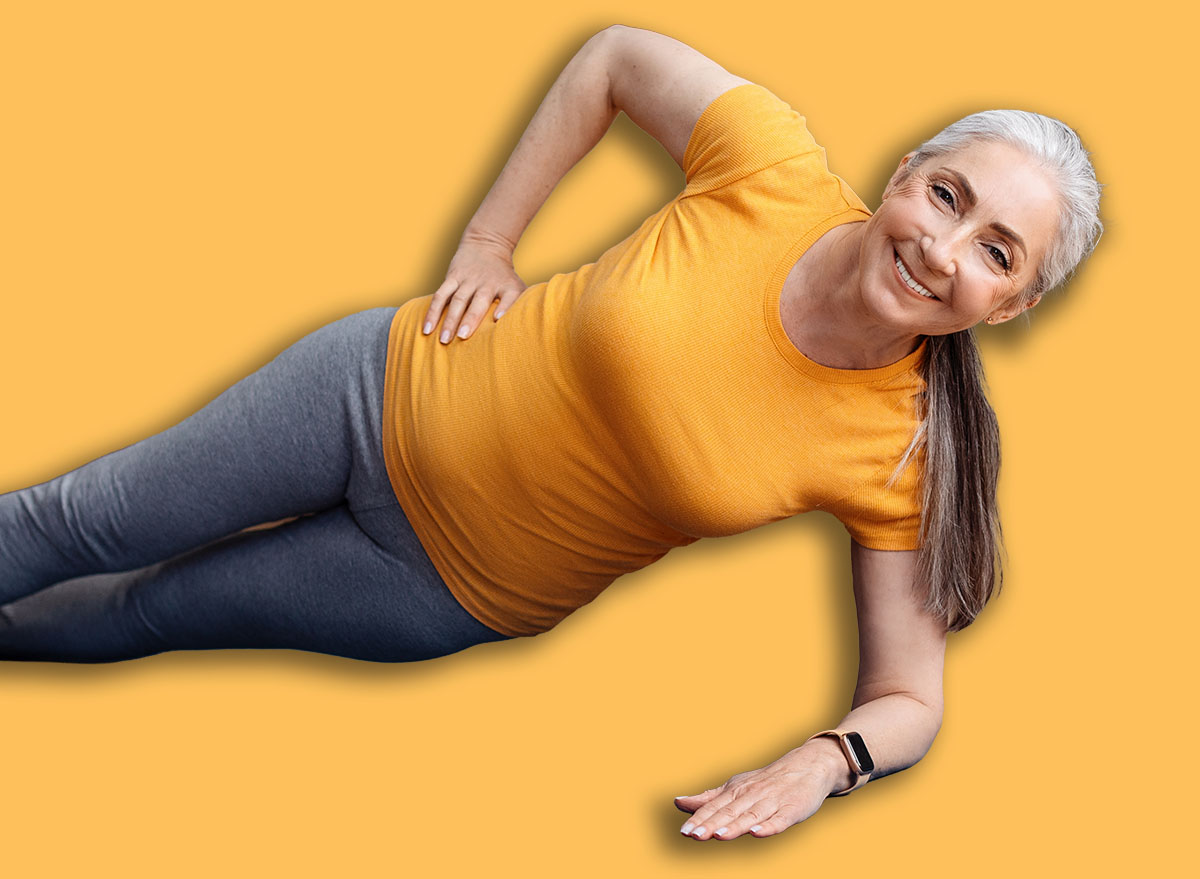
Side Plank Hold
Side planks strengthen the muscles that support your spine from the side, which helps control waist shape and posture. They also improve lateral stability, a key factor for balance and injury prevention after 55. Holding the position builds endurance in muscles that protect your lower back. This strength shows up quickly in daily movement.
Muscles Trained: Obliques, transverse abdominis, glute medius, and spinal stabilizers.
How to Do It:
- Lie on your side with your elbow under your shoulder and knees bent.
- Brace your core and lift your hips off the floor.
- Hold the position while breathing steadily.
- Lower your hips with control.
- Switch sides after completing your reps.
Recommended Sets and Reps: Perform 3 sets of 20 to 30 second holds per side. Rest for 40 seconds between each set.
Best Variations: Straight leg side plank, side plank march, longer holds.
Form Tip: Keep your body in a straight line from head to knees.
Pallof Press
The Pallof press trains your core to resist rotation, an essential component of spine stability. This builds strength without stressing your joints or lower back. It also improves posture by teaching your torso to stay stacked and controlled. Done daily, it reinforces core engagement during everyday tasks.
Muscles Trained: Transverse abdominis, obliques, rectus abdominis, and shoulder stabilizers.
How to Do It:
- Stand sideways to a resistance band anchored at chest height.
- Hold the band close to your chest and brace your core.
- Press the band straight out in front of you.
- Pause briefly while resisting rotation.
- Bring your hands back to your chest with control.
Recommended Sets and Reps: Perform 3 sets of 10 to 12 reps per side. Rest for 40 seconds between each set.
Best Variations: Kneeling Pallof press, overhead Pallof press, longer pauses.
Form Tip: Don’t let your shoulders twist as you press.
Farmer Carry
Farmer carries turn core strength into a full-body skill. Carrying weight while staying upright forces your core to stabilize with every step. This builds real-world strength that supports posture and spinal health. Few exercises translate to daily life as well as this one.
Muscles Trained: Transverse abdominis, obliques, grip muscles, and upper back.
How to Do It:
- Hold a dumbbell or kettlebell in each hand.
- Stand tall and brace your core.
- Walk forward with controlled steps.
- Keep your shoulders down and chest tall.
- Stop when your posture begins to fade.
Recommended Sets and Reps: Perform 3 sets of 30 to 45 second carries. Rest for 60 seconds between each set.
Best Variations: Single-arm carry, suitcase carry, longer-distance walks.
Form Tip: Walk slowly and stay tall throughout.
Best Daily Core Strength Tips for Adults After 55
Core strength returns fastest when it’s trained often and with intention. Daily exercises work because they teach your core to stay active beyond workouts. The goal is better control, not exhaustion.
- Short sessions win: Ten focused minutes daily beats longer, inconsistent workouts.
- Brace before you move: Practice tightening your core before lifts, steps, and transitions.
- Breathe under control: Steady breathing helps your deep core muscles stay engaged.
- Train all directions: Include anti-rotation, side support, and movement-based drills.
- Progress patiently: Increase time, reps, or control before adding load.
- Pair core work with posture checks: Briefly reset your posture during the day to reinforce strength gains.
- Stop before fatigue ruins form: Ending a set early protects your spine and keeps progress moving forward.
Do these consistently, and core strength starts to show up where it matters most: standing taller, moving better, and feeling more supported every day.
References
- Restaino, Robert M et al. “Impact of prolonged sitting on lower and upper limb micro- and macrovascular dilator function.” Experimental physiology vol. 100,7 (2015): 829-38. doi:10.1113/EP085238
- Zhong, Yuanji et al. “Effects of core training on balance performance in older adults: a systematic review and meta-analysis.” Frontiers in public health vol. 13 1661460. 9 Oct. 2025, doi:10.3389/fpubh.2025.1661460