4 Morning Exercises That Restore Arm Strength Faster Than Weight Training After 55
Arm strength after 55 comes from more than curls and heavy presses. Your shoulders, triceps, biceps, upper back, chest, and core all help your arms produce force and stay controlled during daily movement. Reaching overhead, pushing yourself up, pulling something toward you, carrying bags, and supporting your bodyweight all depend on those areas working together.
Morning exercises work well because they give your upper body a chance to move, brace, and build tension before the day gets rolling. You don’t need a long workout or a full rack of weights to make progress. A few focused movements can wake up the shoulders, strengthen the arms, improve posture, and bring the upper back into the equation.
I’ve coached plenty of people who made better progress once they stopped treating arm strength as an arms-only goal. The better approach trains pressing, pulling, shoulder control, and core stability together. The four moves below cover those bases with a mix of bodyweight, band, and dumbbell work that’s simple enough to repeat and strong enough to make your arms work.
Down Dog to Cobra
Down dog to cobra trains your shoulders, triceps, upper back, chest, and core as you move your arms through a controlled range of motion. Pressing back into the down dog asks your shoulders and arms to support your bodyweight, while shifting into cobra opens the chest and reinforces upper-body control. This helps restore arm strength because your arms aren’t just moving freely; they’re helping guide and support your body through each transition. Better control here carries into reaching, pushing, and supporting yourself during daily movement.
Muscles Trained: Shoulders, triceps, chest, upper back, core
How to Do It:
- Start in a high plank position with your hands under your shoulders.
- Push your hips up and back into a down dog position.
- Press your hands firmly into the floor.
- Shift your body forward and lower your hips toward the floor.
- Lift your chest into a cobra position.
- Return to down dog with control.
Recommended Sets and Reps: Perform 3 sets of 6 to 8 reps. Rest for 30 seconds between each set.
Best Variations: Elevated hands down dog to cobra, shorter range reps, slower tempo reps
Form Tip: Press through your hands and keep your shoulders active through the full movement.
Incline Push-Ups
Incline push-ups train your chest, shoulders, triceps, and core while providing a manageable upper-body pressing challenge. The elevated surface makes the movement more approachable than floor push-ups, but your arms still have to press, stabilize, and control each rep. This helps rebuild arm strength because the triceps and shoulders work alongside your chest instead of relying on a machine to guide the motion. Stronger incline push-ups carry over to pushing yourself up from a chair, bracing with your hands, and feeling more capable during upper-body tasks.
Muscles Trained: Chest, shoulders, triceps, core.
How to Do It:
- Place your hands on a bench, counter, or sturdy elevated surface.
- Step your feet back until your body forms a straight line.
- Brace your core and keep your hips level.
- Lower your chest toward the surface by bending your elbows.
- Press through your hands to return to the starting position.
Recommended Sets and Reps: Perform 3 sets of 8 to 12 reps. Rest for 45 seconds between each set.
Best Variations: Counter push-ups, lower incline push-ups, slow tempo incline push-ups
Form Tip: Keep your elbows angled slightly back and avoid letting your hips sag.
Bent-Over Band Rows
Bent-over band rows train your upper back, lats, rear shoulders, biceps, and core while teaching your arms to pull with control. The band keeps tension on the movement, so your back and arms have to stay engaged from the start of the rep to the finish. This helps restore arm strength by building the pulling side of the upper body, which many people miss when they focus only on presses or raises. Stronger rows carry over to carrying, pulling, posture, and keeping your shoulders feeling more supported.
Muscles Trained: Upper back, lats, rear delts, biceps, core
How to Do It:
- Stand on the middle of a resistance band with your feet hip-width apart.
- Hold the ends of the band in each hand.
- Hinge at your hips and keep your back flat.
- Pull your elbows back toward your ribs.
- Squeeze your shoulder blades together.
- Lower your hands with control.
Recommended Sets and Reps: Perform 3 sets of 10 to 15 reps. Rest for 45 seconds between each set.
Best Variations: Single-arm band rows, paused band rows, wider-grip band rows.
Form Tip: Pull through your elbows and keep your shoulders away from your ears.
Half-Kneeling Shoulder Press
The half-kneeling shoulder press trains your shoulders and triceps while your core and hips keep your body steady. The half-kneeling position limits leaning and momentum, so your pressing arm has to do the work more cleanly. This setup helps rebuild arm strength because the shoulder, triceps, and midsection must all coordinate as the dumbbell moves overhead. Stronger overhead pressing carries over to reaching, lifting items onto shelves, and keeping your upper body strong without needing a full gym setup.
Muscles Trained: Shoulders, triceps, upper back, core, glutes
How to Do It:
- Start in a half-kneeling position with one knee on the floor.
- Hold a dumbbell at shoulder height in one hand.
- Brace your core and squeeze your glutes.
- Press the dumbbell overhead until your arm is straight.
- Lower the dumbbell back to shoulder height with control.
- Complete all reps, then switch sides.
Recommended Sets and Reps: Perform 3 sets of 8 to 10 reps per side. Rest for 60 seconds between each set.
Best Variations: Tall-kneeling shoulder press, standing single-arm press, neutral-grip press
Form Tip: Keep your ribs down and avoid leaning back while pressing.
How to Make Morning Arm Training Count
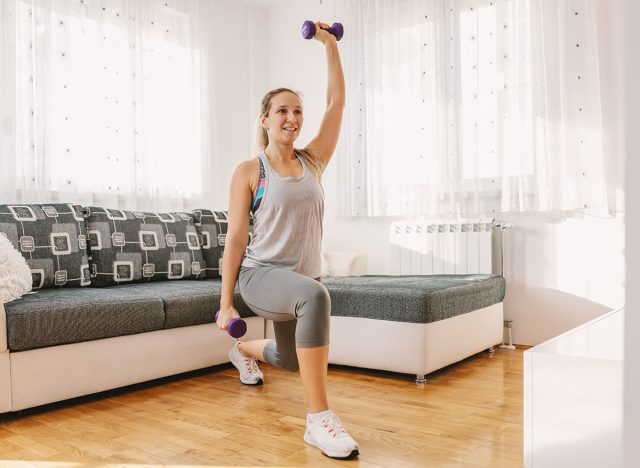
Morning arm-strength work pays off when the movements train more than one part of the upper body. Pressing builds the chest, shoulders, and triceps. Rows strengthen the back and biceps. Down dog to cobra adds mobility and bodyweight control. The half-kneeling press ties the shoulder and core together. Keep the routine focused, and your arms get stronger without needing a long session.
- Train both pushing and pulling: Incline push-ups and shoulder presses build pressing strength, while band rows train the pulling muscles that support posture and shoulder health.
- Move slowly enough to feel the right muscles: Controlled reps keep tension on your arms, shoulders, and upper back. Rushing usually turns the set into momentum.
- Use a level you can repeat consistently: Raise the incline, use a lighter dumbbell, or choose an easier band when form slips. Clean reps beat forced reps.
- Keep your core involved: Your arms work better when your midsection supports your position. Brace before each rep and keep your ribs from flaring.
- Progress in small steps: Add reps, slow the tempo, use a slightly stronger band, or increase the dumbbell weight once the movement feels solid.
A stronger upper body after 55 starts with movements you can do well and repeat often. Use these four exercises in the morning, keep the reps clean, and let your arms, shoulders, and upper back build strength together.
References:
- Pang, Jing et al. “Age-related change in muscle strength, muscle mass, and fat mass between the dominant and non-dominant upper limbs.” Frontiers in public health vol. 11 1284959. 23 Nov. 2023, doi:10.3389/fpubh.2023.1284959
- Schumacher, Leah M et al. “Consistent Morning Exercise May Be Beneficial for Individuals With Obesity.” Exercise and sport sciences reviews vol. 48,4 (2020): 201-208. doi:10.1249/JES.0000000000000226
- Shi H, Hu FB, Huang T, et al. Sedentary Behaviors, Light-Intensity Physical Activity, and Healthy Aging. JAMA Netw Open. 2024;7(6):e2416300. doi:10.1001/jamanetworkopen.2024.16300