5 Chair Exercises That Trim Waist Overhang Faster Than Ab Workouts After 60
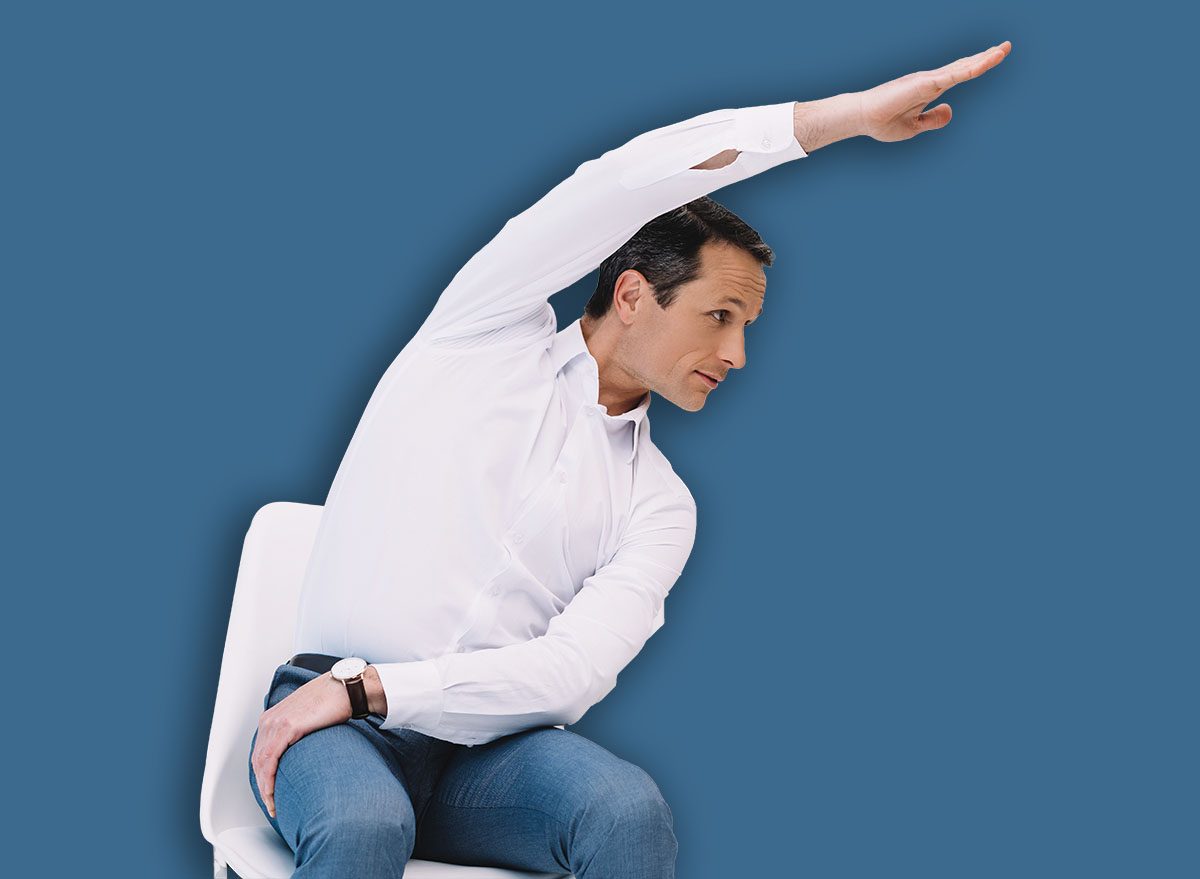

If your goal is to strengthen your core and build a leaner waistline, all you need is a sturdy chair to get started. As you age, your body experiences many changes, including a natural loss of lean muscle, hormonal shifts, and a decline in physical activity. All of these factors make an expanding waistline more common. The good news? Staying on top of your workout routine can help you maintain muscle and stay in shape.
We spoke with Portia Page, Balanced Body Educator, CPT, NCPT, PMA, ACE and AFAA certified to learn where a chair comes in clutch. Pull it up and take a seat, because Page shares five seated exercises that can help tighten and firm your waistline.
Before we dive in, it’s important to note that spot reduction is a myth, meaning you can’t specifically target fat loss in your belly or waistline.
“No exercise, whether seated, standing, or on the floor, can selectively burn fat from the waist or midsection,” Page tells us. “What chair exercises can do is build strength, improve posture, increase daily movement, and give someone over 60 an accessible starting point that builds confidence and consistency. Those benefits make it much more likely they’ll stick with the bigger, broader habits that truly influence body composition.”
Rather than looking for one “magic” exercise, Page recommends selecting movements that build strength in the entire core, back, hips, abs, and pelvic stabilizers while boosting posture and daily function.
Seated Marches
“This exercise activates the deep core while improving balance and hip strength. It teaches the body to stabilize the pelvis as one leg moves, which is a fundamental movement skill we use every day. A bonus is that you can ‘push/drive’ through the other foot to build isometric strength and endurance in the stable/non-moving leg,” Page tells us.
- Begin seated on a chair with your feet placed hip-width apart on the floor.
- Gently draw your lower belly inward.
- Slowly lift one knee up to hip height.
- Lower.
- Alternate sides in a “marching” fashion.
Seated Knee Extension
“Straightening one leg at a time while maintaining an upright posture encourages core stability without excessive strain on the spine. It also strengthens the quadriceps, which are essential for getting up from a chair and climbing stairs, while stretching the ‘backline’ of the body from the lower back, across the glutes, to the hamstrings,” Page points out.
- Begin seated with your knees bent to 90 degrees.
- Brace your core.
- Gradually straighten one knee until that leg is completely extended.
- Hold at the top for 2 to 3 seconds.
- Lower with control
- Repeat on the other side.
RELATED: 5 Core Moves That Burn Belly Fat Faster Than Crunches
Seated Spinal Rotation
“Gentle rotational movement improves spinal mobility while engaging the obliques. Many older adults lose rotational mobility, which affects everything from walking to reaching into the back seat of the car, or overhead into closets, overhead bins on a plane, etc.,” Page explains.
- Begin sitting tall on a sturdy chair with your feet flat on the floor. Activate your core.
- Place your hands behind your head or cross them in front of your chest.
- Slowly twist your torso to the left, keeping your hips facing forward.
- Return to the center, then twist to the right.
Seated Side Bends
“The lateral core/torso muscles are often overlooked. Strengthening them improves trunk stability and control, balance, and posture, and not just the appearance of the waist,” Page tells us.
- Begin sitting tall with your core engaged and your feet flat on the ground.
- Place your right hand on the side of the chair for support. Alternatively, hold a dumbbell with that arm extended toward the floor.
- Extend your right arm overhead and slowly bend to the right, feeling a solid stretch along the left side of your body.
- Hold for a moment at the bottom before returning to the start position.
Sit-to-Stand
“If I could only prescribe one exercise for healthy aging, this would be near the top of the list. Standing up and sitting down repeatedly strengthens the legs, hips, glutes, and core while elevating heart rate. It closely mimics an everyday movement that helps maintain independence. And, honestly, I would maybe ‘start’ at the chair, yet definitely work to the floor, as getting up/down from the floor is truly a measure of longevity and vitality,” Page notes.
- Begin seated at the front of a sturdy chair, feet under your knees.
- Lean forward just a bit.
- Try to stand up without using your knees, hands, or additional support.
- Use control to slowly sit back down.