We've consulted with our team of licensed nutritionists and dietitians to bring you informed recommendations for food products, health aids and nutritional goods to safely and successfully guide you toward making better diet and nutrition choices. We strive to only recommend products that adhere to our philosophy of eating better while still enjoying what you eat.
4 Chair Exercises That Restore Neck Mobility Faster Than Yoga After 60
Copyright Patrick PrzyborowskiExpert-Recommended
Stiff "tech neck" after 60? These 4 chair moves help you turn with ease.
I must confess, I have a bias: I believe that “mobility” isn’t something you have to chase on a rubber mat at a crowded studio—it’s something you can build in the kitchen while waiting for the coffee to brew or at your desk during a long afternoon.
Many of my clients over 60 tell me they’ve tried yoga to fix their “tech neck” or chronic stiffness, only to find the floor transitions too daunting or the poses too complex. If you’re feeling the weight of the day in your shoulders, I suspect there are many of you who just want to move without feeling like you’re performing a circus act. We don’t need complicated sequences to reclaim our range of motion. We need precision, consistency, and a chair.
Try not to think of this as simply “stretching”; you are teaching your nervous system that it is safe to move again. Let’s own this movement together.
Why the Stiffness? A Closer Look
Shutterstock
Our necks aren’t meant to be static, yet our modern lives demand it. As we age, three main culprits often conspire to tighten our cervical spine:
Arthritis & Degeneration: Natural wear and tear on the cervical vertebrae (C1–C7) and the shock-absorbing discs between them can lead to localized stiffness.
The Gravity Load: Over time, the muscles of the upper back—the ones that keep your head atop your spine—can weaken. This causes the head to drift forward, putting immense leverage-based strain on the neck.
Chronic Tension: Stress doesn’t just live in your mind; it lives in your trapezius and levator scapulae muscles. When we’re stressed, these muscles tighten, pulling the shoulders up and creating a protective, rigid “armor” around the neck.
The Science of Simplicity: Research suggests that seated, low-impact mobilization isn’t just “easier”—it’s effective. By removing the need to balance or stabilize the entire body, you isolate the cervical spine. This allows for controlled, repetitive motion that improves blood flow to the joint capsules and gently desensitizes the nerves that trigger pain signals.
The 4-Move Mobility Program
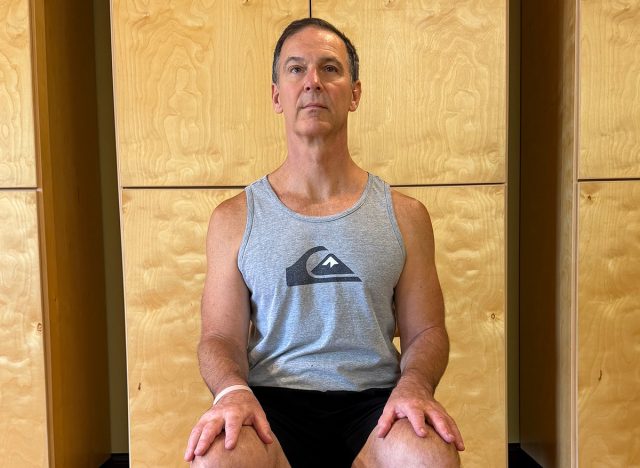
Before you begin: Find a sturdy, armless chair. Sit tall, feet flat on the floor, and imagine a string pulling the crown of your head toward the ceiling.
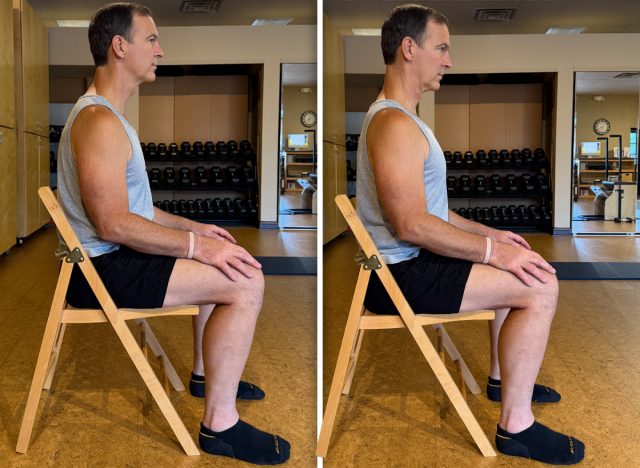
The Chin Retraction (The “Double Chin”)
Copyright Patrick Przyborowski
The Move: Gently draw your chin straight back as if you are making a double chin, without tilting your head up or down.
Target: Deep cervical flexors (front) and suboccipital muscles (base of skull).
Why: This resets the head over the shoulders, relieving the strain on the back of the neck.
Instructions: Inhale, keep your gaze level, and slide your head directly backward. Feel a slight stretch at the base of your skull. Hold for 3 seconds. Repeat 10 times.
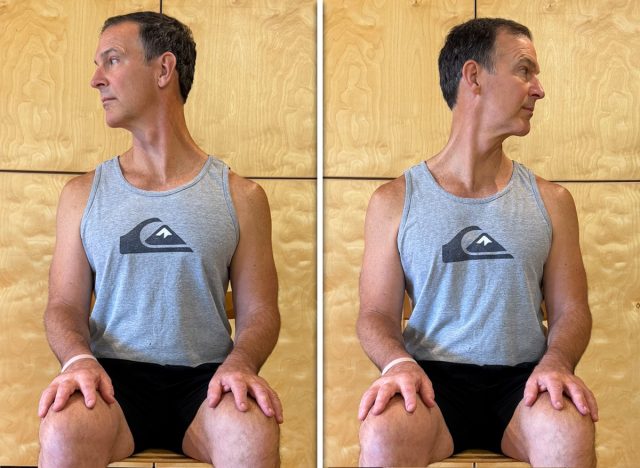
The Controlled Rotation
Copyright Patrick Przyborowski
The Move: Slowly turn your head to look over your right shoulder, then back to center, then left.
Target: Sternocleidomastoid (SCM) and the OA (occipito-atlanto) joint.
Why: This restores the primary functional movement we need for tasks like checking blind spots while driving.
Instructions: Move with intention. Do not “snap” or “whip” the head. If you feel a “catch,” stop just short of it. Keep your shoulders drawn back and down to ensure the movement comes from the neck, not the torso or shoulder girdle. 8 repetitions per side.
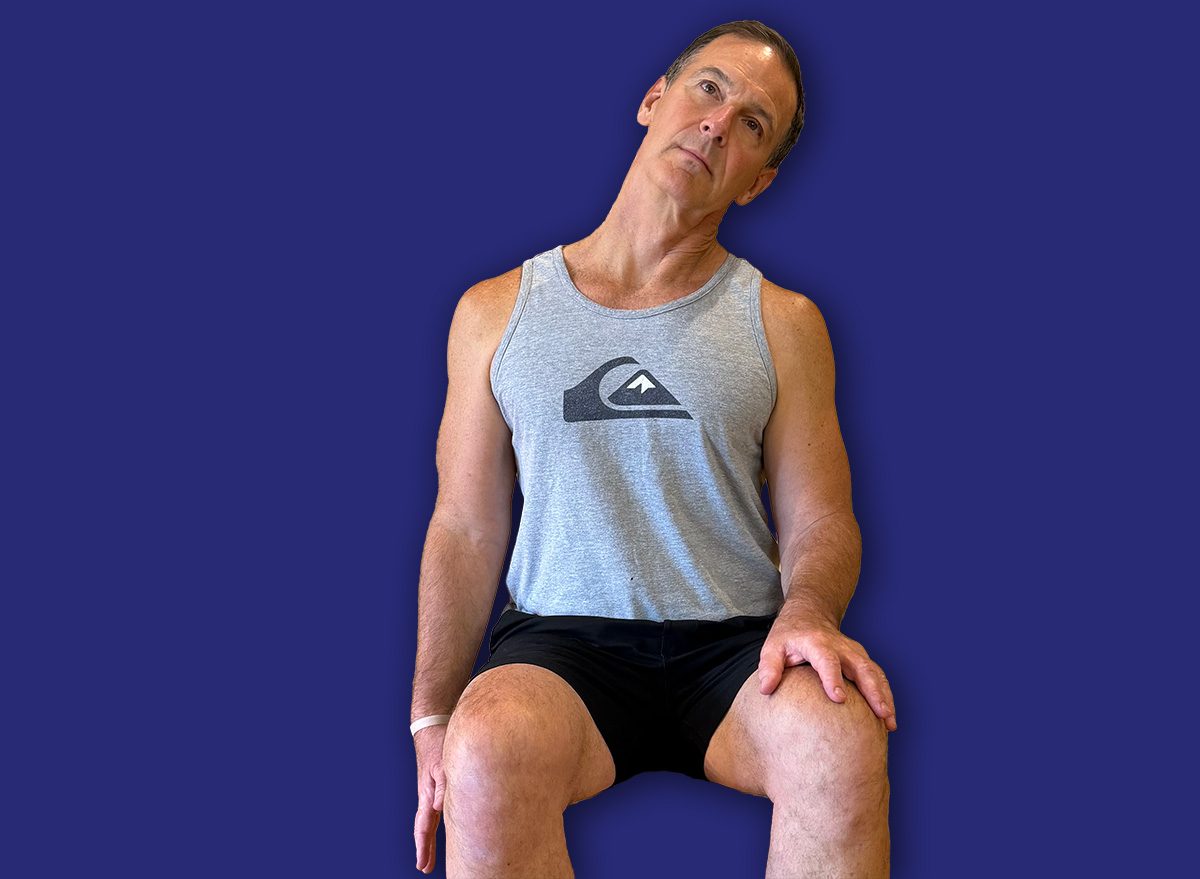
The Lateral Ear-to-Shoulder
Copyright Patrick Przyborowski
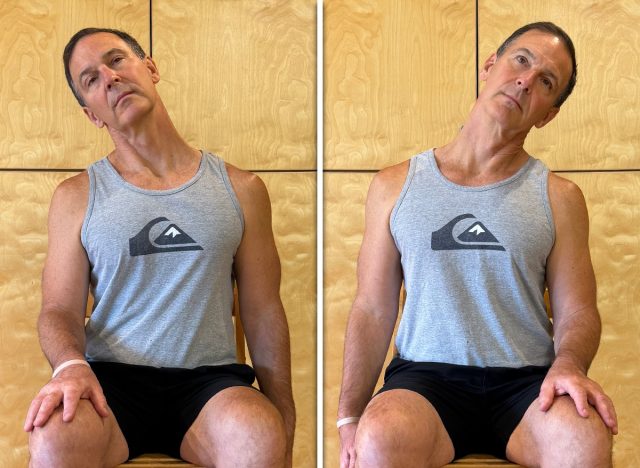
The Move: Drop your right ear toward your right shoulder. Keep your left shoulder down.
Target: Upper trapezius and levator scapulae.
Why: This releases the “stress-carrying” muscles that pull your shoulders toward your ears.
Instructions: Sit tall. As you lean your ear toward your shoulder, reach the opposite fingertips toward the floor to deepen the stretch. Hold for 5 seconds. Repeat 5 times per side.
The Seated “Cat-Cow” Neck Release
Copyright Patrick Przyborowski6254a4d1642c605c54bf1cab17d50f1e
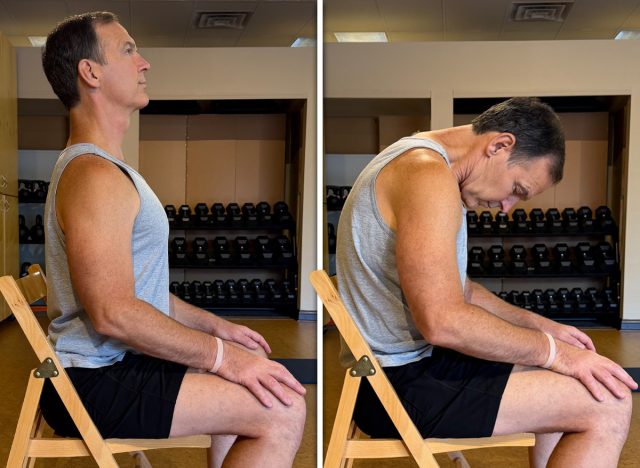
The Move: While rounding your upper back (Cat), gently tuck your chin to your chest. As you extend your chest forward (Cow), look slightly toward the ceiling.
Target: Full cervical and thoracic (upper back) chain.
Why: Your neck doesn’t move in a vacuum; it’s tethered to your mid-back. This mobilizes the entire column.
Instructions: Hands on knees. Exhale, flex the top half of your spine and tuck your chin. Inhale, press your chest out and look up comfortably (looking at the ceiling is too much cervical extension). Keep the movement fluid and rhythmic. 10 total cycles.
Which of these four movements feels the most “stuck” for you right now, and how does your body change when you focus on lengthening through the crown of your head?
A Note on Ownership
Copyright Patrick Przyborowski
Try this now: Stop reading for a moment. Drop your shoulders away from your ears. Take a deep, belly-expanding breath. Did you realize they were creeping upward?
That awareness is the first step. You don’t need a gym, a membership, or a mat. You have a chair, and you have a neck that wants to be free. Practice these four moves during the “in-between” moments of your day. You aren’t just stretching; you’re reclaiming your ability to turn, look, and live with ease.
Patrick Przyborowski, MFA, ACE-CPT, FMS, FCS
Patrick Przyborowski, MFA, ACE-CPT, is the founder of Over Fifty Fitness in Dayton, Ohio, a fully certified STOTT PILATES® instructor and Merrithew Instructor Trainer Read more about Patrick