4 Nightly Stretches That Loosen Your Body Better Than a Massage After 60

The stiffness people over 60 carry into bed at the end of the day is usually the same stiffness they wake up with the next morning. A massage will loosen it, but only briefly. I’ve been a personal trainer for almost 40 years, and for the last 20 I’ve been director and co-founder of TRAINFITNESS, the UK’s best personal training course provider. Four short bedtime stretches, done nightly, produce a lasting looseness that a monthly massage can’t compete with.
Where Stiffness Really Hides

Three big problems show up repeatedly in clients over 60. Lower back tightness, which is really hip flexor tightness pulling on the low back. Hip and buttock stiffness, especially around the deep muscle behind the hip called the piriformis. And shoulders and upper back, which have rounded forward from years of desk work, driving, and looking down at phones and books.
The lower back one is the most misunderstood. Most people think the back muscles are what’s tight, when actually the muscles that need lengthening sit at the front of the hip. Stretch those and the lower back releases as a result. Stretch the lower back directly and you often make things worse.
The hip and glute area is where the deepest tension sits, because these are the muscles that spend all day being sat on. They compress against a chair, forget how to lengthen, and end up tight and grumpy by the evening. This is where a lot of walking discomfort actually comes from.
The upper body issue is chronic in this age group. The chest muscles have shortened, the upper back has weakened, and the shoulders have crept forward. This creates a background tension around the neck and shoulders that most people carry all day without realizing it’s there. Only when you release it do you notice how heavy it was.
Why Stretching Beats a Massage

A massage does something very effective for one hour. The therapist gets into the tissues, breaks up adhesions, and the body feels loose walking out of the door. But by the next morning, most of the release has faded. The muscles have gone back to the shape they hold every day, because a single session doesn’t change the daily habit that made them tight.
Nightly stretching works differently. Small doses of length applied consistently each night teach the muscles to hold a longer position over time. Muscles are living tissue that adapt to what they’re asked to do most often. Ask them to lengthen for a few minutes every night and they gradually stay that way.
There’s also the sleep advantage. Stretching in bed drops the body into a parasympathetic state, the branch of the nervous system that runs recovery and rest. This means you sleep better, recover better overnight, and wake with less residual tension the next day. A massage only touches the muscle. Nightly stretching also changes what the nervous system does with those muscles for the next 8 hours.
And there’s the cost. A monthly massage might be 60 pounds, an hour of your time, and a drive across town. Nightly stretching is free, takes 8 minutes, and happens without leaving the bed. The cumulative effect over a year is dramatic.
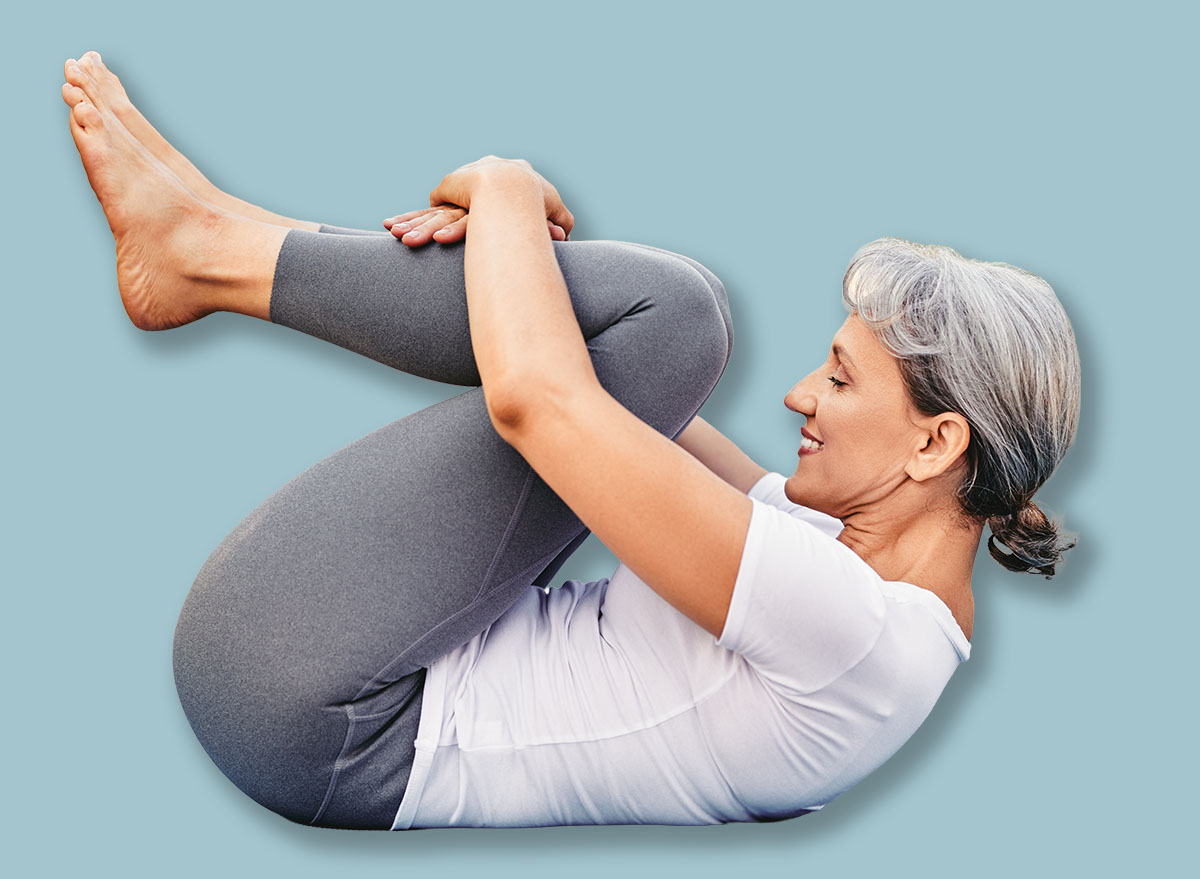
Knees-to-Chest Hug
This releases the lower back and stretches the deep muscles of the buttock, which are the two areas that hold the most tension in over 60s. Doing it lying down means gravity does most of the work, so the body can relax into the position rather than fighting it.
How to Do It:
- Lie on your back in bed with legs straight
- Bend one knee and gently bring it towards your chest
- Wrap both hands around the knee or the shin and pull it slightly closer
- Hold for 30 seconds, breathing slowly
- Release and repeat with the other leg
- Then bring both knees to the chest together and hold for another 30 seconds
Avoid These Mistakes:
- Don’t pull the knee hard or force the range. This is a hold-and-soften stretch, not a pull-and-stretch stretch. Gentle pressure for 30 seconds does more than aggressive pulling for 10.
Reclining Figure-4
This targets the piriformis and other deep hip muscles, which are the biggest source of hidden tension in this age group. It’s the stretch that eases the ache people often get on the outside of the hip after a long day.
How to Do It:
- Lie on your back with knees bent and feet flat on the bed
- Cross the right ankle over the left thigh, just above the knee
- Reach the right hand through the gap between the legs and the left hand around the outside of the left thigh
- Clasp your hands behind the left thigh and gently pull the left leg towards your chest
- You should feel a stretch in the outside of the right hip and buttock
- Hold for 30 seconds
- Swap sides
Avoid These Mistakes:
- Don’t lift your head off the bed to try to reach the leg. Keep your head resting on the pillow and let your hands come to whatever grip is comfortable. If you can’t reach the thigh, use a towel looped around it as an extension of your arms.
Supine Spinal Twist
This releases the whole length of the spine, from the neck down to the tailbone, and gives the lower back the rotation it rarely gets in daily life. The twist also gently compresses and releases the muscles alongside the spine, which is one of the most satisfying sensations at the end of the day.
How to Do It:
- Lie on your back with arms out to the sides at shoulder height, palms up
- Bend the knees and bring them towards the chest
- Slowly lower both knees together to the right side, keeping the shoulders flat on the bed
- Turn the head to look towards the left hand if that’s comfortable
- Hold for 30 seconds, breathing slowly
- Bring the knees back to center and lower to the left side
- Hold for 30 seconds
Avoid These Mistakes:
- Don’t lift the opposite shoulder off the bed as your knees drop. The value of the twist comes from keeping both shoulders down. If a shoulder wants to lift, let your knees stay higher instead of forcing them lower.
Towel Chest Opener
This opens the chest and the front of the shoulders, which have been shortened by decades of sitting and looking forwards. It’s the stretch that lifts the tension out of the neck and upper back before sleep, which improves both the depth of sleep and the way you feel on waking.
How to Do It:
- Sit on the edge of the bed
- Roll a large towel or a pillow lengthways
- Lie back so the towel or pillow runs down the length of your spine, from the base of the skull to the tailbone
- Let both arms fall out to the sides at shoulder height, palms up
- Let the shoulders and chest gently open under gravity
- Hold for 2 to 3 minutes, breathing slowly
Avoid These Mistakes:
- Don’t use a towel or pillow so thick that it forces your chest open too aggressively. Start with something modest, about the thickness of a rolled hand towel, and progress to a firmer prop over weeks. If you feel any pinching or discomfort in the shoulders, reduce the height.
How Often to Stretch

Do the sequence in the order above, once a night, ideally after you’re already in bed and about to switch the light off. The whole thing takes 8 to 10 minutes.
Seven nights a week is the target. This isn’t a workout that needs recovery days. It’s more like brushing your teeth for the muscles, and consistency is what makes it work. Missing one night doesn’t matter. Missing a week starts to undo the progress.
The best signal you’re doing enough is that the stretches feel less intense over time. When a stretch that used to feel deep starts to feel mild, that’s the muscle lengthening. Keep going, and gradually add a small extension to the range each fortnight.
What Results to Expect

By the end of the first week, most people notice they’re sleeping better. That’s the parasympathetic effect of the stretches themselves, and it happens before any real change in muscle length.
By 2 to 3 weeks, the morning stiffness that most over 60s wake up with starts to ease. Getting out of bed feels less like a maneuver. The first few steps of the day feel more like the last few, rather than the creaky opening of a rusty joint.
By 4 to 6 weeks, the muscle length has genuinely changed. The lower back sits more comfortably during a long walk. Shoulders sit back rather than rolled forwards. The hips feel less cramped after a car journey. Family members sometimes comment that you look more relaxed.
By 3 months, the change is substantial enough that a massage becomes optional rather than needed. The body has learned to hold a looser resting state, which is what a massage tries to achieve temporarily. Nightly stretching, done consistently, replaces that need for most people over 60.