4 Standing Exercises That Trim Apron Belly Faster Than Gym Classes After 60
An apron belly can make people chase the wrong workout. It seems logical to keep searching for the perfect lower-ab move, but the body doesn’t trim one area just because that area gets the most attention. The better path is a workout that creates more total effort and keeps you consistent.
Standing exercises are useful because they make the session feel active right away. You’re using your legs, hips, arms, and core while your heart rate climbs. That means more calories burned during the workout and a stronger training effect than sitting on machines or moving through a slow class that never quite asks enough of you.
With clients over 60, I’m looking for intensity they can control. The rep has to stay clean, the breathing should pick up, and the movement should still feel repeatable next time. That balance matters because body-composition change comes from stacking good sessions, not surviving one brutal workout.
This four-exercise circuit uses power, strength, and faster-paced intervals to help you train hard in a short window. Start light, rest long enough to stay sharp, and use the low-impact options anytime your knees, hips, or back need a friendlier version.
Single-Arm Kettlebell Swing
The single-arm kettlebell swing brings a lot of effort into one standing movement. Your hips create the power, your grip controls the bell, and your core keeps your torso from rotating as the weight moves. That makes it a strong option for a short, calorie-burning circuit when your form stays crisp. Use a light kettlebell and practice the two-hand swing first if this version feels new.
Muscles Trained: Glutes, hamstrings, core, upper back, grip, shoulders.
How to Do It:
- Stand with your feet slightly wider than hip-width and place a kettlebell in front of you.
- Hinge at your hips and grip the handle with one hand.
- Pull the kettlebell back between your legs.
- Drive your hips forward to swing the bell to chest height.
- Keep your free arm relaxed at your side or out for balance.
- Let the bell return between your legs and repeat before switching sides.
Recommended Sets and Reps: Perform 3 sets of 8 to 10 reps per side. Rest for 45 to 60 seconds between sets.
Best Variations: Two-hand kettlebell swings, kettlebell deadlifts, single-arm swing holds.
Form Tip: Let your hips drive the bell. Your arm should guide the weight, not lift it.
Dumbbell Squat to Press
The dumbbell squat to press gives the workout a full-body strength piece. Your legs create the drive out of the squat, and your upper body finishes the press overhead. The move raises the demand of the circuit without needing heavy weights. Keep the dumbbells light enough that the press stays smooth.
Muscles Trained: Quadriceps, glutes, hamstrings, shoulders, triceps, core.
How to Do It:
- Stand with your feet about shoulder-width apart and hold dumbbells at shoulder height.
- Brace your core and keep your chest lifted.
- Lower into a squat you can control.
- Press through your whole feet to stand tall.
- Press the dumbbells overhead.
- Lower the weights back to your shoulders and repeat.
Recommended Sets and Reps: Perform 3 sets of 8 to 10 reps. Rest for 45 to 60 seconds between sets.
Best Variations: Bodyweight squat to reach, goblet squat, alternating dumbbell squat to press.
Form Tip: Stand fully before pressing so the movement stays powerful and controlled.
Squat Jumps
Squat jumps add the highest-intensity piece of the circuit. They train your legs to produce force quickly, and even a small jump can raise your heart rate fast. Keep the jump low and land quietly so the exercise stays athletic without feeling reckless. Use the lower-impact variation when jumping doesn’t feel right for your joints.
Muscles Trained: Quadriceps, glutes, hamstrings, calves, core.
How to Do It:
- Stand with your feet about shoulder-width apart.
- Brace your core and lower into a shallow squat.
- Drive through your feet and jump straight up.
- Land softly with your knees slightly bent.
- Reset your stance.
- Repeat for the full set.
Recommended Sets and Reps: Perform 3 sets of 6 to 8 reps. Rest for 45 to 60 seconds between sets.
Best Variations: Squat to calf raise, assisted squat jumps, low squat jumps.
Form Tip: Land with control and reset before the next rep.
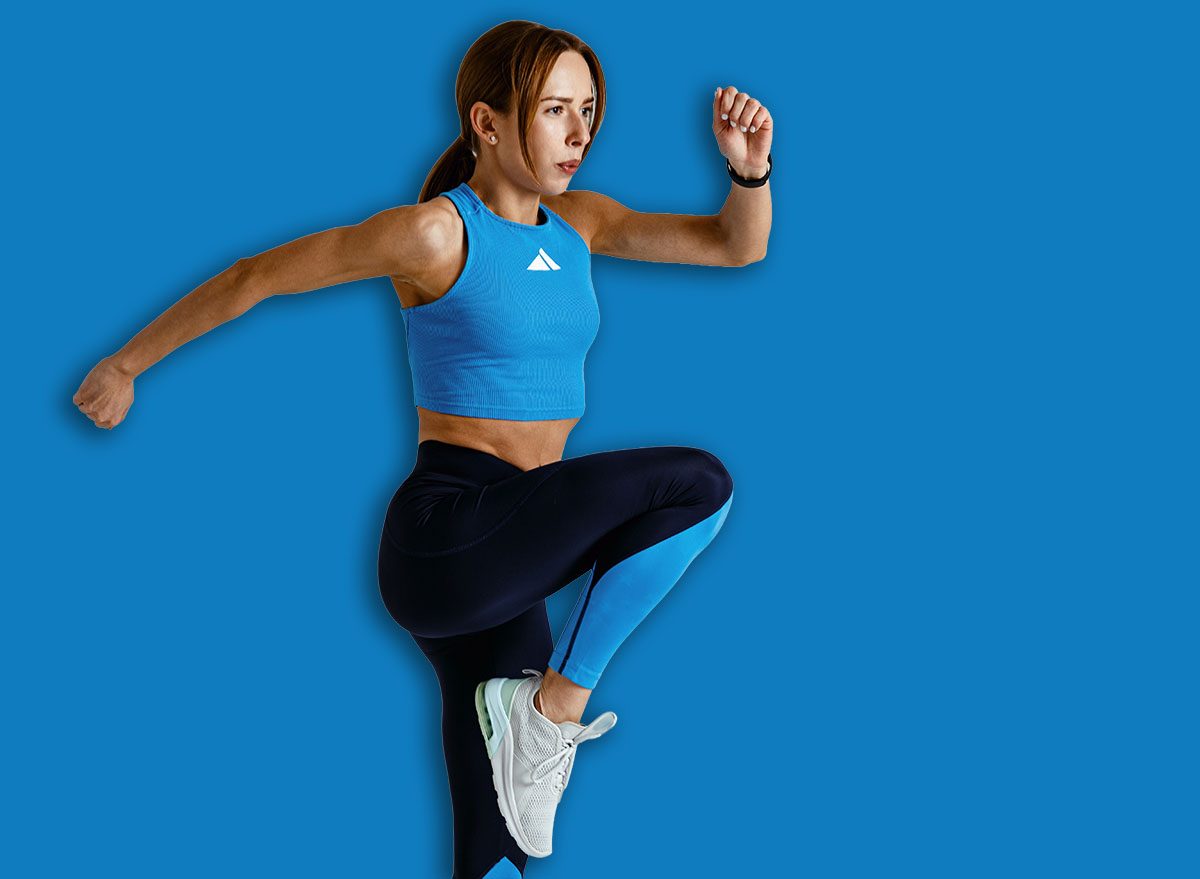
High Knees
High knees finish the circuit with a simple conditioning interval. The goal is to move quickly while staying tall and controlled. Your breathing should pick up, but your posture shouldn’t fall apart. Use a marching version if running in place feels too jarring.
Muscles Trained: Hip flexors, quadriceps, calves, glutes, core.
How to Do It:
- Stand tall with your feet hip-width apart.
- Brace your core and keep your chest lifted.
- Drive one knee toward hip height.
- Lower that foot and quickly switch sides.
- Pump your arms naturally as you move.
- Continue for the full interval.
Recommended Sets and Reps: Perform 3 sets of 20 to 30 seconds. Rest for 30 to 45 seconds between sets.
Best Variations: Marching high knees, supported high knees, slow-tempo high knees.
Form Tip: Stay tall and keep the footfalls light.
How to Use These Standing Exercises After 60

Use these four exercises as a circuit two to three days per week. Complete one set of each move in order, rest for 60 to 90 seconds, then repeat for two to three total rounds.
- Start with the cleanest version: Good form lets you train harder over time. Use lighter weights, lower jumps, or marching high knees when needed.
- Keep the pace honest: The workout should raise your breathing, but every rep should still look controlled.
- Rest before form slips: Short rests help the circuit feel active. Take a little more time when your jumps, swings, or presses start to lose quality.
- Use the low-impact options: Squat to calf raises and marching high knees still create useful effort while reducing impact.
- Build the rest of the week around movement: Walking, strength work, and consistent meals help support the body-composition changes behind the apron-belly goal.
Trimming an apron belly takes more than a few ab reps. Use standing exercises that create real effort, keep your whole body involved, and give you a repeatable way to train with purpose.
References
- Kolnes, Kristoffer Jensen et al. “Effect of Exercise Training on Fat Loss-Energetic Perspectives and the Role of Improved Adipose Tissue Function and Body Fat Distribution.” Frontiers in physiology vol. 12 737709. 24 Sep. 2021, doi:10.3389/fphys.2021.737709
- Garatachea, Nuria et al. “Exercise attenuates the major hallmarks of aging.” Rejuvenation research vol. 18,1 (2015): 57-89. doi:10.1089/rej.2014.1623