10-Minute Home Routine That Builds Posture Strength Faster Than the Gym After 60

Posture is often one of the first things someone notices about you. But beyond aesthetics, strong posture helps to ensure your joints and bones maintain alignment; it also prevents neck and back discomfort. If you’re looking to improve your posture, your workout routine is a solid place to begin. To help you get started, we learned six home exercises that build postural strength quicker than Pilates after 60.
“You don’t fix posture by trying harder to stand up straight. You fix it by training the muscles and mobility that make good posture automatic. Ten minutes a day, done consistently, does more than any expensive class or product. And the earlier you start, the less rebuilding you have to do later,” explains Dr. Andrew Gorecki, PT, DPT, FAFS, Owner of Superior Physical Therapy in Traverse City, MI, and co-founder/CEO of MovementRx, a remote therapeutic monitoring platform used by PT clinics nationwide.
Below are six morning moves to add to your routine.
Ankle Rocks
“The posture chain starts at the feet. Stiff ankles force the whole system to compensate upward. This is the piece nobody thinks about,” says Dr. Gorecki.
- Begin standing near a counter for support with your feet hip-width apart.
- Slowly rock forward onto the balls of your feet, holding for 2 seconds.
- Then, rock back onto your heels, holding for 2 seconds.
- Complete 10 to 15 rocks.
- Then, add side-to-side weight shifting for 10 reps.
Standing Hip Circles
“Hip mobility is the single most under-addressed piece of the posture puzzle in older adults. Tight hips force the low back to arch, which cascades up through the whole spine,” Dr. Gorecki says. “[This exercise] hits the hip in three planes. [It] frees up the hips so the pelvis can sit correctly instead of tilting forward and pulling the low back with it.”
- Begin standing tall with your hands on your hips.
- Start to make slow circles with your hips, as if you’re stirring with your pelvis.
- Perform 5 circles in each direction.
- Then, shift your hips forward and back for 5 reps and side-to-side for another 5 reps.
RELATED: The 6-Minute Morning Routine That Restores Posture Faster Than the Gym After 60
Cat-Cow
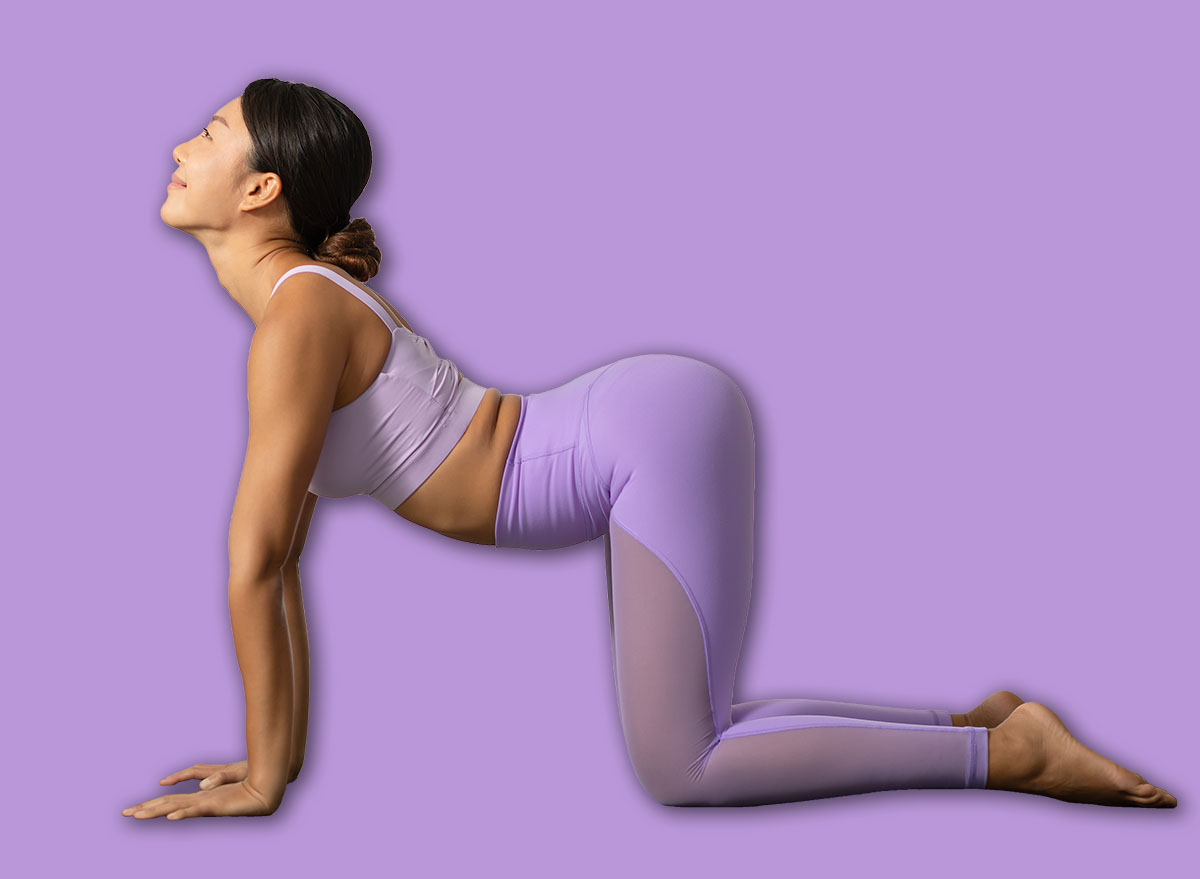
“Cat-cow wakes up the entire spine and trains the deep core to control spinal position. One of the highest-return exercises for posture at any age,” Dr. Gorecki tells us.
- Assume a tabletop position on your hands and knees.
- For cow pose, breathe in, drop your belly toward the floor, concave your back, and gaze upward, holding for 2 seconds.
- For cat pose, breathe out, round your back, tuck your chin in toward your chest, and tuck your tailbone, holding for 2 seconds.
- Perform 8 to 10 rounds.
Thoracic Rotation
“The thoracic spine (mid back) is where posture is won or lost after 60. When the mid back stiffens, the shoulders round forward and the neck jams up trying to compensate. Getting rotation back into the mid back is the single most impactful thing you can do for upper-body posture,” Dr. Gorecki explains.
- Begin sitting tall in a sturdy chair with your feet flat on the ground.
- Cross your arms over your chest.
- Gradually rotate your upper body to the right as far as you’re comfortably able to, holding for 2 seconds.
- Return to the center.
- Then, rotate to the left.
- Perform 8 rotations in each direction.
Wall Angels
“Wall angels train the muscles that hold the shoulders back and down, which are the postural muscles most weakened by decades of sitting and phone use. Feels weirdly hard for how simple it looks,” Dr. Gorecki says.
- Stand tall with your back pressed against a wall and your feet 6 inches away from it.
- Press your lower back into the wall.
- Lift your arms to a goalpost position so that the backs of your hands, elbows, and shoulders all touch the wall.
- Then, slide your arms up the wall as high as they’ll go while keeping your hands and elbows against the wall.
- Use control as you slide them back down.
- Perform 10 slow reps.
Chin Tucks
“Forward head posture is one of the most visible signs of poor posture in older adults, and one of the most fixable. Chin tucks train the deep neck flexors that hold the head over the shoulders instead of drifting forward,” Dr. Gorecki says.
- Begin sitting or standing tall.
- Glide your head straight back over your shoulders, thinking about making a double chin.
- Hold for 2 seconds.
- Return to the start position.
- Perform 10 reps.