6 Quick Standing Exercises That Deliver More Results Than Hour-Long Workouts After 45

Somewhere after 45, the return on investment from long workouts starts to shrink. You can spend an hour exercising and still feel stiff, sore, or underwhelmed with your results. However, this doesn’t mean your body has stopped responding, it just means your body now responds better to how you train instead of how long you train.
Research shows that after reaching midlife, workouts that combine large muscle groups, boost cardiovascular fitness, and engage full-body coordination can outperform longer, lower-quality training sessions. Strength training specifically can help you hold on to lean muscle mass, which naturally declines with age, while short bursts of exercise that elevate heart rate can improve insulin sensitivity, cardiovascular health, and energy expenditure (a.k.a. calorie burn).
This is where standing exercises enter the picture. We chatted with James Bickerstaff, CPT, a personal trainer at OriGym, who shares his top six standing exercises that deliver more results than hour-long workouts after 45. They’re quick, practical, and scalable, making them easier to stick with long term. Read on for the exercises and detailed step-by-step instructions.
(Next up: If You Can Hold a Plank This Long After 50, Your Core Is Stronger Than Most Athletes.)
Squats
The almighty squat is the king of compound exercises. Squats deliver a serious bang for your buck by engaging your quads, glutes, hamstrings, and core all at once. These are the largest muscle groups in the body, and working them together creates a strong metabolic and cardiovascular response.
How to do it:
- Stand with your feet shoulder-width apart and your toes turned out slightly.
- Push your hips back as you bend your knees.
- Keep your chest upright, back flat, and core engaged throughout the movement.
- Drive through your heels and go as low as comfortable.
- Slowly push back up to a standing position with control.
- Aim for 12 to 15 reps for two to three, resting 60 to 90 seconds between sets.
Reverse Lunges
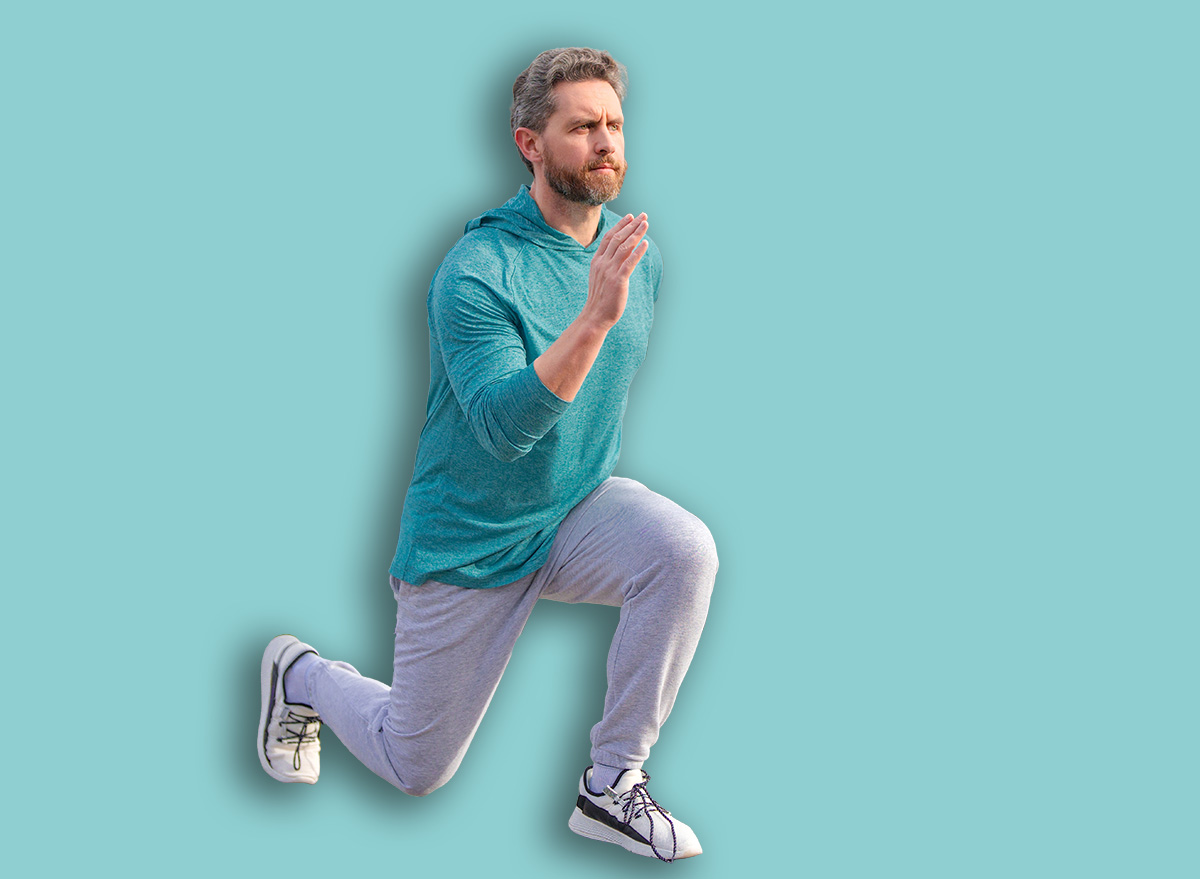
Reverse lunges will challenge your strength, balance, and coordination while being easier on your knees than forward lunges. That makes them super helpful after 45 when keeping your joints healthy matters as much as muscle engagement. “Reverse lunges target your glutes and quads whilst engaging your core, making it a full body exercise,” explains Bickerstaff.
How to do it:
- Stand tall with your feet hip-width apart.
- Step one foot back and slowly lower your hips.
- Lower until both knees are bent comfortably.
- Keep your torso upright and weight through your front heel.
- Push through the front foot to return to standing then switch legs.
- Perform two to three sets of 10 to 12 reps per leg, resting 45 to 60 seconds between sets.
Standing Knee Drives
Standing knee drives are a simple but effective way to elevate your heart rate while strengthening your midsection and lower body. Bickerstaff tells us, “Standing knee drives will help improve your coordination, balance, and cardiovascular health.”
How to do it:
- Stand upright with one leg slightly behind you.
- Keep both feet parallel and facing forward.
- Drive your back knee upward toward your chest.
- Pump your opposite arm as you lift your knee.
- Complete the reps on one side before switching legs.
- Aim for 10 to 15 reps for two to three sets per leg, resting 30 to 45 seconds between sets.
Standing Overhead Press
“A standing overhead press recruits your shoulders and arms while forcing the core to work harder to stabilize the body,” explains Bickerstaff. The standing overhead press demands full-body engagement, making it more effective than seated or machine-based presses.
How to do it:
- Stand with your feet shoulder-width apart holding dumbbells.
- Raise the dumbbells to shoulder level with your elbows slightly bent.
- Flex your core and avoid arching your lower back.
- Press the dumbbells overhead until your arms are fully extended.
- Lower the weights back to shoulder height with control.
- Complete two to three sets of 10 to 12 reps, 2 to 3 sets. Rest for 60 to 90 seconds between sets.
Alternating Side Lunges
“Side lunges are excellent for working muscles we often neglect, particularly the inner thighs and glutes,” says Bickerstaff. “This movement improves lower body strength, hip mobility, and joint resilience.”
How to do it:
- Stand tall with your feet hip-width apart.
- Step out to the side with your left leg.
- Bend your knee and push your hips back.
- Keep your opposite leg straight and your chest upright.
- Push off your bent leg to return to center then switch sides.
- Perform eight to 10 reps per side for two to three sets. Rest for 30 to 45 seconds.
Calf Raises
Calf raises may seem like a waste of time, but they can be crucial in developing lower-body endurance, circulation, and walking efficiency, all of which can impact your health and fitness.
“Calf raises can help build lower leg strength and improve your circulation,” says Bickerstaff. “They can also help with ankle support, helping you to walk more efficiently and improving your lower body’s endurance.”
How to do it:
- Stand tall with your feet hip-width apart.
- Rise up onto the balls of your feet.
- Pause briefly at the top of the movement.
- Lower your heels back down under control.
- Ensure your feet are fully flat before repeating.
- Aim for two to three sets of 15 to 20 reps, resting for 30 to 45 seconds between sets.