4 Standing Exercises That Flatten Side Belly After 45, According to a Trainer
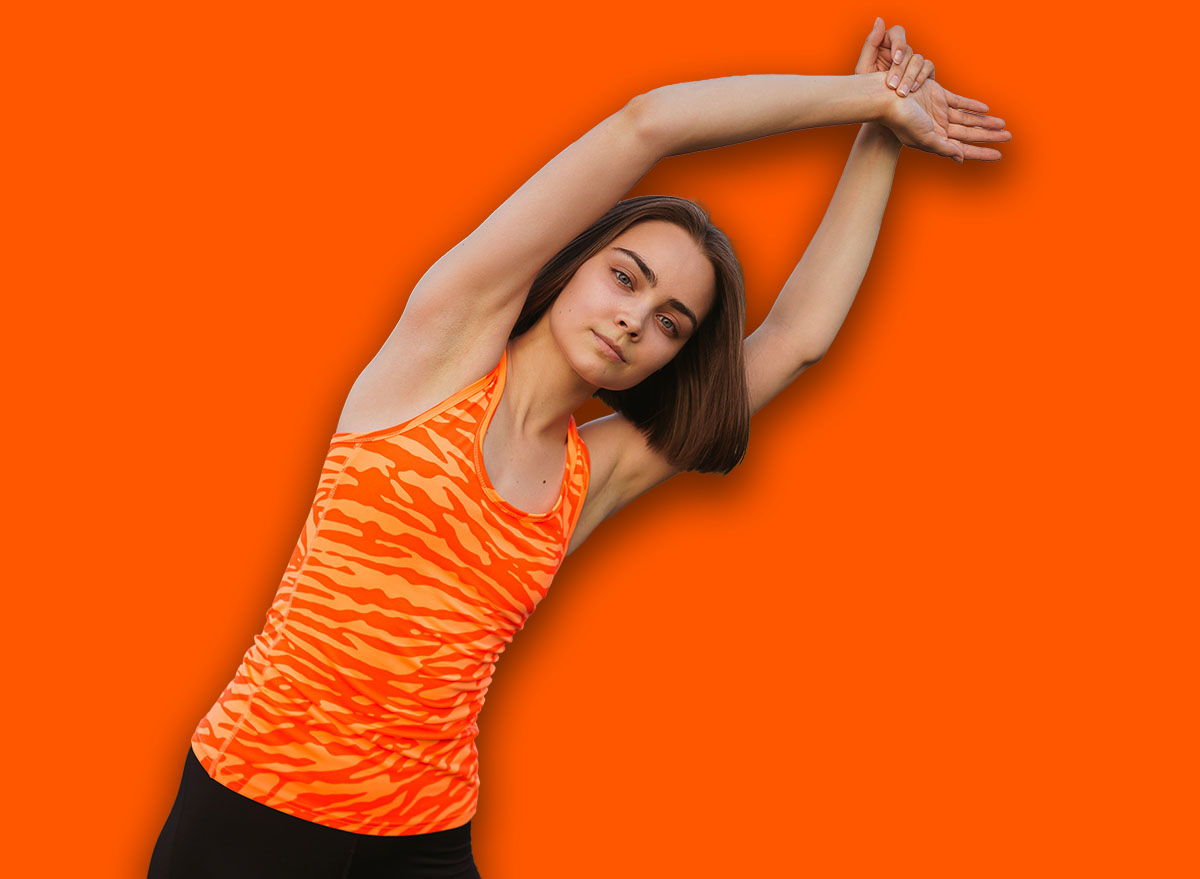

Side belly fat has a way of hanging on, especially as you move through your 40s. Hormonal shifts, more time spent sitting, and fewer daily opportunities for movement all play a role. The solution isn’t setting world-record plank holds or chasing fatigue on the floor, but rather choosing movements that force your core to stabilize while your body stays upright and active.
Standing exercises hit the obliques in a way planks often miss. When you’re on your feet, your core has to manage balance, rotation, and resistance simultaneously. That demand lights up the muscles along your sides and drives up calorie burn. You’re training strength and function at the same time, while avoiding the monotony of planks.
And not so surprisingly, these moves also fit real life better. They reinforce posture, support spinal health, and carry over to everyday activities like walking, lifting groceries, or reaching overhead. Functional core training matters more after 45, when efficiency and joint-friendly movement should lead the way.
Ahead, you’ll find four standing exercises that zero in on side belly fat while building serious core strength. Each one challenges your obliques differently, keeps you moving, and delivers results without dropping to the floor.
Dumbbell Side Bends
Dumbbell side bends directly target the obliques with constant tension through a natural range of motion. Unlike planks, there’s no passive holding here. Your side core muscles actively shorten and lengthen with every rep. That muscular action drives strength gains while also increasing metabolic demand. When done with control, this move helps tighten the waistline and reinforce spinal stability, both of which become more important as you age.
Muscles Trained: Obliques, quadratus lumborum, transverse abdominis, and erector spinae.
How to Do It:
- Grab a dumbbell in one hand and stand tall with your feet hip-width apart.
- Brace your core and let the weight hang naturally at your side.
- Slowly bend sideways toward the dumbbell without leaning forward or backward.
- Pause briefly at the bottom while keeping your chest tall.
- Drive back to standing by squeezing your side core muscles.
- Complete all reps before switching sides.
Recommended Sets and Reps: Knock out 3 sets of 10 to 12 reps per side. Rest for 45 seconds between each set.
Best Variations: Cable side bends, kettlebell side bends, and overhead side bends.
Form Tip: Move slowly and keep your shoulders stacked over your hips throughout.
Standing Dumbbell Chops
Standing dumbbell chops train your core to resist and produce rotation, which is a major driver of side belly engagement. This movement mimics real-world actions like lifting, twisting, and reaching. Your obliques work overtime to control the weight as it moves across your body. That combination of strength and coordination makes this exercise far more effective than static core holds.
Muscles Trained: Obliques, transverse abdominis, rectus abdominis, and shoulders.
How to Do It:
- Hold a dumbbell with both hands at hip height on one side of your body.
- Stand with your feet shoulder-width apart and knees softly bent.
- Brace your core and rotate your torso as you lift the weight diagonally across your body.
- Finish with the dumbbell just above shoulder height on the opposite side.
- Control the weight back to the starting position.
- Complete all reps before switching sides.
Recommended Sets and Reps: Perform 3 sets of 8 to 10 reps per side. Rest for 60 seconds between each set.
Best Variations: Cable chops, medicine ball chops, resistance band chops.
Form Tip: Rotate through your torso, not your arms, and keep your hips steady.
Pallof Press
The Pallof press is all about resisting rotation, which lights up the deep core muscles that wrap around your waist. This anti-rotation demand keeps your obliques engaged the entire time. It also reinforces proper bracing, which protects your spine and improves posture. Over time, this leads to a tighter, more stable midsection without excessive strain.
Muscles Trained: Transverse abdominis, obliques, rectus abdominis, and glutes.
How to Do It:
- Attach a resistance band or cable at chest height.
- Stand sideways to the anchor point and hold the handle with both hands at your chest.
- Step away until there’s steady tension on the band.
- Press your hands straight out in front of you while keeping your torso square.
- Pause briefly with arms extended.
- Bring the handle back to your chest with control and repeat.
Recommended Sets and Reps: Knock out 3 sets of 10 to 12 reps per side. Rest for 45 seconds between each set.
Best Variations: Tall kneeling Pallof press, overhead Pallof press, single arm Pallof press.
Form Tip: Exhale as you press and don’t let your shoulders twist.
Suitcase Carry
A suitcase carries a challenges your core with every step you take. Carrying weight on one side forces your obliques to stabilize your torso and prevent leaning. This constant engagement builds endurance and strength through the entire side of your core. It also improves grip strength and posture, making it a high-return exercise after 45.
Muscles Trained:
Obliques, transverse abdominis, quadratus lumborum, and forearms.
How to Do It:
- Hold a dumbbell or kettlebell in one hand at your side.
- Stand tall with your shoulders level and core braced.
- Walk forward with controlled steps for the prescribed distance or time.
- Keep your torso upright and avoid leaning toward the weight.
- Turn carefully and continue walking if space allows.
- Switch hands after completing the set.
Recommended Sets and Reps: Perform 3 sets of 30 to 45 seconds per side. Rest for 60 seconds between each set.
Best Variations: Farmer carry, overhead carry, bottom-up kettlebell carry.
Form Tip: Imagine balancing a glass of water on your head as you walk.
Best Tips for Flattening the Side Belly After 45

Flattening side belly fat takes more than a single exercise. It’s about stacking smart habits that support fat loss, muscle tone, and recovery. Standing core work shines here because it trains your body to move the way it actually does throughout the day. Pairing these exercises with consistent routines and supportive lifestyle choices makes the biggest difference.
- Train upright more often: Standing movements burn more calories and recruit more muscle than floor-based holds.
- Progress your load gradually: Slight increases in weight force your obliques to adapt without overwhelming your joints.
- Focus on breathing: Strong exhales during effort improve core activation and support better posture.
- Move daily outside the gym: Walking, carrying groceries, and staying active reinforce core engagement all day long.
- Support recovery: Quality sleep and adequate protein help preserve muscle and keep fat loss moving forward.
- Dial in protein and fiber at most meals: Protein supports muscle retention as you lean out, while fiber helps manage appetite and blood sugar. Together, they make it easier to reduce overall calories without feeling drained or restricted, which directly supports fat loss around the waist.
These standing exercises don’t just flatten your side belly. They build a stronger, more resilient core that supports everything you do after 45.
References
- Alley, Dawn E et al. “A research agenda: the changing relationship between body weight and health in aging.” The journals of gerontology. Series A, Biological sciences and medical sciences vol. 63,11 (2008): 1257-9. doi:10.1093/gerona/63.11.1257
- Rodríguez-Perea, Ángela et al. “Core training and performance: a systematic review with meta-analysis.” Biology of sport vol. 40,4 (2023): 975-992. doi:10.5114/biolsport.2023.123319