6 Standing Exercises That Flatten Belly Overhang Faster Than Planks After 55

Belly overhang after 55 is often the result of several overlapping factors: age-related muscle loss, lack of daily movement, and hormonal shifts. While research suggests that fat loss cannot be targeted to one area (a.k.a. spot reduction), studies also show that your daily calorie burn and amount of lean muscle mass are essential in how your midsection holds onto fat as you age.
That’s where standing core exercises come in. These dynamic movements recruit more muscle mass and elevate your heart rate faster than regular floor-based core exercises. This leads to more calories burned, better neuromuscular coordination, and stronger activation of those deep ab muscles that help pull your stomach inward and flatten belly overhang.
To learn more, we spoke with James Brady, CPT, certified personal trainer at OriGym, who tells us, “For those over 55, consistency beats intensity every time. Standing exercises are easier to stick to and when you train the core daily and stay upright, you burn more calories overall. That is what helps belly overhang reduce faster over time.”
In this article, Brady shares six standing exercises designed to be performed upright, without equipment, and without getting down on the floor. Keep reading for the exercises and detailed instructions. Then, when you’re finished, don’t miss If You Can Hold These 4 Standing Positions After 55, Your Core Strength Is Elite.
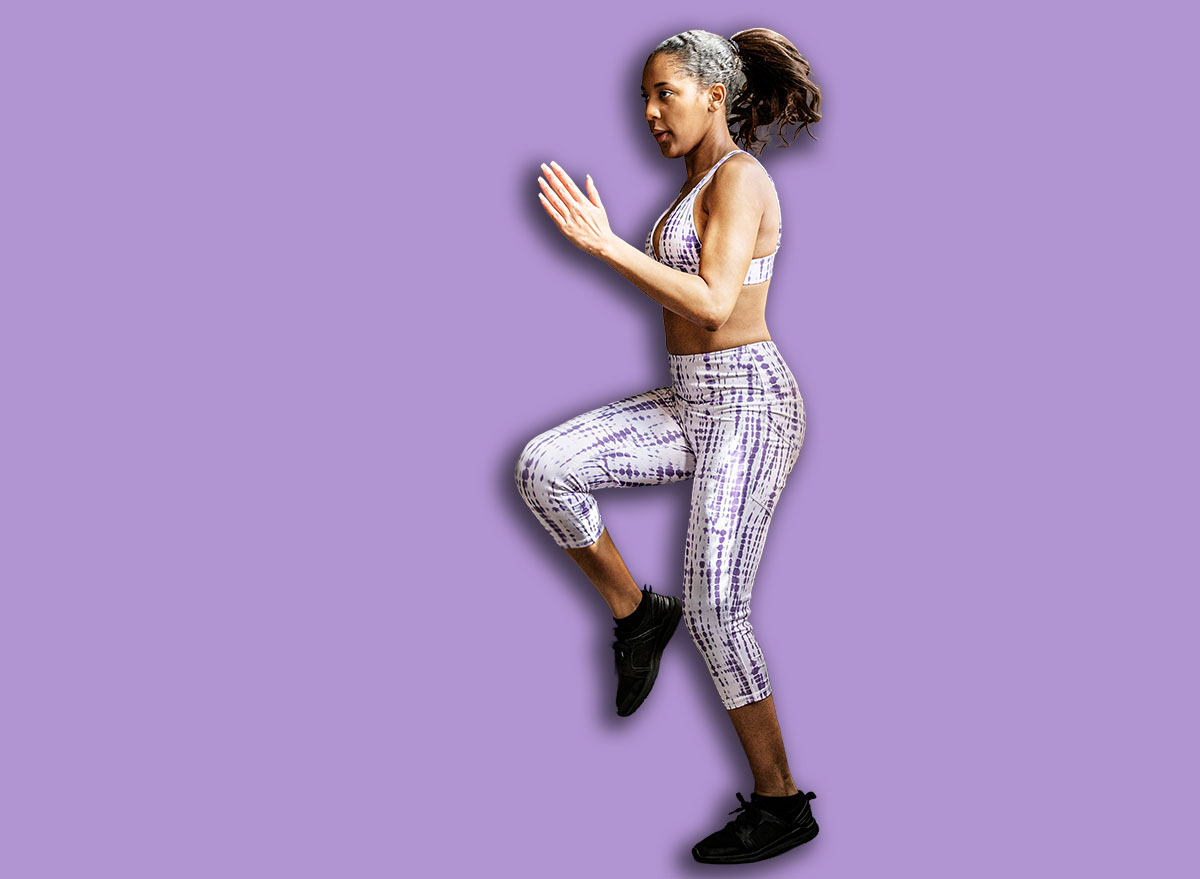
Standing Knee Lifts
Standing knee lifts are a simple and effective way to activate your lower ab muscles while staying on your feet. This movement challenges balance, hip control, and deep core engagement without placing stress on your shoulders or wrists.
How to do it:
- Stand tall with your feet hip-width apart and arms relaxed at your sides.
- Engage your core as if gently tightening a zipper from your hips to your ribs.
- Shift your weight slightly onto one leg.
- Lift your opposite knee toward your chest in a slow, controlled motion.
- Keep your chest upright and avoid leaning backward.
- Pause for one to two seconds at the top while maintaining core tension.
- Lower your leg slowly and return to the starting position.
- Alternate sides while maintaining the same tempo throughout.
- Perform two to three sets of 10 to 15 reps per side. Rest for 30 to 45 seconds between sets.
Standing Crunches with Reach
Standing crunches with reach combine spinal flexion and breathing, two elements that have a big influence on deep core muscle activation.
“Remembering to breathe during this exercise matters as it helps activate the deep core muscles that flatten the stomach area,” says Brady. “Breathing is the secret weapon to perform this successfully.
How to do it:
- Stand with your feet shoulder-width apart.
- Raise both arms above your head with your palms facing inward.
- Take a deep inhale through your nose.
- As you exhale, draw your ribs down toward your hips.
- Simultaneously reach your arms slightly forward and downward.
- Feel the abdominal muscles contract as you crunch.
- Pause for one to two seconds at the bottom of the movement.
- Slowly return to the starting position with control.
- Complete two to three sets of 12 to 15 reps, resting for 30 to 45 seconds between sets.
RELATED: 5 Exercises Women Over 50 Should Do Every Morning to Restore Muscle Tone
Standing Oblique Twists
Standing oblique twists strengthen the muscles along the sides of your waist, which play a vital role in pulling your abdomen inward and supporting good posture. “Standing oblique twists help improve balance, which matters more as you age,” explains Brady.
How to do it:
- Stand tall with your feet slightly wider than hip-width apart.
- Bring your hands together in front of your chest.
- Flex your core and keep your hips facing forward.
- Slowly rotate your upper body to one side.
- Pause for one to two seconds at the end range without forcing a torso twist.
- Return to the center position under control.
- Rotate to the opposite side with the same tempo.
- Continue alternating sides smoothly and with good form.
- Perform two to three sets of 10 to 12 twists per side. Rest for 30 to 45 seconds between sets.
Marching Holds
Marching holds increase time under tension for your core by adding a pause at the top of each knee lift. That pause forces the abdominal muscles to stabilize the pelvis more intensely than faster movements.
How to do it:
- Stand upright with your feet hip-width apart.
- Engage your core and keep your eyes looking forward.
- Lift one knee toward hip height.
- Hold that knee in place for two to three seconds.
- Maintain steady breathing during the hold.
- Lower your leg slowly back to the floor.
- Repeat on the opposite side with the same control.
- Avoid leaning back or collapsing through your hips.
- Aim for two to three sets of 8 to 12 reps per side, resting for 30 to 45 seconds between sets.
Standing Side Bends
Standing side bends strengthen the lateral core muscles that support posture and spinal alignment. “Better posture alone can make the stomach look flatter,” says Brady.
How to do it:
- Stand tall with your feet hip-width apart.
- Place one hand lightly on the side of your thigh.
- Keep your chest open and your shoulders relaxed.
- Slowly slide your hand down your leg as you bend sideways.
- Stop before the movement turns into a forward lean.
- Pause for one to two seconds while keeping your core braced.
- Return to the center position with control.
- Switch sides and repeat.
- Perform two to three sets of 12 to 15 reps per side. Rest for 30 to 45 seconds between sets.
Cross-Body Knee Drives
Cross-body knee drives combine rotation, hip flexion, and balance, making them one of the most complete standing core exercises available.
How to do it:
- Stand with your feet shoulder-width apart.
- Place your hands lightly behind your head or at chest height.
- Flex your core and lift your right knee.
- Rotate your torso slightly to bring your left elbow toward the raised knee.
- Pause for one to two seconds as the elbow and knee approach each other.
- Lower both with control and return to the starting position.
- Repeat on the opposite side.
- Complete two to three sets of 10 to 12 reps per side, resting for 30 to 45 seconds between sets.