4 Standing Exercises That Build Strength Faster Than People Half Your Age Expect After 70
Strength after 70 can surprise people, sometimes quickly. A little more control when you stand, a smoother step, or a carry that feels less awkward can change how confidently you move through the day. Those wins may look small from the outside, but they matter.
This routine stays upright for a reason. Getting down to the floor isn’t always the best starting point, and it isn’t necessary for building useful strength. Standing exercises can train your legs, hips, grip, posture, and core in positions that feel closer to real life.
A lot of strength work after 70 comes down to confidence. I’ve seen people light up when a movement that felt shaky last month suddenly feels smoother and more controlled. That’s the goal here: exercises that build strength you can feel right away and trust more over time.
Use these four standing exercises two to four days per week. Keep support nearby, start with light resistance, and build the challenge only when the reps feel steady.
Suitcase Carry March
The suitcase carry march is one of those exercises that feels more useful than it looks. Holding weight on one side asks your grip, core, hips, and posture to work together while your legs keep moving. That makes it great for carrying groceries, walking with better control, and staying steady when your body has to manage an uneven load. Start light and stand near a wall or counter if balance feels uncertain.
Muscles Trained: Core, obliques, glutes, hip flexors, grip, upper back.
How to Do It:
- Stand tall with a light dumbbell or kettlebell in one hand.
- Keep your feet hip-width apart and your shoulders level.
- Brace your core lightly.
- Lift one knee toward hip height.
- Lower that foot with control, then lift the other knee.
- Continue marching before switching the weight to the other hand.
Recommended Sets and Reps: Perform 3 sets of 20 to 30 seconds per side. Rest for 30 to 45 seconds between sets.
Best Variations: Bodyweight marching, supported suitcase march, suitcase carry walks.
Form Tip: Keep your shoulders level and avoid leaning toward the weight.
Counter-Supported Split Squat
A supported split squat gives each leg a chance to build strength without turning balance into the main event. The counter or chair lets you stay steady while your front leg does the work. This exercise helps with stairs, getting up from low seats, and stepping with more control. Keep the range small at first and make the bottom position feel solid.
Muscles Trained: Quadriceps, glutes, hamstrings, calves, core.
How to Do It:
- Stand beside a counter or sturdy chair.
- Hold the support lightly with one hand.
- Step one foot back into a split stance.
- Keep your front foot flat and your torso tall.
- Bend both knees and lower a few inches.
- Press through your front foot to return to standing.
Recommended Sets and Reps: Perform 3 sets of 6 to 10 reps per side. Rest for 45 to 60 seconds between sets.
Best Variations: Short-range split squats, supported reverse lunges, slow-tempo split squats.
Form Tip: Let the support help your balance while your legs do the work.
Standing Band Pallof Press
The Pallof press is a quiet core exercise until you try to do it well. The band pulls you to the side, and your job is to stay tall as your arms press forward. That trains your midsection to resist twisting, which matters when you turn, reach, carry something, or catch yourself during a small stumble. Use a light band and take your time with each press.
Muscles Trained: Deep core, obliques, shoulders, glutes, upper back.
How to Do It:
- Anchor a resistance band at chest height.
- Stand sideways to the anchor and hold the band at your chest.
- Step away until the band has light tension.
- Set your feet about hip-width apart and brace your core.
- Press your hands straight out in front of your chest.
- Pause, then bring your hands back in with control.
Recommended Sets and Reps: Perform 3 sets of 8 to 10 reps per side. Rest for 30 to 45 seconds between sets.
Best Variations: Short-hold Pallof presses, wider-stance Pallof presses, supported Pallof presses.
Form Tip: Keep your ribs and hips facing forward as your arms move.
Goblet Squat to Calf Raise
The goblet squat to calf raise trains strength through the legs, then adds a strong finish through the lower legs. That combination helps build power for standing, stepping, and pushing off the ground when you walk. The dumbbell or kettlebell gives your body a clear center point, which can make the squat feel easier to organize. Use a light weight and rise onto your toes only as high as you can control.
Muscles Trained: Quadriceps, glutes, hamstrings, calves, core, upper back.
How to Do It:
- Stand with your feet about shoulder-width apart and hold a dumbbell or kettlebell at chest height.
- Brace your core and keep your chest lifted.
- Lower into a squat you can control.
- Press through your feet to stand tall.
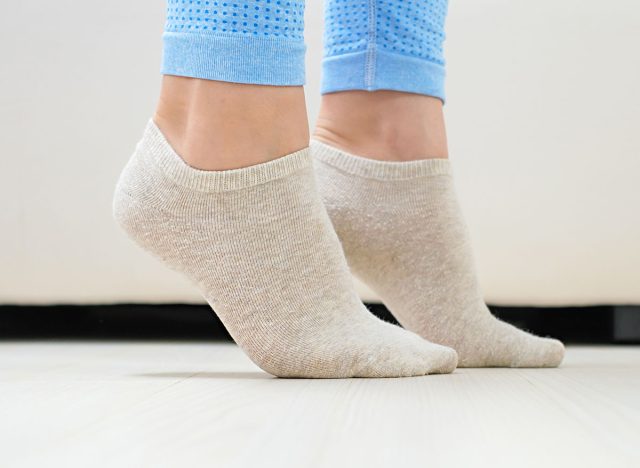
- Rise onto the balls of your feet at the top.
- Lower your heels with control and repeat.
Recommended Sets and Reps: Perform 3 sets of 8 to 10 reps. Rest for 45 to 60 seconds between sets.
Best Variations: Bodyweight squat to calf raise, chair squat to calf raise, goblet squat without the calf raise.
Form Tip: Pause at the top of the calf raise and lower your heels slowly.
How to Use These Standing Exercises After 70
Use these exercises as a short strength circuit. Complete one set of each move in order, rest for 60 to 90 seconds, then repeat for two to three total rounds.
- Keep support nearby: A wall, counter, or sturdy chair can help you train harder without feeling unsure on your feet.
- Choose light resistance first: The first goal is clean movement. Add load once the reps feel steady.
- Move with patience: A slower rep can build more usable strength than a rushed one.
- Train both balance and power: Marching, split squats, Pallof presses, and calf raises all challenge control without needing high-impact work.
- Progress in small steps: Add a few seconds, a few reps, a stronger band, or a slightly heavier weight once the routine feels comfortable.
Strength after 70 isn’t about proving anything to anyone else. It’s about building the kind of body that feels ready for the day. These four exercises give you a practical way to train that strength while staying upright, supported, and in control.
References
- Burtscher, Johannes et al. “How much resistance exercise is beneficial for healthy aging and longevity?.” Journal of sport and health science vol. 12,3 (2023): 284-286. doi:10.1016/j.jshs.2022.11.004
- Tøien, Tiril et al. “Heavy Strength Training in Older Adults: Implications for Health, Disease and Physical Performance.” Journal of cachexia, sarcopenia and muscle vol. 16,2 (2025): e13804. doi:10.1002/jcsm.13804