5 Standing Exercises That Address Hunched Posture Faster Than Stretching After 60
The way most days are set up can pull your body forward without you realizing it. Screens sit in front of us, errands keep our hands busy, and long stretches of sitting can make a rounded upper back feel normal. By the end of the day, the chest often feels tight, the shoulders drift forward, and standing tall takes more effort than it should.
When I coach adults over 60 on posture, I use mobility and strength together. Mobility gives the chest, shoulders, and upper back room to move. Strength gives the muscles around the shoulder blades the ability to hold a better position once you find it. That combination tends to carry over much better than stretching alone.
Your posture also gets shaped by the hours between workouts. A few quick check-ins during the day can help you reset before the rounded position settles back in. These standing exercises build the movement and strength you need to stand taller, keep your shoulders more organized, and make upright posture feel more natural.
Wall Angels
Wall angels help your shoulders and upper back move through a greater range of motion, while the wall provides feedback on your posture. Your upper back, rear shoulders, and rotator cuff work to guide your arms up and down without your ribs flaring or your shoulders shrugging. This exercise can feel challenging even without resistance because it asks you to control your position rather than simply reach overhead. Keep the range comfortable and let your mobility improve gradually.
Muscles Trained: Rear delts, lower traps, middle traps, rotator cuff, upper back.
How to Do It:
- Stand with your back against a wall and place your feet a few inches forward.
- Let the back of your head and upper back rest lightly against the wall.
- Raise your arms into a goalpost position with your elbows bent.
- Slide your arms upward as far as you can control.
- Keep your ribs stacked over your hips as your arms move.
- Return to the starting position with control.
Recommended Sets and Reps: Perform 3 sets of 8 to 10 reps. Rest for 30 to 45 seconds between each set.
Best Variations: Half-wall angels, wall slides, slow-tempo wall angels.
Form Tip: Keep your chin level and avoid forcing your arms higher than your shoulders can control.
Wall Pec Stretch With Reach
A wall pec stretch with reach opens the front of your chest and shoulders while gently encouraging your upper back to rotate. That matters because a rounded posture often comes with a front side that feels restricted and an upper back that has stopped moving as freely. The reach adds a little active control, which makes the stretch more useful than simply hanging in one position. Keep the rotation smooth and stay in a range that feels comfortable.
Muscles Trained: Chest, front shoulders, upper back, obliques.
How to Do It:
- Stand beside a wall with your right hand placed on it at shoulder height.
- Keep your right arm mostly straight with a soft bend in the elbow.
- Turn your chest gently away from the wall until you feel a stretch across your chest.
- Reach your left arm forward as you rotate slightly through your upper back.
- Pause for a breath.
- Return to the starting position and repeat before switching sides.
Recommended Sets and Reps: Perform 2 to 3 sets of 6 to 8 reps per side. Rest for 20 to 30 seconds between sides.
Best Variations: Lower-arm pec stretch, higher-arm pec stretch, slow-tempo pec stretch with reach.
Form Tip: Turn through your chest and upper back to lengthen the stretch.
Band Pull-Aparts
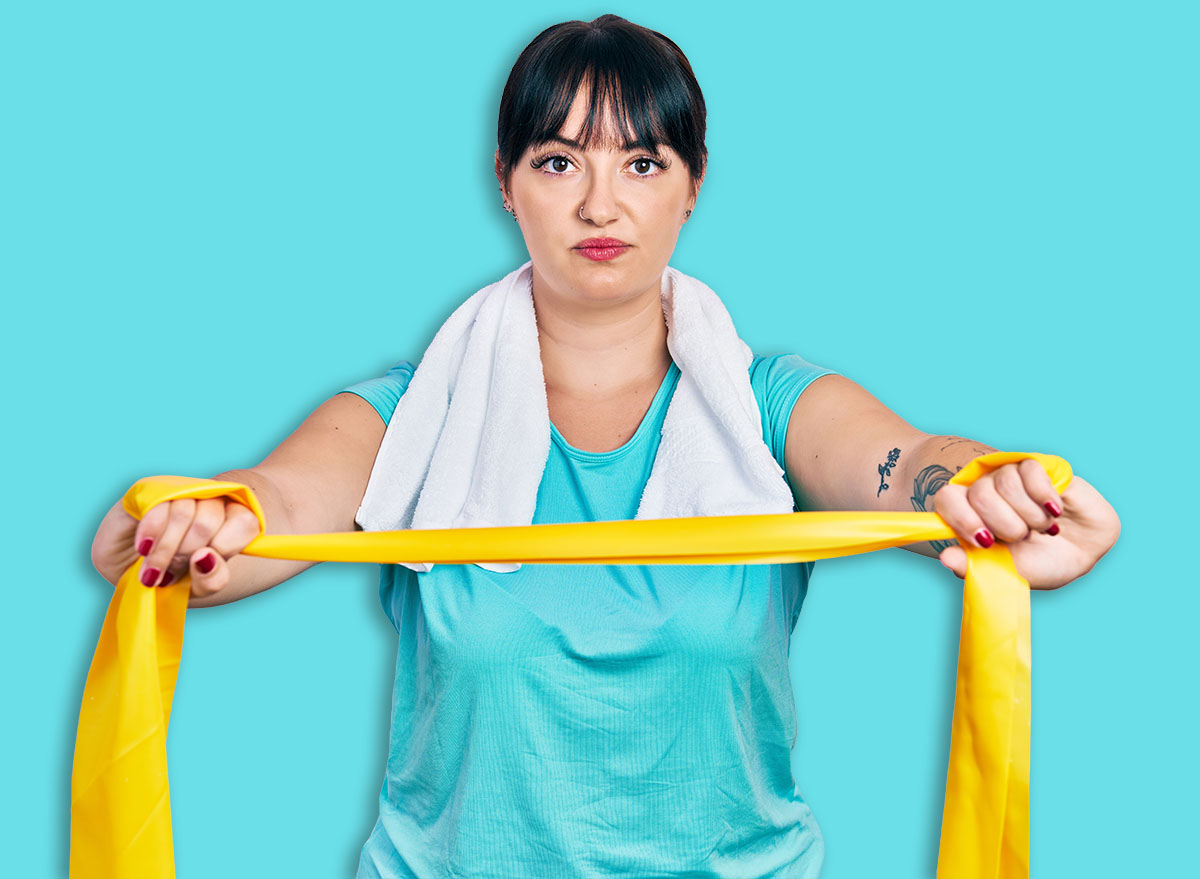
Band pull-aparts strengthen the rear shoulders and upper-back muscles that help guide your shoulder blades into a more upright position. The movement gives you a simple way to train the opposite pattern of all the reaching and pressing that happens during a normal day. A light band is enough when you keep the reps smooth and avoid letting your neck take over. This is an easy exercise to perform regularly because the setup is simple and the movement stays controlled.
Muscles Trained: Rear delts, rhomboids, middle traps, rotator cuff, upper back.
How to Do It:
- Stand tall with your feet about hip-width apart.
- Hold a light resistance band at shoulder height with your arms straight.
- Brace your core and relax your shoulders away from your ears.
- Pull the band apart until your hands move out to your sides.
- Pause briefly as your shoulder blades come together.
- Return to the starting position with control.
Recommended Sets and Reps: Perform 3 sets of 12 to 15 reps. Rest for 30 to 45 seconds between each set.
Best Variations: Underhand pull-aparts, diagonal pull-aparts, slow-tempo pull-aparts.
Form Tip: Keep your ribs stacked and avoid leaning backward as you pull the band apart.
Standing Band Face Pull
Standing band face pulls build the upper-back and shoulder strength that helps your body resist a rounded position. The pull combines a row with external rotation, which trains the rear shoulders and rotator cuff while asking your shoulder blades to move with control. It also gives you a strong posture cue: pull tall, keep your neck long, and let your elbows travel wide. Use a light band so you can control the return on every rep.
Muscles Trained: Rear delts, rhomboids, middle traps, lower traps, rotator cuff, biceps.
How to Do It:
- Anchor a resistance band at eye level.
- Stand facing the anchor with your feet hip-width apart.
- Hold the ends of the band with your palms facing down.
- Pull the band toward your forehead or nose.
- Draw your elbows out and back as your hands separate slightly.
- Return to the starting position with control.
Recommended Sets and Reps: Perform 3 sets of 10 to 12 reps. Rest for 30 to 45 seconds between each set.
Best Variations: Half-kneeling face pulls, single-arm face pulls, slow-tempo face pulls.
Form Tip: Keep your shoulders down and away from your ears as you pull.
Farmer Carry
Farmer carries strengthen your grip, upper back, shoulders, core, hips, and legs while reinforcing a taller walking posture. Once you pick up the weights, your body has to organize itself around the load. Your upper back helps keep the shoulders from rolling forward, while your core keeps your ribs and pelvis steady as you walk. This makes the carry a useful finishing exercise for anyone who wants posture work to show up outside the workout.
Muscles Trained: Upper back, shoulders, forearms, grip, core, glutes, quadriceps, calves.
How to Do It:
- Hold a dumbbell or kettlebell in each hand at your sides.
- Stand tall with your chest open and your shoulders relaxed.
- Brace your core and keep your ribs stacked over your hips.
- Walk forward with short, controlled steps.
- Keep your arms long and avoid letting the weights pull your shoulders forward.
- Turn carefully and continue until the set ends.
Recommended Sets and Reps: Perform 3 sets of 20 to 40 seconds. Rest for 45 to 60 seconds between each set.
Best Variations: Suitcase carries, light kettlebell carries, slow-tempo farmer carries.
Form Tip: Walk tall and keep your gaze straight ahead instead of looking down at your feet.
How to Improve Posture Throughout the Day After 60

These exercises work best when they support the way you move outside the workout. Use them two to four times per week, then give yourself a few short posture resets during the day.
- Set a simple cue: Think “tall chest, relaxed shoulders, eyes forward” when you stand up, walk, or wait in line.
- Break up long sitting periods: Stand, take a short walk, or perform a few wall slides after extended stretches in one position.
- Keep the work balanced: Pair chest-opening mobility with upper-back strength so your body has both room to move and the strength to stay organized.
- Progress gradually: Add a few reps, use a slightly stronger band, or carry a little more weight once the current version feels solid.
Better posture is built through repetition. Give your shoulders and upper back regular practice, stay aware of how you carry yourself through the day, and a taller position can start to feel easier to hold.
References
- Gunaydin OE, Ertekin E, Gunaydin G. Four weeks of exercise regimen for sedentary workers with rounded shoulder posture: a randomized controlled study. Sao Paulo Med J. 2022 Sep 12;141(3):e2022257. doi: 10.1590/1516-3180.2022.0257.R1.06072022. PMID: 36102464; PMCID: PMC10065112.
- Lee DY, Nam CW, Sung YB, Kim K, Lee HY. Changes in rounded shoulder posture and forward head posture according to exercise methods. J Phys Ther Sci. 2017 Oct;29(10):1824-1827. doi: 10.1589/jpts.29.1824. Epub 2017 Oct 21. PMID: 29184298; PMCID: PMC5684019.