5 Daily Exercises That Firm Tummy Roll Faster Than Gym Sessions After 55

A tummy roll can feel like a very specific concern, but the changes people want around their middle come from a broader training picture. Consistent strength work helps maintain lean muscle, regular activity increases the work your body does across the week, and a routine you can repeat makes those efforts easier to sustain.
With clients, I address this by designing sessions they can actually fit into their week. The workout should feel purposeful without taking so much out of them that it becomes hard to repeat. A concise circuit often works well because it creates meaningful effort, keeps the body moving, and gives people a clear plan they can build on as their strength improves.
Compound exercises and controlled intervals increase the total work in a short session. They challenge larger muscle groups, raise the training demand, and support the calorie-burning side of body-composition goals while helping you hold onto strength.
These five exercises are designed to do exactly that. Use them as a circuit, choose weights and intervals you can control, and let the routine become a consistent part of the habits that support a firmer middle over time.
Dumbbell Squat to Press
The dumbbell squat-to-press gives your legs, hips, shoulders, triceps, and core a lot to do in a single rep. Your lower body creates the drive out of the squat, then your upper body finishes the movement overhead. That combination brings more total muscle into the session and makes the exercise a strong fit for body-composition goals. Start with light dumbbells and keep the squat depth in a range you can control.
Muscles Trained: Quadriceps, glutes, hamstrings, shoulders, triceps, core.
How to Do It:
- Stand with your feet about shoulder-width apart and hold dumbbells at shoulder height.
- Brace your core and keep your chest tall.
- Sit your hips back and lower into a controlled squat.
- Press through your whole feet to stand tall.
- Continue the motion by pressing the dumbbells overhead.
- Lower the dumbbells back to shoulder height and repeat.
Recommended Sets and Reps: Perform 3 sets of 8 to 10 reps. Rest for 45 to 60 seconds between sets.
Best Variations: Bodyweight squat to reach, goblet squat, alternating dumbbell press.
Form Tip: Keep your ribs stacked over your hips as the dumbbells travel overhead.
Incline Push-Up
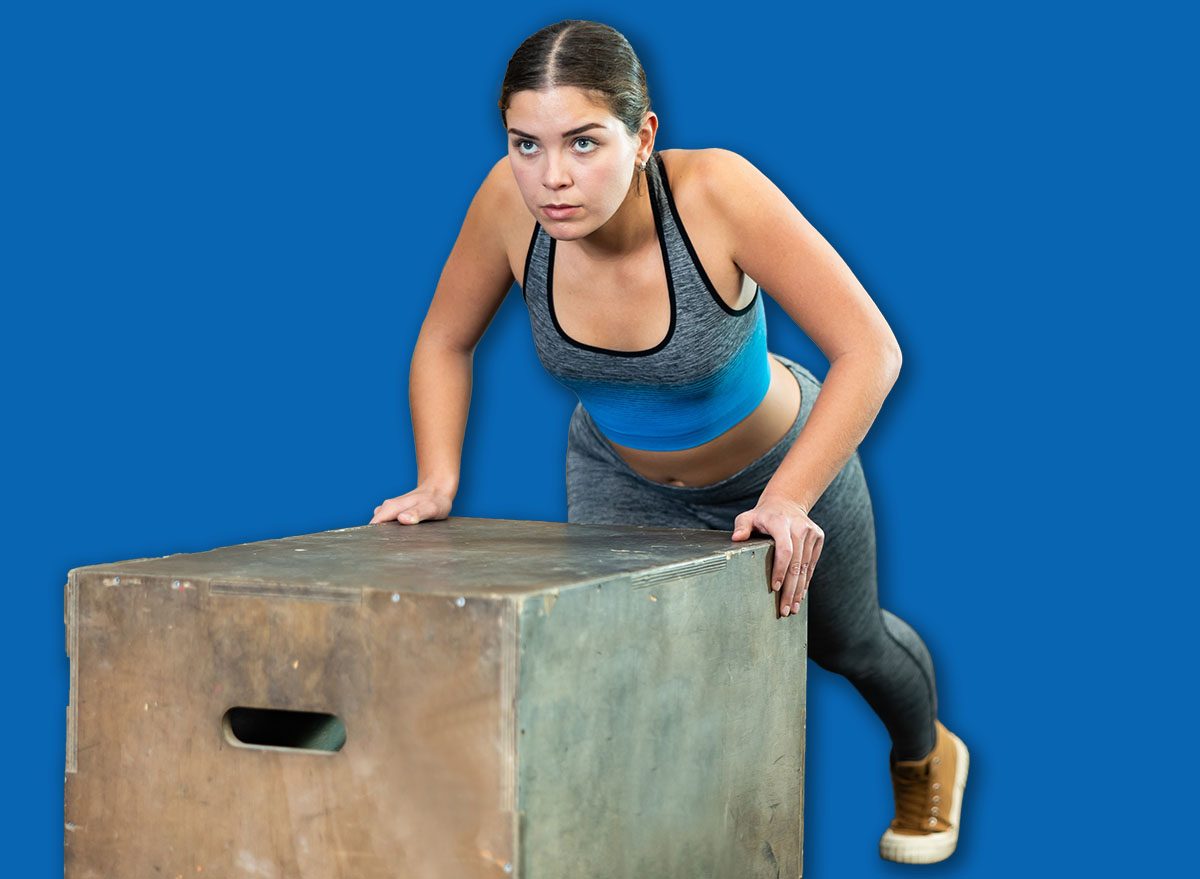
Incline push-ups target the chest, shoulders, triceps, and core while offering a simple way to scale the movement. A higher surface makes the push-up more accessible, while a lower surface adds challenge as your strength improves. Your midsection has to stay firm through the entire rep so your body moves as one unit. Use a sturdy counter, bench, or wall and focus on smooth, controlled reps.
Muscles Trained: Chest, shoulders, triceps, core, glutes.
How to Do It:
- Place your hands on a sturdy, elevated surface slightly wider than shoulder-width.
- Step your feet back until your body forms a straight line.
- Brace your core and squeeze your glutes.
- Lower your chest toward the surface with control.
- Bend your elbows to roughly 90 degrees, or as far as you can move smoothly.
- Press through your palms to return to the starting position.
Recommended Sets and Reps: Perform 3 sets of 8 to 12 reps. Rest for 45 to 60 seconds between sets.
Best Variations: Wall push-ups, counter push-ups, slow-tempo incline push-ups.
Form Tip: Keep your elbows angled slightly back and avoid letting your hips sag as you lower.
Dumbbell Bent-Over Row
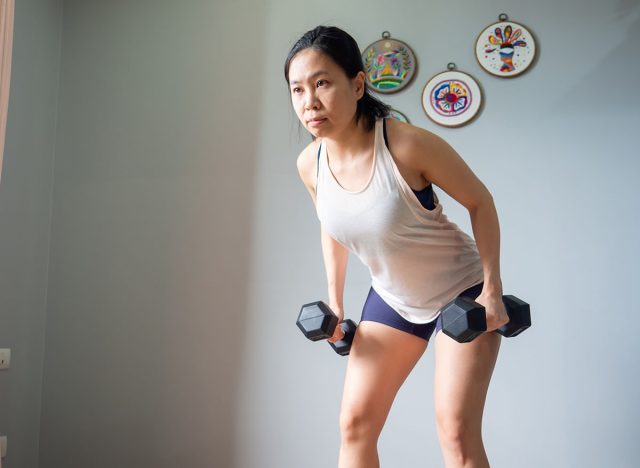
Dumbbell bent-over rows build upper-back strength while giving the biceps, grip, hips, and core plenty of work. The row helps strengthen the muscles that support tall posture, while the hinged position asks your midsection to stay steady under the load. This adds a valuable pulling pattern to balance the pressing work from push-ups and squat-to-press reps. Keep the dumbbells light enough that you can pause at the top without losing your body position.
Muscles Trained: Upper back, lats, rear delts, biceps, core, glutes, forearms.
How to Do It:
- Stand with your feet hip-width apart and hold a dumbbell in each hand.
- Soften your knees and push your hips back.
- Let the dumbbells hang below your shoulders with your spine long.
- Pull your elbows back toward your ribs.
- Pause briefly as your upper back tightens.
- Lower the dumbbells with control and repeat.
Recommended Sets and Reps: Perform 3 sets of 10 to 12 reps. Rest for 45 to 60 seconds between sets.
Best Variations: Supported single-arm rows, split-stance rows, slow-tempo rows.
Form Tip: Keep your torso steady and focus on pulling your elbows back rather than curling the weights.
Suitcase Carry March
Suitcase carry marches make your core work in a very practical way. Holding weight on one side challenges the obliques to keep your torso tall while your hips and standing leg manage each step. The march also engages the hip flexors and calves, which keep the movement active without requiring travel across a large space. Use one dumbbell or kettlebell and switch sides each set.
Muscles Trained: Obliques, deep core, grip, shoulders, glutes, hip flexors, calves.
How to Do It:
- Stand tall with a dumbbell or kettlebell in your right hand.
- Let the weight hang at your side with your shoulder relaxed.
- Brace your core and keep your ribs stacked over your hips.
- Lift your left knee toward hip height with control.
- Lower your foot and continue marching in place.
- Complete the set, then switch the weight to your left hand.
Recommended Sets and Reps: Perform 3 sets of 20 to 30 seconds per side. Rest for 30 to 45 seconds between sets.
Best Variations: Static suitcase holds, farmer carry marches, slow-tempo suitcase marches.
Form Tip: Resist leaning toward or away from the weight as you march.
Medicine Ball Slam Intervals
Medicine ball slam intervals give the routine a strong conditioning finish while still involving your abs, upper back, hips, and legs. Each slam starts with a tall reach, then uses the whole body to drive the ball into the floor. The quick reset keeps your heart rate elevated, and the controlled hinge used to pick up the ball reinforces strong movement through the hips. Use a soft slam ball and reset your position before every rep.
Muscles Trained: Abs, lats, shoulders, upper back, glutes, quadriceps, hamstrings, core.
How to Do It:
- Stand with your feet about shoulder-width apart and hold a soft medicine ball with both hands.
- Brace your core and raise the ball overhead.
- Reach tall while keeping your ribs stacked over your hips.
- Drive the ball straight down toward the floor with force.
- Hinge at your hips and bend your knees to pick up the ball.
- Stand tall, reset, and repeat.
Recommended Sets and Reps: Perform 3 sets of 20 to 30 seconds. Rest for 45 to 60 seconds between sets.
Best Variations: Low-impact ball slams, scoop slams, side slams.
Form Tip: Use your hips and abs to power the slam, then pick up the ball with a controlled hinge.
How to Use These Daily Exercises After 55
This routine works well as a short daily circuit when you manage the effort across the week. Keep the weights moderate, move with control, and let the sessions build consistency.
- Complete one set of each exercise in order: Rest for 60 to 90 seconds after the medicine ball slams, then repeat the circuit.
- Use two to three rounds on strength-focused days: Pick three nonconsecutive days each week for the fuller version of the workout.
- Keep lighter days lighter: Complete one round with a relaxed pace on the other days to stay active and reinforce the movement patterns.
- Progress gradually: Add a few reps, a little time, or a small amount of weight when your current version feels strong and controlled.
- Support the work with daily movement: Walking, active hobbies, protein-rich meals, hydration, and solid sleep all help the training show up more clearly over time.
A firmer midsection develops through the work your whole body does consistently. Keep the circuit purposeful, build the challenge slowly, and let those daily sessions add up.
References
- Irving BA, Davis CK, Brock DW, Weltman JY, Swift D, Barrett EJ, Gaesser GA, Weltman A. Effect of exercise training intensity on abdominal visceral fat and body composition. Med Sci Sports Exerc. 2008 Nov;40(11):1863-72. doi: 10.1249/MSS.0b013e3181801d40. PMID: 18845966; PMCID: PMC2730190.
- Cox CE. Role of Physical Activity for Weight Loss and Weight Maintenance. Diabetes Spectr. 2017 Aug;30(3):157-160. doi: 10.2337/ds17-0013. PMID: 28848307; PMCID: PMC5556592.
- Jagsz S, Sikora M. The Effectiveness of High-Intensity Interval Training vs. Cardio Training for Weight Loss in Patients with Obesity: A Systematic Review. J Clin Med. 2025 Feb 15;14(4):1282. doi: 10.3390/jcm14041282. PMID: 40004812; PMCID: PMC11856721.