5 Standing Exercises That Restore Knee Strength Faster Than Gym Machines After 60

The recipe for knee strength after 60 depends on more than the knee joint itself. Your quads help straighten and control the knee, your glutes and hamstrings support the hips, and your core helps keep your body stacked when you step, squat, hinge, or march. When those areas lose strength, the knees often feel less reliable on stairs, during walks, and during simple transitions like getting in and out of a chair.
Gym machines can help build muscle, but they don’t always train the way your knees work in daily life. A leg extension machine targets the quads, and a leg curl machine hits the hamstrings, but real movement asks your legs to coordinate with your hips, feet, and trunk. That’s why standing exercises can give you a better foundation. You’re training strength, control, and balance together.
I’ve seen this with clients who want stronger knees but don’t feel ready to jump straight into heavy lower-body work. The best starting point usually involves movements that build confidence while teaching the legs to absorb force, control position, and drive through the floor. The five exercises below train your quads, glutes, hamstrings, hips, and core, which gives your knees more support where they need it most.
Low Box Step-Ups
Low box step-ups train your quads, glutes, calves, and core while giving your knee a controlled way to build strength through stepping. The low height keeps the movement approachable, but your lead leg still has to drive the work and control your bodyweight. That makes step-ups more useful than many gym machines because they train the knee in a pattern you use every day. Stronger step-ups carry over to stairs, curbs, uneven ground, and walking with more confidence.
Muscles Trained: Quadriceps, glutes, calves, core
How to Do It:
- Stand facing a low box or sturdy step.
- Place your whole foot on the box.
- Brace your core and keep your chest lifted.
- Press through your lead foot to stand tall on the box.
- Step back down with control.
- Complete all reps, then switch sides.
Recommended Sets and Reps: Perform 3 sets of 8 to 10 reps per leg. Rest for 45 seconds between each set.
Best Variations: Assisted step-ups, slower step-downs, slightly higher step-ups
Form Tip: Drive through your whole foot and keep your knee tracking over your toes.
Extended Leg Glute Bridge
Extended leg glute bridges train your glutes and hamstrings while supporting better hip control around the knees. Extending the legs farther from your body increases hamstring demand, helping balance the front-of-thigh work from squats and step-ups. Stronger glutes and hamstrings help keep the knees from taking on every bit of lower-body stress. This move also builds the backside strength you need for walking, climbing stairs, and standing with better control.
Muscles Trained: Glutes, hamstrings, core
How to Do It:
- Lie on your back with your knees bent and feet flat on the floor.
- Walk your feet farther away from your hips.
- Brace your core and press through your heels.
- Lift your hips until your body forms a straight line from shoulders to knees.
- Squeeze your glutes at the top.
- Lower your hips with control.
Recommended Sets and Reps: Perform 3 sets of 10 to 12 reps. Rest for 45 seconds between each set.
Best Variations: Standard glute bridges, paused glute bridges, single-leg bridge holds
Form Tip: Press through your heels and stop if your lower back takes over.
Dumbbell RDL
Dumbbell RDLs train your hamstrings, glutes, and core while teaching your hips to handle more of the workload. A stronger hinge can take pressure off the knees because your hips and hamstrings learn to contribute, rather than letting every lower-body movement become knee-dominant. As you lower the weights, your hamstrings control the motion and your core keeps your back flat. That carries over to bending, lifting, walking uphill, and moving with stronger support around the knees.
Muscles Trained: Hamstrings, glutes, lower back, core
How to Do It:
- Stand with your feet hip-width apart and hold dumbbells in front of your thighs.
- Brace your core and soften your knees.
- Push your hips back as the dumbbells travel down your legs.
- Lower until you feel a stretch through your hamstrings.
- Drive your hips forward to return to standing.
- Squeeze your glutes at the top.
Recommended Sets and Reps: Perform 3 sets of 8 to 12 reps. Rest for 60 seconds between each set.
Best Variations: Staggered-stance RDL, bodyweight good morning, tempo RDL
Form Tip: Keep the dumbbells close to your legs and move through your hips.
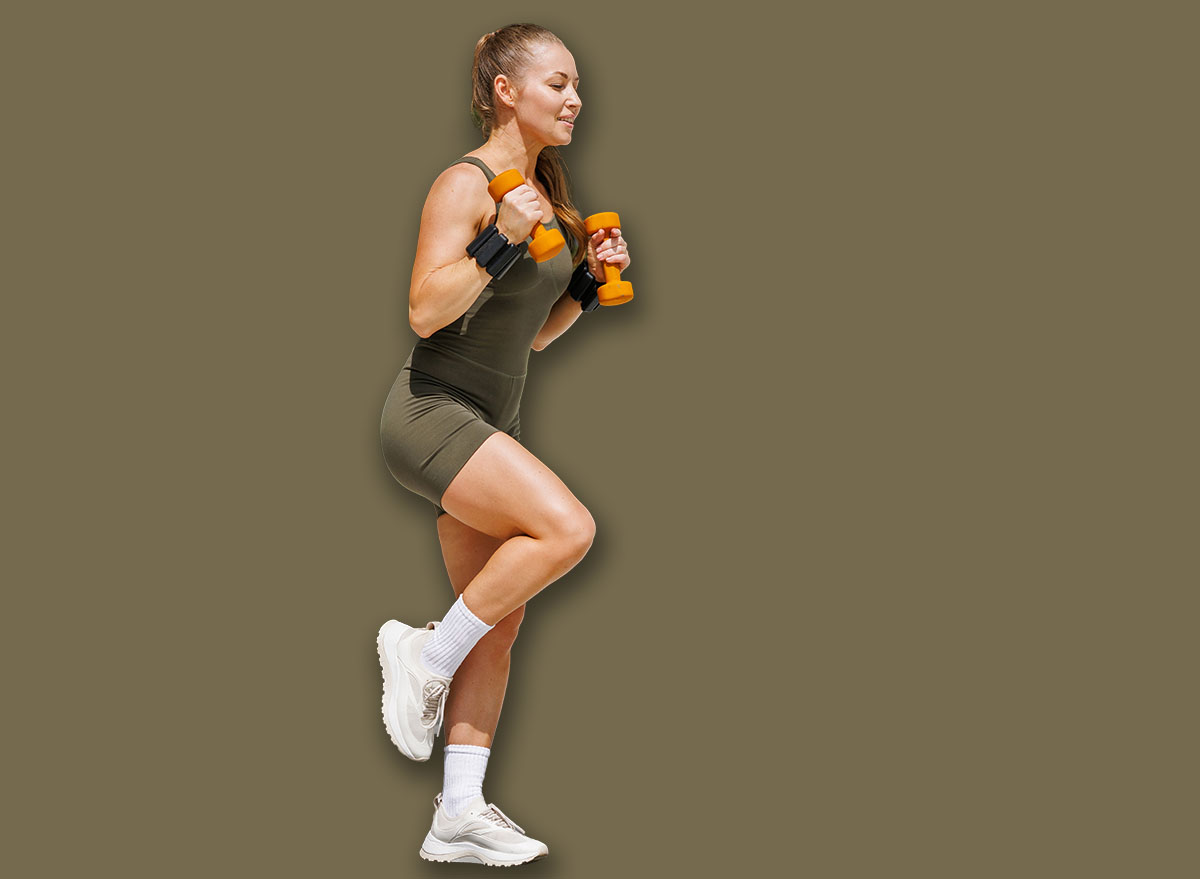
Dumbbell Marching
Dumbbell marching trains your hip flexors, quads, calves, and core while building single-leg control. Each knee lift forces the standing leg to stabilize, which gives the knee more practice holding a position under load. This helps restore knee strength because the joint must remain steady while the rest of the body moves. It also carries over to walking up stairs, stepping over objects, and maintaining balance during daily movement.
Muscles Trained: Hip flexors, quadriceps, calves, glutes, core
How to Do It:
- Stand tall with a dumbbell in each hand or one dumbbell held at your chest.
- Brace your core and keep your shoulders relaxed.
- Shift your weight onto one foot.
- Lift your opposite knee toward your chest.
- Lower your foot back to the floor with control.
- Alternate sides in a steady rhythm.
Recommended Sets and Reps: Perform 3 sets of 10 to 12 reps per leg. Rest for 45 seconds between each set.
Best Variations: Bodyweight marching, suitcase marching, slower marching
Form Tip: Stay tall and avoid leaning back as your knee lifts.
Goblet Box Squats
Goblet box squats train your quads, glutes, hamstrings, and core while giving your knees a clear, controlled squat pattern. The box sets the depth, which can help you move with more confidence and avoid dropping lower than your body can control. Holding the weight at your chest also encourages a taller torso and better bracing. Compared with gym machines, goblet box squats build knee strength in a pattern that carries over directly to sitting, standing, and climbing stairs.
Muscles Trained: Quadriceps, glutes, hamstrings, core
How to Do It:
- Stand in front of a box or sturdy chair with your feet shoulder-width apart.
- Hold a dumbbell or kettlebell at your chest.
- Brace your core and keep your chest lifted.
- Lower your hips toward the box with control.
- Lightly tap the box without relaxing.
- Drive through your feet to return to standing.
Recommended Sets and Reps: Perform 3 sets of 8 to 12 reps. Rest for 60 seconds between each set.
Best Variations: Bodyweight box squats, pause box squats, slower tempo box squats
Form Tip: Keep your knees tracking with your toes and avoid collapsing onto the box.
How to Build Stronger Knees After 60

Stronger knees come from better support above and below the joint. Your hips, quads, hamstrings, calves, and core all play a role in how the knees feel when you move. These exercises give your legs more practice controlling real positions rather than just pushing against a machine path. Keep the load manageable, focus on smooth reps, and let strength build through better movement.
- Start with a range you can control: Use a low box for step-ups and a comfortable box height for squats. Clean movement builds confidence and helps your knees tolerate more work over time.
- Train both the front and back of your legs: Step-ups and box squats build quad strength, while bridges and RDLs strengthen the glutes and hamstrings. Balanced strength gives the knees more support.
- Slow down the lowering phase: Step down, hinge, and squat with control. Slower lowering teaches your legs to absorb force, which matters for stairs, curbs, and everyday movement.
- Use support when needed: A wall, rail, or chair can help you stay steady while you build strength. Light support keeps the focus on control instead of wobbling through reps.
- Progress in small steps: Add a few reps, use a slightly heavier dumbbell, raise the step height, or slow the tempo. Small changes keep your knees improving without turning the workout into a grind.
Think of knee strength as a team effort. Train the muscles around the joint, keep your reps clean, and give your legs consistent practice in the positions you use every day.
References
- Küçük, Hamza et al. “Strength training intervention for adult individuals with knee osteoarthritis: Establishing fidelity.” Frontiers in physiology vol. 16 1583153. 18 Jun. 2025, doi:10.3389/fphys.2025.1583153
- Sadeghi, Alireza et al. “Effectiveness of muscle strengthening exercises on the clinical outcomes of patients with knee osteoarthritis: A randomized four-arm controlled trial.” Caspian journal of internal medicine vol. 14,3 (2023): 433-442. doi:10.22088/cjim.14.3.433