5 Standing Exercises That Regain Muscle Mass Better Than Gym Machines After 50

Regaining muscle mass after 50 takes more than sitting down at a machine and knocking out a few isolated reps. Your body needs exercises that challenge larger muscle groups, generate enough tension to drive adaptation, and train the patterns you actually use outside the gym. Squatting, hinging, rowing, pressing, and resisting rotation all give your muscles a stronger reason to respond.
Standing exercises do a great job here because they engage your whole body. Your legs have to drive force into the ground, your core has to brace, and your upper body has to control the weight without a machine locking everything into place. That extra demand is exactly what makes these moves so useful for rebuilding muscle while also improving balance, coordination, and confidence.
I’ve seen plenty of clients make better progress when they move away from machine-only training and start using exercises that ask more from the body. Machines can absolutely help, especially for targeted work, but standing strength exercises usually offer more carryover. They teach your muscles to work together, and after 50, that matters for everything from lifting bags to climbing stairs to staying strong through the hips, back, and shoulders.
The five exercises below cover the biggest muscle-building patterns: squat, hinge, pull, press, and brace. Goblet squats and dumbbell RDLs train your lower body. Barbell bent-over rows build your back and arms. Single-arm dumbbell presses strengthen your shoulders while your core fights to stay steady. Band Pallof presses round it out by training the midsection to resist rotation and support everything else.
Goblet Squats
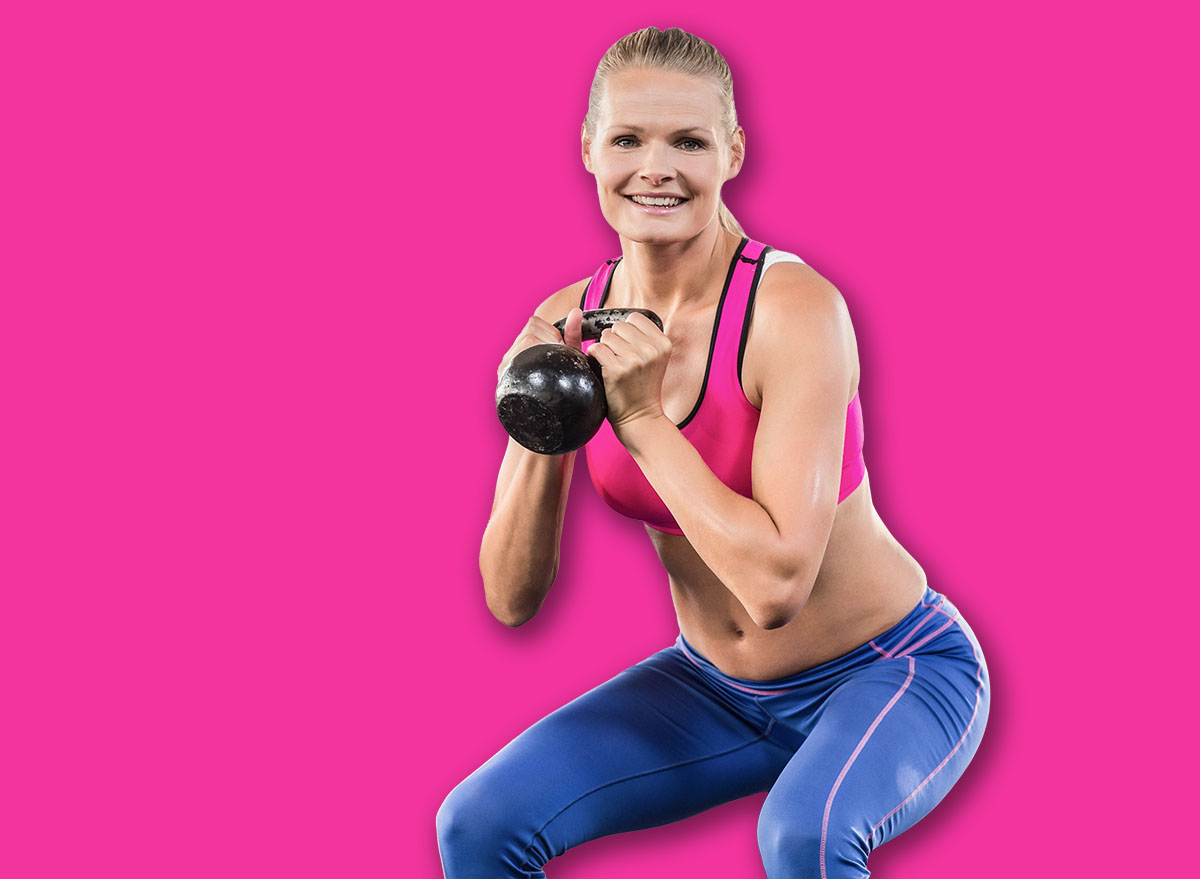
Goblet squats train your quads, glutes, hamstrings, and core while forcing your torso to stay upright under load. Holding the weight at your chest makes your midsection brace harder, and your legs have to work through a deeper, more useful range rather than pushing along a fixed machine path. That makes goblet squats a strong muscle-building move after 50 because you’re training lower-body strength, posture, and control simultaneously. Stronger squats carry over to standing up from chairs, climbing stairs, lifting from low positions, and keeping your legs powerful for daily life.
Muscles Trained: Quadriceps, glutes, hamstrings, core
How to Do It:
- Stand with your feet about shoulder-width apart.
- Hold a dumbbell or kettlebell at your chest.
- Brace your core and keep your chest lifted.
- Lower into a squat by bending your hips and knees.
- Drive through your feet to return to standing.
- Squeeze your glutes at the top.
Recommended Sets and Reps: Perform 3 to 4 sets of 8 to 12 reps. Rest for 60 seconds between each set.
Best Variations: Pause goblet squats, tempo goblet squats, heel-elevated goblet squats
Form Tip: Keep the weight close to your chest and drive your knees in line with your toes.
Dumbbell RDL
Dumbbell RDLs train your hamstrings, glutes, lower back, and core while teaching your hips to handle the work. As the dumbbells lower, your hamstrings lengthen under tension, which creates a strong muscle-building stimulus through the back of your legs. Gym machines can isolate the hamstrings, but RDLs also train your hinge pattern, your posture, and your ability to control load while standing. Better hinge strength helps with lifting, bending, walking uphill, and keeping your lower back from taking over when your hips should be doing the job.
Muscles Trained: Hamstrings, glutes, lower back, core
How to Do It:
- Stand with your feet hip-width apart and hold dumbbells in front of your thighs.
- Brace your core and soften your knees.
- Push your hips back as the dumbbells travel down your legs.
- Lower until you feel a stretch through your hamstrings.
- Drive your hips forward to return to standing.
- Finish tall without leaning back.
Recommended Sets and Reps: Perform 3 to 4 sets of 8 to 12 reps. Rest for 60 seconds between each set.
Best Variations: Staggered-stance RDL, single-leg RDL, tempo RDL
Form Tip: Keep the dumbbells close to your legs and move through your hips.
Barbell Bent-Over Row
Barbell bent-over rows train your upper back, lats, rear delts, biceps, and core while your hips hold a strong hinge position. Pulling the bar toward your torso builds muscle in the back and arms, but the standing setup also engages your trunk to keep your spine steady. Machine rows can help build pulling strength, but barbell rows demand more total-body tension. That matters after 50 because a stronger back supports posture, shoulder health, grip strength, and the pulling power you use when carrying, lifting, or moving things around the house.
Muscles Trained: Upper back, lats, rear delts, biceps, core
How to Do It:
- Stand with your feet hip-width apart and hold a barbell in front of your thighs.
- Brace your core and hinge at your hips.
- Keep your back flat and let the bar hang below your shoulders.
- Pull the bar toward your lower ribs.
- Squeeze your shoulder blades briefly.
- Lower the bar with control.
Recommended Sets and Reps: Perform 3 to 4 sets of 8 to 10 reps. Rest for 60 to 90 seconds between each set.
Best Variations: Underhand barbell rows, paused rows, dumbbell bent-over rows
Form Tip: Pull your elbows back and keep your torso still.
Standing Single-Arm Shoulder Press
Standing single-arm shoulder presses train your shoulders and triceps while your core works to keep your body from leaning. Pressing one dumbbell overhead creates an uneven load, so your midsection has to brace from your ribs through your hips. That uneven loading gives the exercise greater value than many seated machine presses, as your shoulder strength and core stability develop together. Stronger overhead pressing carries over to reaching, lifting items onto shelves, carrying weight, and keeping your upper body strong without depending on machine support.
Muscles Trained: Shoulders, triceps, upper back, core
How to Do It:
- Stand tall with your feet hip-width apart.
- Hold one dumbbell at shoulder height.
- Brace your core and squeeze your glutes.
- Press the dumbbell overhead until your arm is straight.
- Lower the dumbbell back to shoulder height with control.
- Complete all reps, then switch sides.
Recommended Sets and Reps: Perform 3 sets of 8 to 10 reps per side. Rest for 60 seconds between each set.
Best Variations: Neutral-grip press, alternating dumbbell press, half-kneeling press
Form Tip: Keep your ribs down and avoid leaning away from the dumbbell.
Band Pallof Press
Band Pallof presses train your core to resist rotation while your arms move away from your body. The band tries to pull your torso sideways, and your midsection has to fight to stay square. That makes the Pallof press a smart addition to a muscle-building routine because a stronger core gives your squats, rows, presses, and hinges a better base to work from. After 50, that stability also carries into walking, lifting, reaching, and staying steady when your body gets pulled off-center.
Muscles Trained: Core, obliques, shoulders, glutes
How to Do It:
- Anchor a resistance band at chest height.
- Stand sideways to the anchor point with your feet shoulder-width apart.
- Hold the band at your chest with both hands.
- Brace your core and keep your torso square.
- Press your hands straight forward without rotating.
- Bring your hands back to your chest with control.
Recommended Sets and Reps: Perform 3 sets of 10 to 12 reps per side. Rest for 30 to 45 seconds between each set.
Best Variations: Pallof press hold, overhead Pallof press, split-stance Pallof press
Form Tip: Keep your ribs down and resist the band pulling you sideways.
What Helps Standing Strength Work Build More Muscle

Standing strength exercises give you a strong return when the effort matches the goal. Pick loads that make the last few reps challenging, keep your form clean, and train these movements with enough consistency to let your body adapt. The goal isn’t to rush through a circuit. The goal is to create tension, control the weight, and make the right muscles do the work.
- Prioritize compound moves first: Squats, RDLs, rows, and presses use more muscle than most machine-based isolation exercises. Start with them while your energy is highest.
- Use muscle-building rep ranges: Most of these exercises work well for 3 to 4 sets of 8 to 12 reps. The final reps should feel challenging without forcing your form to fall apart.
- Control the lowering phase: Lower the weight slowly during squats, RDLs, rows, and presses to keep your muscles under tension longer. More control usually means better stimulus.
- Keep your core active: Standing lifts demand a strong brace. Set your ribs, tighten your midsection, and keep your posture steady before each rep.
- Progress in small steps: Add a little weight, one or two reps, a stronger band, or a brief pause when the exercise starts to feel too easy. Small jumps help you keep building without beating up your joints.
Standing exercises train muscles in a way that feels useful beyond the workout. Build strength through these five patterns, give your body consistent practice, and the muscles you regain will help you move better in the places that matter most.
References
- Strasser, Barbara et al. “Role of Dietary Protein and Muscular Fitness on Longevity and Aging.” Aging and disease vol. 9,1 119-132. 1 Feb. 2018, doi:10.14336/AD.2017.0202
- Brogno, Brian. “Aging With Strength: Functional Training to Support Independence and Quality of Life.” Inquiry : a journal of medical care organization, provision and financing vol. 62 (2025): 469580251348133. doi:10.1177/00469580251348133