5 Standing Exercises That Restore Chest Strength Faster Than Bench Press After 50

The bench press has long been considered the gold standard for chest strength. Walk into almost any gym, and it’s one of the first exercises you’ll see people doing. But after 50, chasing heavier bench press numbers isn’t the smartest or safest approach to maintaining upper body strength.
As you age, your joint health, shoulder mobility, and posture become more crucial than ever. Heavy barbell pressing can place a ton of stress on your shoulders, elbows, and wrists, especially if your mobility has declined or previous injuries are present. That’s why lifting heavy barbell presses is not the best idea after 50.
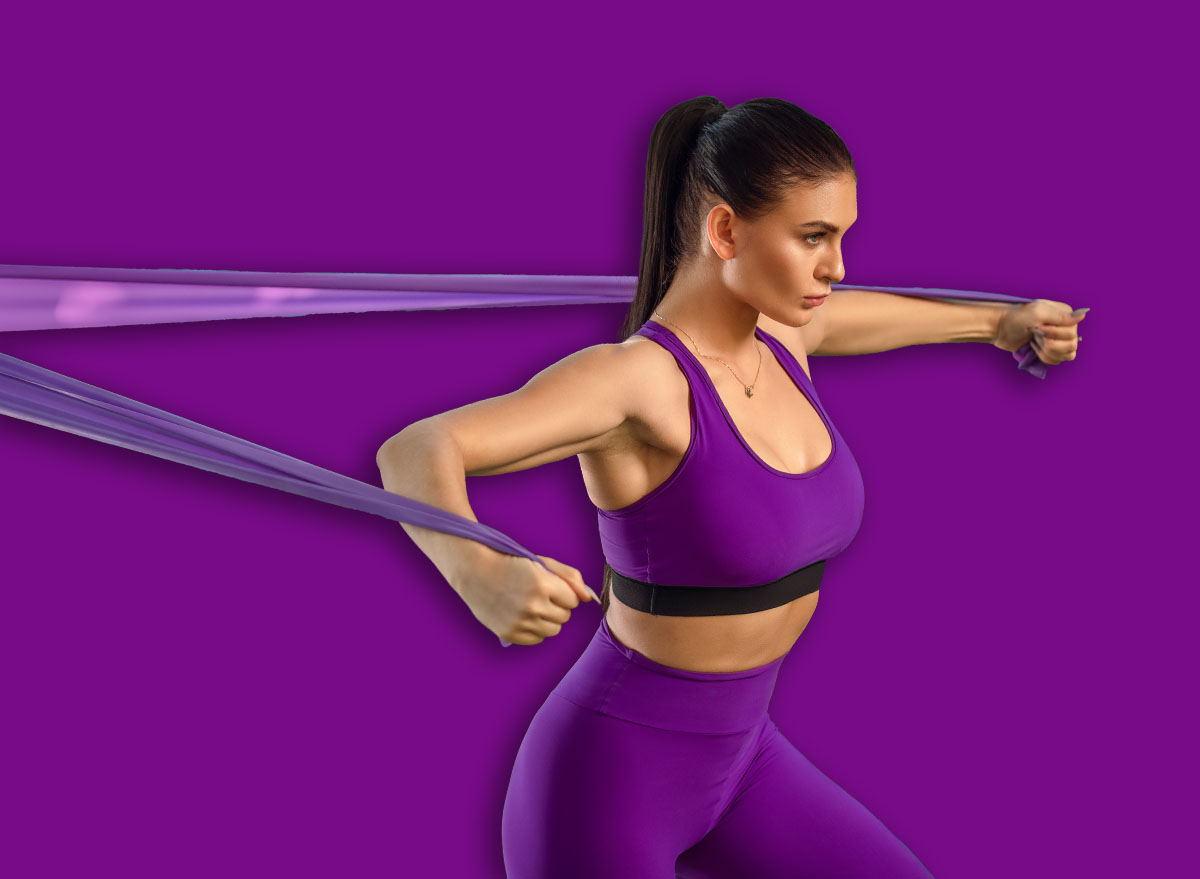
According to research, a smarter approach is to do functional resistance exercises using bodyweight or elastic resistance, which can effectively boost muscular strength and movement quality in older adults while reducing joint strain.
Standing exercises also offer additional benefits that traditional bench pressing can’t provide. Since you’re upright during standing exercises, your core and stabilizing muscles are forced to work continuously to maintain proper posture and alignment. This creates a more integrated, full-body strength that translates directly to everyday pushing, carrying, and lifting movements.
To find out which standing exercises are best for restoring chest strength faster than bench press after 50, we chatted with James Brady, CPT, a certified personal trainer at OriGym. Read on for the exercises and detailed step-by-step instructions. Then, when you’re done, check out these 6 Bodyweight Exercises That Shrink Muffin Top Faster Than Crunches After 60.
Wall Push-ups
Wall push-ups position your body at an incline, which reduces stress on your shoulders and wrists while engaging your chest, shoulders, and triceps. “Wall push-ups are one of the safest and most effective ways to rebuild chest strength after 50,” says Brady.
How to do it:
- Stand facing a wall with your feet about one step away.
- Place your hands on the wall slightly wider than shoulder-width apart.
- Keep your body in a straight line from head to toe.
- Engage your core and keep your chest lifted.
- Bend your elbows to lower your chest toward the wall.
- Pause for one to two seconds when your chest is close to the wall.
- Push through your palms to return to the starting position.
- Perform two to three sets of 12 to 15 reps and rest for 45 to 60 seconds between sets.
Standing Chest Press With Resistance Band
Resistance bands create continuous tension, forcing your chest muscles to stay engaged during both the pressing and return phases of the movement. This can increase muscle activation without needing heavy loads. “Resistance bands create constant tension on the chest muscles without placing excessive strain on the shoulders,” Brady explains.
How to do it:
- Anchor a resistance band securely behind you at chest height.
- Hold the handles with your palms facing downward or inward.
- Stand tall with one foot slightly in front of the other.
- Position your hands at chest level with your elbows bent.
- Flex your core and keep your posture upright.
- Press your arms forward until fully extended.
- Pause for one to two seconds at the end of the movement.
- Complete two to three sets of 10 to 15 reps. Rest for 45 to 60 seconds between sets.
Standing Chest Fly
“Standing chest flies strengthen the chest while also improving shoulder mobility and posture,” Brady says. Because the movement occurs through a wide range of motion, it helps increase chest muscle activation and boost shoulder stability.
How to do it:
- Stand with your feet shoulder-width apart while holding light dumbbells at your sides
- Keep your chest lifted and your shoulders relaxed.
- Extend your arms out to the sides with a slight bend in your elbows.
- Engage your core to stabilize your torso.
- Bring your hands together in front of your chest in a wide arc.
- Pause for one to two seconds when your hands meet.
- Slowly return your arms to the starting position and avoid shrugging your shoulders during the movement.
- Aim for two to three sets of 10 to 12 reps, resting for 45 to 60 seconds between sets.
Incline Push-ups
“Incline push ups train the chest through a natural movement pattern while reducing pressure on the joints,” Brady explains.. The higher the incline, the easier the movement becomes.
How to do it:
- Place your hands on a sturdy countertop, bench, or table.
- Step your feet back until your body forms a straight line.
- Position your hands slightly wider than shoulder-width apart.
- Brace your core and glutes.
- Bend your elbows to lower your chest toward the surface.
- Keep your elbows angled slightly downward rather than flared outward.
- Pause for one to two seconds at the bottom of the movement.
- Perform two to three sets of 8 to 12 reps. Rest for 45 to 60 seconds between sets.
Standing Punch Presses
Standing punch presses involve alternating your arms rapidly, forcing your core to stabilize your torso throughout the entire movement. “Standing punch presses combine chest activation with core engagement and light cardio,” says Brady.
How to do it:
- Stand tall holding light dumbbells at chest height.
- Position your feet hip-width apart with your knees slightly bent.
- Flex your core and keep your shoulders relaxed.
- Press one arm forward in a controlled punching motion.
- Rotate slightly through your shoulder without twisting your torso too much.
- Return your arm back to chest height and repeat with the opposite arm.
- Complete two to three sets of 20 total punches, resting for 45 to 60 seconds between sets.