4 Strength Tests Every Man Over 50 Should Be Able to Pass

Turning 50 doesn’t mean your strongest years belong in the past. In fact, I’ve worked with plenty of men in their 50s, 60s, and even 70s who outperform people decades younger because they’ve continued building functional strength. The key isn’t chasing one-rep maxes or spending hours in the weight room. It’s maintaining the strength, endurance, and stability needed to handle everyday life with confidence.
When I assess a client’s fitness, I rarely start with heavy weights. Instead, I use simple movement tests that reveal how well the body works as a complete system. Strong legs, a stable core, balanced upper-body strength, and solid muscular endurance matter far more than how much someone can bench press once. These assessments closely mirror the movements you’ll rely on every day, making them excellent indicators of healthy aging.
I’ve used these four strength tests with hundreds of men over 50, and they consistently identify both strengths and weaknesses. Don’t worry if one challenge feels tougher than another. Think of these tests as a snapshot of your current fitness, not a final grade. If you pass all four with good form, you’ve built a foundation of strength that puts you well ahead of the average man your age.
Sit-to-Stand Test
Lower-body strength serves as the foundation for nearly every movement you perform, making this one of the most valuable assessments available. Standing up repeatedly without using your hands challenges the quadriceps, glutes, hamstrings, and core while measuring muscular endurance at the same time. Men who perform well on this test typically walk faster, climb stairs more comfortably, and maintain greater independence as they age. It’s one of the simplest yet most revealing measures of functional strength.
How to Perform It
- Sit near the front of a sturdy chair.
- Cross your arms over your chest.
- Stand completely.
- Sit back down with control.
- Continue for 30 seconds.
- Count your total repetitions.
Push-Up Test
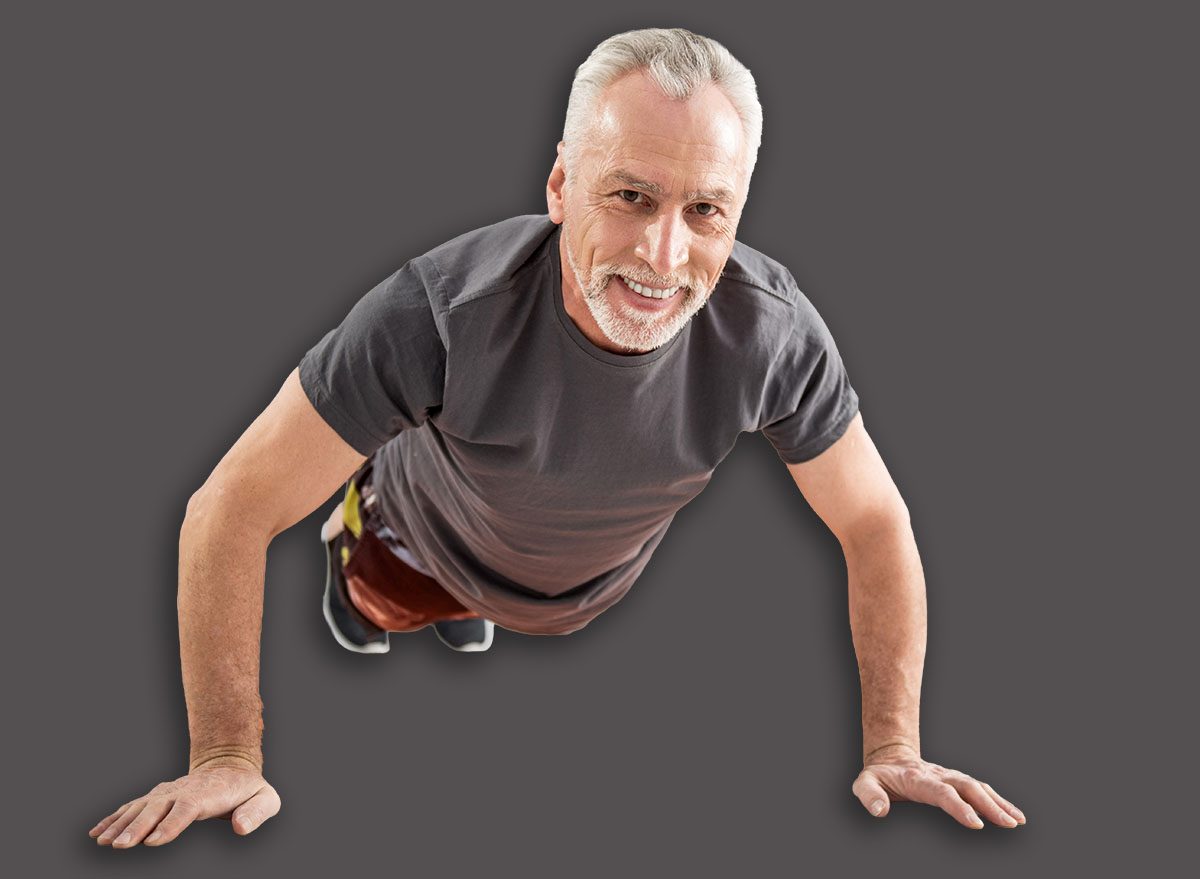
Pushing strength remains essential for everything from moving furniture to getting yourself off the floor. Push-ups assess the chest, shoulders, triceps, and core while also revealing muscular endurance and body control. I always remind clients that proper technique matters far more than racing through sloppy repetitions. If standard push-ups prove too difficult, performing them from an elevated surface still provides valuable insight into current strength levels.
How to Perform It
- Begin in a push-up position or with your hands on an elevated surface.
- Keep your body in a straight line.
- Lower until your elbows reach about 90 degrees.
- Push back to full arm extension.
- Continue without sacrificing form.
- Count your total repetitions.
Farmer’s Carry
Real-world strength rarely involves lifting something once and putting it back down. More often, it means carrying groceries, luggage, tools, or boxes while maintaining good posture. That’s exactly why I include the farmer’s carry in nearly every assessment. It challenges your grip, shoulders, core, hips, and legs simultaneously while revealing how well your body stabilizes under load. Men who perform this test confidently usually excel during everyday physical tasks.
How to Perform It
- Hold a heavy dumbbell or kettlebell in each hand.
- Stand tall.
- Tighten your core.
- Walk at a steady pace.
- Maintain upright posture.
- Continue until the time expires.
Single-Leg Sit-to-Stand
I like ending with a challenge that combines strength, balance, coordination, and control. Standing from a chair using primarily one leg requires tremendous hip, quadriceps, and core strength while exposing differences between the left and right sides of the body. Many men discover this assessment challenges them more than traditional strength exercises because it removes the ability to compensate with the stronger leg. Completing it successfully shows impressive functional fitness that carries over into countless daily activities.
How to Perform It
- Sit on a sturdy chair.
- Extend one leg slightly in front of you.
- Lean forward.
- Stand using the supporting leg as much as possible.
- Sit back down under control.
- Perform five repetitions on each leg.