5 Morning Exercises That Build Thigh Strength Faster Than Gym Machines After 60
Thigh strength has a way of showing up before the day is fully underway. When your legs feel capable, getting moving feels more rhythmic. You feel more prepared for whatever the morning brings, and that feeling tends to carry forward once you’re out the door.
Gym machines can load the thighs well, but home training gives the legs a different kind of job. Your body has to manage its own position as you lower, rise, shift weight, and push through the floor. That makes the work useful for building strength that carries into everyday movement.
One of the first things I watch during a client’s lower-body work is where the effort starts to fade. A heel may get light, a knee may drift, or the hips may stop contributing near the bottom of the rep. Simple movements with a band, a low step, or bodyweight make those details easy to spot and improve. Once the position stays solid, a few more reps or a little more resistance can create the next level of progress.
This morning routine gives your thighs focused work without requiring a long setup. Move through the exercises with control, stay patient with the progression, and let the quality of each rep build stronger legs over time.
Walking Lunges
Walking lunges train the thighs in ways that carry over directly into walking, climbing stairs, and getting up from the floor. Each step gives the front leg a chance to absorb your body weight, then drive you forward with strength. Your glutes and core help keep the movement organized, making this a strong full-leg exercise to open the routine. Start with shorter steps and use a wall or countertop for light support until the movement feels steady.
Muscles Trained: Quadriceps, glutes, hamstrings, calves, core.
How to Do It:
- Stand tall with your feet hip-width apart.
- Step forward with one foot and lower into a controlled lunge.
- Keep your front heel planted and your knee tracking with your toes.
- Press through your front foot to stand.
- Step forward with the opposite leg and repeat.
- Continue alternating sides for the full set.
Recommended Sets and Reps: Perform 3 sets of 6 to 8 reps per side. Rest for 45 to 60 seconds between sets.
Best Variations: Supported walking lunges, reverse lunges, slow-tempo walking lunges.
Form Tip: Use a shorter stride until you can stay balanced and keep your front knee moving smoothly.
Mini-Band Lateral Walk
Mini-band lateral walks strengthen the outer hips and thighs, which help keep your knees and pelvis steady when you walk, turn, or step sideways. The band adds constant tension, so your legs have to stay active even during the smaller steps. This makes it a useful complement to forward-and-back movements like lunges and step-ups. Keep the steps small enough that you can maintain tension without rocking your torso.
Muscles Trained: Glute medius, outer hips, quadriceps, glutes, core.
How to Do It:
- Place a light mini band above your knees or around your ankles.
- Stand with your feet hip-width apart.
- Bend your knees slightly and brace your core.
- Step one foot out to the side.
- Bring your other foot in without letting the band go slack.
- Continue for the full set, then repeat in the other direction.
Recommended Sets and Reps: Perform 3 sets of 8 to 12 steps per direction. Rest for 30 to 45 seconds between sets.
Best Variations: Bodyweight lateral steps, ankle-band walks, slow-tempo band walks.
Form Tip: Keep your toes facing forward and hold a slight bend in your knees throughout the set.
Glute Bridge
Glute bridges strengthen the hips and hamstrings that work alongside your thighs every time you stand, climb, or walk uphill. The movement also gives your lower body a chance to generate force without placing a heavy demand on balance first thing in the morning. A strong bridge helps your legs feel more connected from the hips through the knees. Pause at the top of each rep and make the glutes do the work.
Muscles Trained: Glutes, hamstrings, quadriceps, core.
How to Do It:
- Lie on your back with your knees bent and feet flat on the floor.
- Set your feet about hip-width apart.
- Brace your core and press through your whole feet.
- Lift your hips until your body forms a straight line from shoulders to knees.
- Pause briefly and squeeze your glutes.
- Lower your hips with control and repeat.
Recommended Sets and Reps: Perform 3 sets of 10 to 15 reps. Rest for 45 seconds between sets.
Best Variations: Bridge holds, single-leg-assisted bridges, slow-tempo glute bridges.
Form Tip: Keep your ribs down as you lift so the movement comes from your hips.
Low Step-Up
Low step-ups build thigh strength through a pattern that shows up every time you take the stairs or step onto a curb. The leg on the step has to create the lift, while the hips and core help you stay steady as you come up. A low platform gives you plenty of room to focus on good knee position and smooth control. Use the bottom stair or another stable surface, never a chair.
Muscles Trained: Quadriceps, glutes, hamstrings, calves, core.
How to Do It:
- Stand facing a low, sturdy step or bottom stair.
- Place your whole right foot on the step.
- Brace your core and keep your chest tall.
- Press through your right foot to stand on the step.
- Step back down with control.
- Complete all reps, then switch sides.
Recommended Sets and Reps: Perform 3 sets of 8 to 10 reps per side. Rest for 45 to 60 seconds between sets.
Best Variations: Assisted low step-ups, low step-downs, slow-tempo step-ups.
Form Tip: Let the leg on the step create the lift and use the trailing foot only for light balance support.
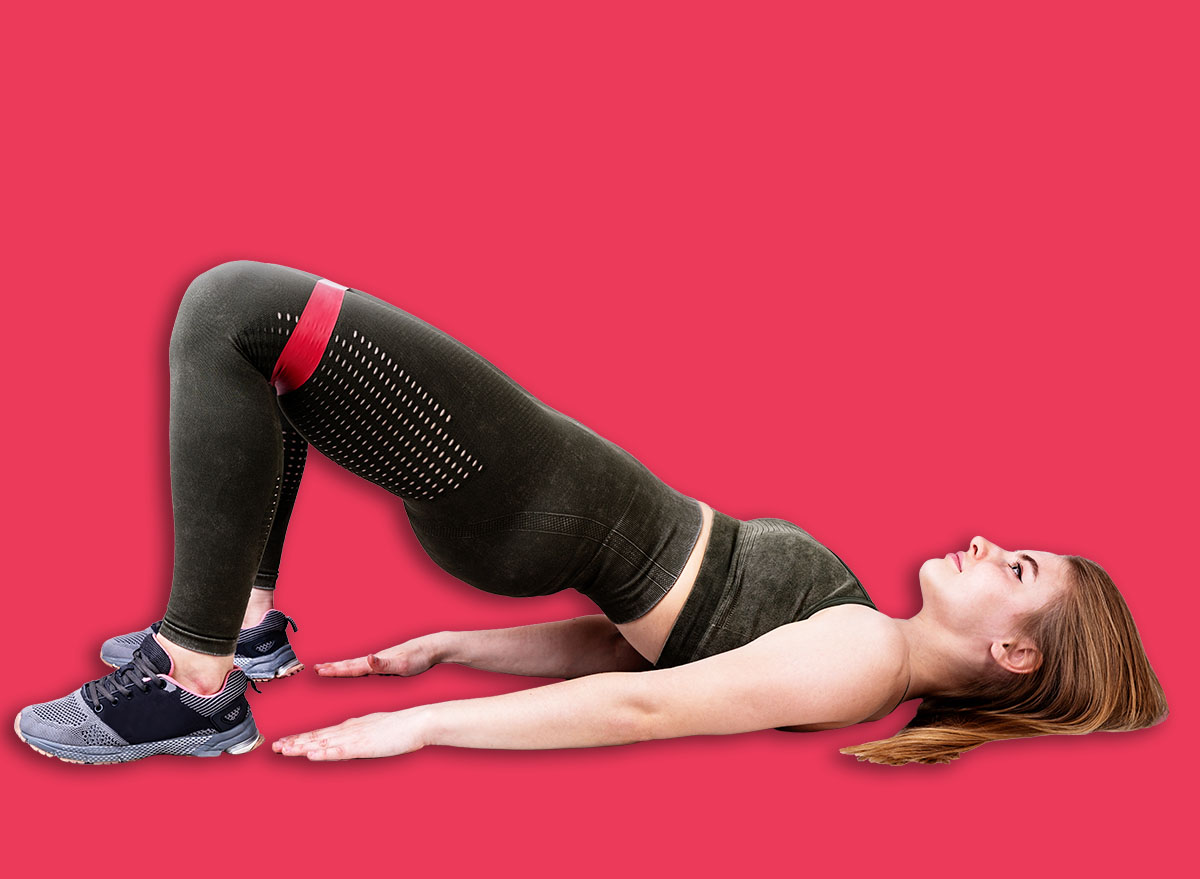
Mini-Band Glute Bridge
The mini-band glute bridge adds extra work for the outer hips and thighs while you build strength through the glutes and hamstrings. Applying gentle pressure against the band prompts your legs to maintain a strong position from start to finish. That added hip control supports cleaner knee alignment during walking lunges, step-ups, and everyday movement. Use a light band at first to keep the bridge smooth and steady.
Muscles Trained: Glutes, hamstrings, outer hips, quadriceps, core.
How to Do It:
- Place a light mini band above your knees.
- Lie on your back with your knees bent and feet flat on the floor.
- Set your feet hip-width apart and press lightly out against the band.
- Brace your core and press through your feet.
- Lift your hips into a bridge while keeping tension on the band.
- Lower with control and repeat.
Recommended Sets and Reps: Perform 3 sets of 10 to 12 reps. Rest for 45 seconds between sets.
Best Variations: Banded bridge holds, banded bridge pulses, slow-tempo mini-band glute bridges.
Form Tip: Keep steady tension on the band without forcing your knees excessively wide.
How to Use This Morning Thigh-Strength Routine After 60
Use these exercises two to three mornings per week. Complete one set of each move in order, rest for 60 to 90 seconds after the final exercise, then repeat for two to three total rounds.
- Start with steady reps: Your first week should feel controlled from beginning to end.
- Add difficulty gradually: Build by adding a few reps, using a slightly stronger band, or reducing the support you use during lunges and step-ups.
- Keep the step height low: A lower step gives your thighs plenty of work while making it easier to maintain good control.
- Walk after the session when you can: A comfortable 10 to 15-minute walk gives your legs a chance to use the strength you just trained.
- Let soreness guide your schedule: Mild muscle fatigue is normal. Give your legs an extra day between sessions when they still feel heavily worked.
A short morning strength session can create a useful rhythm for your legs. Keep the movements clean, progress patiently, and your thighs can build the strength that makes the rest of your day feel more capable.
References
- Steves, Claire J et al. “Kicking Back Cognitive Ageing: Leg Power Predicts Cognitive Ageing after Ten Years in Older Female Twins.” Gerontology vol. 62,2 (2016): 138-49. doi:10.1159/000441029
- Schumacher LM, Thomas JG, Raynor HA, Rhodes RE, Bond DS. Consistent Morning Exercise May Be Beneficial for Individuals With Obesity. Exerc Sport Sci Rev. 2020 Oct;48(4):201-208. doi: 10.1249/JES.0000000000000226. PMID: 32658039; PMCID: PMC7492403.
- Zolfaghari S, Hafid A, Abdullah S, Kristoffersson A, Folke M. Evaluating muscle aging during relaxed standing, squats and lunges through electrical bioimpedance. Sci Rep. 2025 Nov 10;15(1):39359. doi: 10.1038/s41598-025-27187-3. PMID: 41214249; PMCID: PMC12603303.