4 Chair Exercises That Restore Leg Strength Faster Than Lifting Weights After 65

Leg strength is directly connected to how freely you move through life after 65. Stronger legs make it easier to stand from a chair, climb steps, walk with confidence, and handle the ordinary parts of the day without needing as much help. That kind of strength supports independence in a very real way.
It also plays a role in staying resilient. When the legs are stronger, the body has more support when balance gets challenged, footing changes, or fatigue sets in. For anyone coming back from a layoff or working around a previous injury, controlled chair exercises can offer a steady way to rebuild confidence without forcing the workout to feel intimidating.
Lifting weights can be valuable, but chair training has a practical advantage: it gives you support, a clear target, and exercises you can repeat consistently at home. The chair helps you control the range of motion while your legs still do meaningful work.
Use this routine two to four times per week. Move slowly, use your hands for balance when needed, and focus on making each rep stronger and cleaner over time.
Sit-to-Stand
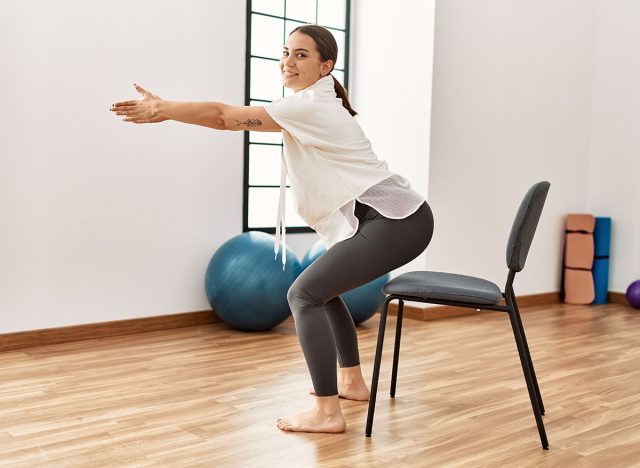
The sit-to-stand builds strength through one of the most important daily movements. It trains your thighs and hips to create the force needed to rise from a seated position. The chair provides a consistent target, making progress easy to track.
Muscles Trained: Quadriceps, glutes, hamstrings, core.
How to Do It:
- Sit near the front edge of a sturdy chair.
- Place your feet flat on the floor about hip-width apart.
- Brace your core and lean your chest slightly forward.
- Press through your whole foot to stand tall.
- Push your hips back and lower toward the chair.
- Tap the seat lightly and repeat.
Recommended Sets and Reps: Perform 3 sets of 10 to 12 reps. Rest for 45 to 60 seconds between sets.
Best Variations: Higher-chair sit-to-stands, pause sit-to-stands, slow-tempo sit-to-stands.
Form Tip: Stand all the way up at the top without rushing the return to the chair.
Chair-Supported Reverse Lunge
Chair-supported reverse lunges rebuild strength one leg at a time. The chair provides balanced support while the front leg handles most of the work. This helps strengthen the thighs, glutes, and hips in a pattern that carries over to stairs and walking.
Muscles Trained: Quadriceps, glutes, hamstrings, calves, core.
How to Do It:
- Stand beside a sturdy chair with one hand resting lightly on the back.
- Set your feet hip-width apart.
- Step one foot back into a reverse lunge.
- Lower with control as both knees bend.
- Press through your front foot to stand.
- Complete all reps, then switch sides.
Recommended Sets and Reps: Perform 3 sets of 6 to 10 reps per side. Rest for 45 to 60 seconds between sets.
Best Variations: Short-range reverse lunges, supported split squats, slow-tempo reverse lunges.
Form Tip: Keep your front heel grounded and let the chair support your balance, not your effort.
Seated Leg Extension With Pause
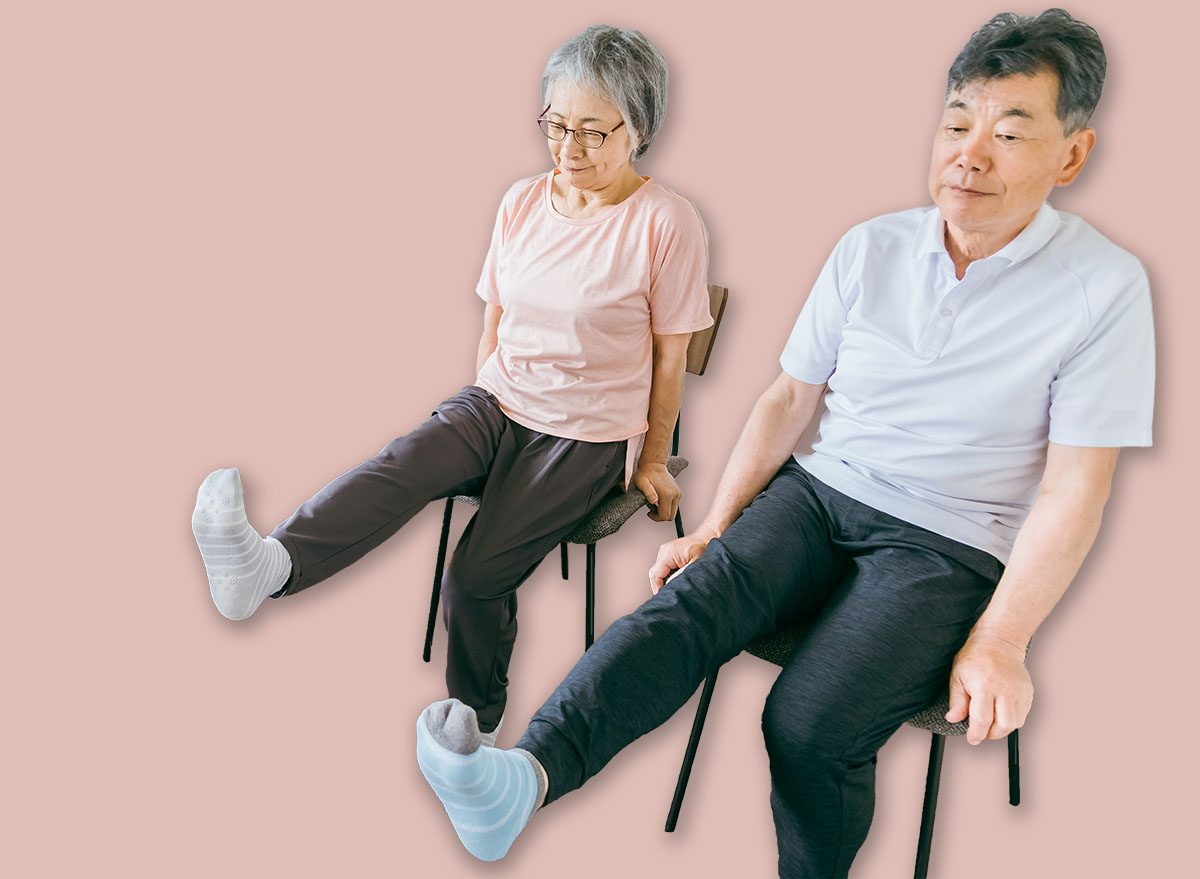
Seated leg extensions give the front of your thighs direct work. The pause at the top helps the quadriceps engage fully, which supports the knee and strengthens the muscles used for standing and stepping. This is a simple exercise, but it works best when every rep stays controlled.
Muscles Trained: Quadriceps, hip flexors, core.
How to Do It:
- Sit tall near the front edge of a sturdy chair.
- Keep both feet flat on the floor.
- Brace your core and keep your chest lifted.
- Extend one leg until the knee is nearly straight.
- Pause for 1 second, then tighten your thigh.
- Lower your foot with control and repeat before switching sides.
Recommended Sets and Reps: Perform 3 sets of 10 to 12 reps per side. Rest for 30 to 45 seconds between sets.
Best Variations: Alternating leg extensions, longer top holds, slow-tempo leg extensions.
Form Tip: Keep your upper body still so your thigh controls the movement.
Chair-Supported Calf Raise
Chair-supported calf raises strengthen the lower legs and ankles. Strong calves help with push-off during walking and support balance when you shift your weight. The chair gives you a steady handhold so you can focus on rising, pausing, and lowering with control.
Muscles Trained: Calves, ankles, lower legs.
How to Do It:
- Stand behind a sturdy chair with both hands lightly on the back.
- Set your feet hip-width apart.
- Press through the balls of your feet to lift your heels.
- Pause briefly at the top.
- Lower your heels slowly.
- Repeat for the full set.
Recommended Sets and Reps: Perform 3 sets of 12 to 15 reps. Rest for 30 to 45 seconds between sets.
Best Variations: Pause calf raises, single-leg-assisted calf raises, slow-tempo calf raises.
Form Tip: Rise straight up and keep your ankles from rolling outward.
How to Use Chair Exercises to Rebuild Leg Strength After 65
Use this as a short lower-body circuit. Complete one set of each exercise in order, rest for 60 to 90 seconds, then repeat for two to three total rounds.
- Start with the version that feels steady: Use your hands for balance and shorten the range when needed. Strong, controlled reps matter most.
- Progress in small steps: Add a few reps, slow the lowering phase, or use less support once the movement feels solid.
- Pay attention to side-to-side strength: Single-leg work can show whether one leg needs more control. Keep the reps even and let the weaker side set the pace.
- Support recovery with consistency: Short sessions repeated through the week can rebuild strength without overwhelming your joints.
- Use your strength daily: Walk, take stairs when appropriate, and practice standing from chairs with more control.
Stronger legs can change how independent and capable you feel after 65. Keep the routine simple, make the reps clean, and let steady practice rebuild strength that supports your everyday life.
References
- Frith, Emily, and Paul D Loprinzi. “The Association between Lower Extremity Muscular Strength and Cognitive Function in a National Sample of Older Adults.” Journal of lifestyle medicine vol. 8,2 (2018): 99-104. doi:10.15280/jlm.2018.8.2.99
- Tøien, Tiril et al. “Heavy Strength Training in Older Adults: Implications for Health, Disease and Physical Performance.” Journal of cachexia, sarcopenia and muscle vol. 16,2 (2025): e13804. doi:10.1002/jcsm.13804