3 Chair Exercises That Smooth Bat Wings in 21 Days After 60

After almost 40 years working as a personal trainer, and the last 25 as co-founder of TRAINFITNESS, the UK’s favorite fitness education company, upper-arm sagging is one of the most common complaints I hear from women in their 60s. Three chair exercises, done consistently for 21 days, produce a visible change in the back of the arm that most people didn’t think was possible without weights or a gym.
Bat wings, the loose skin and soft tissue on the back of the upper arm, are one of the most common concerns I hear from women in their 60s. The underlying cause is almost never the skin itself. The muscle underneath has faded, and the surface follows.
The tricep, the muscle on the back of the upper arm, is one of the fastest muscles to shrink from lack of use. Modern life uses the biceps at the front of the arm for lifting and carrying, but almost nothing uses the triceps. Result: the front of the arm holds its shape, the back doesn’t. What used to be muscle becomes empty space, and the skin sits softer than it did.
The other factor is loss of general muscle mass. After 60, everyone loses roughly one percent of their muscle mass per year without training. Some of that comes off the arms, especially the back where the muscle was small to begin with. Add loose skin from a lifetime of gaining and losing weight, and you get the classic bat wing appearance.
The good news is that the muscle underneath responds very well to training, even in the 60s and 70s. New muscle fills out the arm from underneath, which tightens the whole look even before the skin has had time to adapt.
Chairs give you a stable platform that lets you load the triceps without asking the shoulders or the trunk to hold everything else together. That means the arms can do harder work than they could in a standing position, which is what actually builds the muscle.
There’s also the safety angle. The wrists, shoulders and elbows in this age group are often more sensitive than they were, and chair exercises let you find a starting angle that doesn’t aggravate any of them. Progress from there is gradual and predictable.
And chair exercises can be done in the home, in ordinary clothes, without going anywhere. Consistency is the biggest predictor of change in this kind of program, and the routine has to fit into daily life to happen daily. A chair, a couple of water bottles, and 10 minutes is all it takes. These three chair exercises can help you smooth bat wings in just three weeks.
Chair Tricep Dip
This is the most direct exercise for the back of the upper arm. It loads the triceps with a portion of your body’s own weight, which is more than most other tricep exercises can manage, and it does this in a position that spares the shoulders.
How to Do It:
- Sit on a sturdy chair with hands gripping the front edge of the seat, fingers pointing forward
- Slide your bottom off the front of the chair
- Walk your feet out a foot or so, knees bent
- Slowly bend your elbows and lower your bottom towards the floor
- Stop when your elbows are at 90 degrees
- Push through your hands to lift back up
- Do 8 to 12 reps
Avoid These Mistakes:
- Don’t let your shoulders shrug up towards your ears at the bottom of the dip. Keep your shoulders pulled down and back throughout. If they shrug, you’ve dropped too far. Come up higher.
Sets and Reps: 8 to 12 reps per set.
Seated Overhead Tricep Extension
This trains the long head of the tricep, which is the part that sits along the back of the arm and gives the arm its shape. This is the exercise that most directly tightens the bat wing appearance.
How to Do It:
- Sit tall on a sturdy chair, feet flat on the floor
- Hold a 500ml water bottle in both hands, gripping it above your head with your arms fully extended
- Slowly bend your elbows and lower the bottle behind your head
- Stop when your elbows are at 90 degrees
- Extend your arms back up, squeezing your triceps at the top
- Do 12 to 15 reps
- Progress to a heavier bottle as it gets easier
Avoid These Mistakes:
- Don’t let your elbows flare out to the sides as you lower the bottle. Keep your elbows pointing up towards the ceiling throughout. If they flare, the exercise stops loading the triceps and starts loading the shoulders.
Sets and Reps: 12 to 15 reps per set, progressing to a heavier bottle as it gets easier.
Seated Bent-Over Rear Raise
This works the rear delts and the muscles between the shoulder blades, which fill out the back of the upper arm and the shoulder area. This is what gives the whole back-of-the-arm view a firmer look, not just the tricep on its own.
How to Do It:
- Sit tall on a sturdy chair, feet flat on the floor, hip-width apart
- Hold a 500ml water bottle in each hand, palms facing each other
- Hinge forward from your hips until your chest is at about 45 degrees to the floor
- Let your arms hang straight down from your shoulders
- Slowly lift both arms out to the sides until they are level with your shoulders
- Squeeze your shoulder blades together at the top
- Lower with control
- Do 12 to 15 reps
Avoid These Mistakes:
- Don’t use momentum to swing your arms up. The value is in the muscle doing the work, not the swing. Slow the lift down to 2 seconds up and 2 seconds down, and you’ll feel the difference immediately.
Sets and Reps: 12 to 15 reps per set.
How Often to Do This
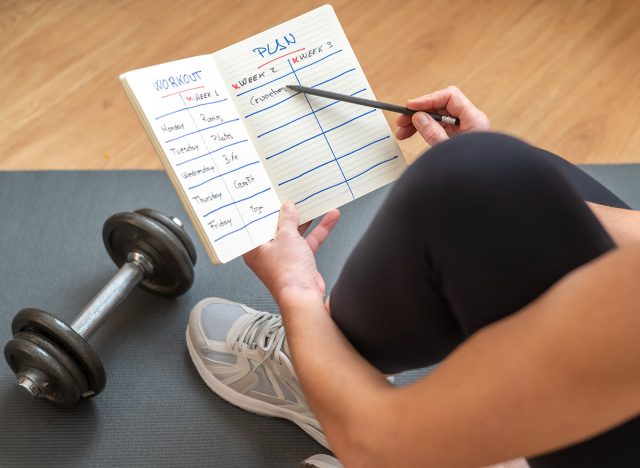
Days 1 to 7: Do the three exercises once a day, one set of each, at the rep counts described. This builds the movement patterns and gives your muscles a chance to wake up without any soreness.
Days 8 to 14: Add a second set of each. Rest 30 seconds between sets. The routine now takes about 12 minutes and starts producing measurable strength gains.
Days 15 to 21: Add a third set, and either increase the water bottle size to 750ml or slow the tempo to 3 seconds on the way down. This is where the visible change accelerates.
Do the routine six days a week, with one rest day. If you’re sore in the first few days, that’s normal and it fades within a fortnight. If it lingers beyond that, drop the volume by one set until it clears.
What to Expect
By day 7, most people notice their arms feel firmer to the touch, even if the mirror doesn’t show anything yet. That’s the muscle waking up and holding tension.
By day 14, the mirror starts to catch up. The back of the upper arm sits tighter, the underside is less wobbly when the arm is raised, and the shape from the shoulder down looks more defined. Not a dramatic change, but a real one.
By day 21, most clients report a visible improvement that other people notice. The bat wing softness is meaningfully reduced. Not gone, especially for anyone who’s had a lot of weight loss and gain over the years, but noticeably firmer and more contoured than it was three weeks earlier.
The bigger changes come with the next 60 days. Muscle takes months to fully build, and skin takes even longer to adapt to the new underlying shape. Twenty-one days is where the routine proves itself. The next three months are where the arms genuinely change.