The 6-Minute Chair Routine That Trims Waist Overhang After 55, According to a Trainer


Strong, confident movement can keep improving well past 55, especially when your training plan stays simple and consistent. One of the most effective ways to tighten your midsection is to focus on targeted core work that fits easily into your daily routine. Over the years, coaching adults in their fifties, sixties, and beyond, I’ve seen short, focused chair workouts create real momentum when people commit to them regularly.
Seated core training creates an ideal environment to wake up the muscles that support your waistline and posture. It allows you to train with control, build awareness through your midsection, and stack productive sessions throughout the week. In my programming, chair-based movements often serve as a potent starting point because they help clients quickly feel their core working and build early wins that keep motivation high.
The 6-Minute Chair Routine That Trims Waist Overhang After 55 fits perfectly into busy days and delivers meaningful core work in a short window. With just a sturdy chair and a few focused minutes, you can challenge your midsection, improve muscular endurance, and build viable strength that supports a tighter waistline. Here’s exactly how to perform the routine for the best results.
The 6-Minute Chair Routine That Trims Waist Overhang After 55
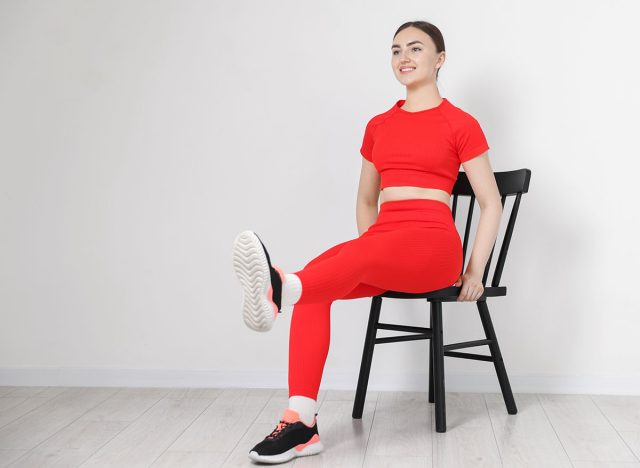
What you need: A sturdy chair and six uninterrupted minutes. This routine uses two targeted seated core moves performed in short intervals to build strength and endurance through your midsection.
The Routine: Alternate the exercises for 3 total rounds, resting for 30 seconds between each.
- Seated Flutter Kicks: 30 seconds
- Seated Knee Tucks: 30 seconds
Below, you’ll learn exactly how to perform each move for maximum core activation and waist-tightening results.
Directions
Set a timer for 30-second intervals. Perform Seated Flutter Kicks for 30 seconds, then move directly into Seated Knee Tucks for 30 seconds. Continue alternating until you complete 3 full rounds. Stay tall through your torso and keep your core braced throughout each interval. Read on for the detailed instructions.
Seated Flutter Kicks
Seated flutter kicks fire up the lower portion of your core, an area that often weakens with age and contributes to that soft lower-belly look many adults notice over time. This movement also challenges hip flexor endurance and teaches your core to stabilize while your legs move, which carries over into walking, climbing stairs, and daily movement. I like this exercise because most people feel their abs engage immediately without having to get down on the floor. Over time, stronger lower-core endurance helps pull the midsection in tighter and supports better posture.
How to do it:
- Sit tall near the front edge of a sturdy chair.
- Place your hands lightly on the sides of the seat for support.
- Lean your torso back slightly while keeping your chest lifted.
- Extend both legs out in front of you.
- Begin alternating small, controlled kicks up and down.
- Keep your core tight and avoid rounding your lower back.
- Continue for the full 30-second interval.
Best Variations:
- Bent-knee flutter kicks
- Hands-free flutter kicks
- Slower tempo flutter kicks.
Seated Knee Tucks
Seated knee tucks train your entire midsection to contract and control movement simultaneously. This pattern strengthens the deep abdominal muscles that help flatten the waistline and support the spine. Many adults struggle to properly brace their core during daily movement, and this exercise builds that skill in a very joint-friendly position. I program knee tucks often because they deliver a strong core stimulus in a short window, which fits perfectly into quick daily routines like this one.
How to do it:
- Sit near the front edge of your chair with your hands holding the sides.
- Lean back slightly while keeping your spine tall.
- Extend your legs straight out in front of you.
- Pull both knees toward your chest in a controlled motion.
- Briefly squeeze your abs at the top position.
- Extend your legs back out with control.
- Repeat for the full 30-second interval.
Best Variations:
- Single-leg alternating knee tucks
- Slower tempo knee tucks
- Hold-and-pause knee tucks.
Best Daily Habits to Trim Waist Overhang After 55

If you want this six-minute routine to actually move the needle, what you do outside the workout matters just as much as the exercises themselves. Core training works best when it pairs with smart daily habits that support fat loss, posture, and muscle activation. In my coaching work, the clients who see the fastest changes usually focus on a few simple behaviors they can repeat consistently. Rather than a complete lifestyle overhaul, you need a handful of high-impact habits that reinforce the work you’re doing in the chair. Lock these in, and your results tend to show up faster and stick around longer.
- Train your core frequently, not occasionally. Short daily sessions beat one long workout each week. Your core responds well to consistent activation.
- Prioritize protein at each meal. Aim for a solid protein source at every meal to support muscle maintenance and help manage appetite.
- Walk more throughout the day. Regular walking increases daily calorie burn and supports better blood flow to the midsection.
- Sit tall whenever possible. Posture habits matter. Keeping your rib cage stacked over your hips helps your core stay lightly engaged all day.
- Control your eating pace. Slowing down meals improves awareness of fullness and often reduces mindless overeating.
- Stay hydrated. Even mild dehydration can affect energy levels and workout quality. Keep water intake steady throughout the day.
- Progress the routine over time. As the exercises feel easier, slow the tempo or extend the work intervals to keep your core challenged.
Stay patient, stay consistent, and give this routine a few weeks of honest effort. Most adults over 55 start to notice better core engagement, improved posture, and a tighter feeling through the waist when they stack these habits together.
References
- Klempel, Natalie et al. “The Effect of Chair-Based Exercise on Physical Function in Older Adults: A Systematic Review and Meta-Analysis.” International journal of environmental research and public health vol. 18,4 1902. 16 Feb. 2021, doi:10.3390/ijerph18041902
- Schumacher, Leah M et al. “Sustaining Regular Exercise During Weight Loss Maintenance: The Role of Consistent Exercise Timing.” Journal of physical activity & health vol. 18,10 1253-1260. 14 Aug. 2021, doi:10.1123/jpah.2021-0135