7 Chair Exercises That Reverse Rounded Posture After 50, According to Experts

Chair exercises are a trainer favorite because of their accessibility. These low-impact movements can be done anytime, anywhere. Plus, they boost strength, cardiovascular endurance, flexibility, and balance, and even improve posture. Rounded posture can occur after 50 due to muscle loss and weak bones. Sitting in a slouched position can worsen the situation. To help reverse rounded posture after 50, try these seven expert-recommended chair exercises.
“We see many changes in the body after age 50. While it’s not unique to this age group, we see more rounded shoulder posture (forward head carriage + thoracic kyphosis) than in other age groups,” explains Marta Hanrahan, Registered Massage Therapist, Yoga Therapist, Clinical Director at Myosense Wellness in Ottawa, Ontario. “This is due to a mix of factors: aging, hormonal changes, repetitive strain, and behavioural loading patterns. Basically: more years working against gravity! Clinically, this pattern can be described as Upper Crossed Syndrome (UCS).”
Why Rounded Posture Becomes More Prevalent With Age
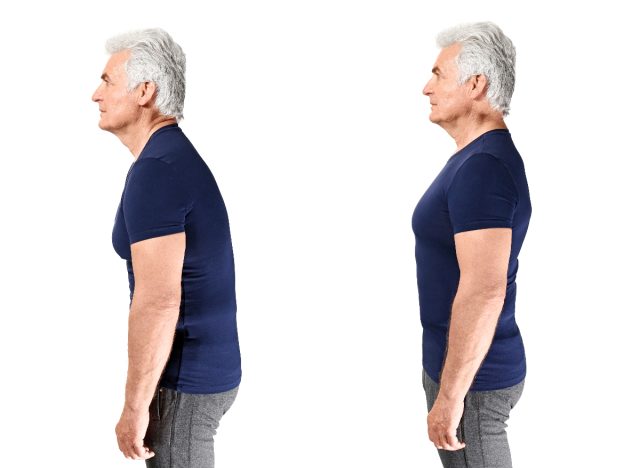
Years of working at a desk, sitting hunched over your screen, and driving can tighten the muscles in your front shoulders and chest. This pulls your upper body forward.
“At the same time, the muscles in your upper back—the rhomboids, lower traps, and rear delts—weaken from years of underuse, so there’s nothing strong enough to pull you back into alignment,” explains Dr. Gbolahan Okubadejo, a NYC area Spinal and Orthopaedic Surgeon who’s skilled in a variety of spine surgery techniques, including invasive procedures and cutting-edge robotic-assisted surgery. “Your deep neck flexors also tend to give out, which is why the head starts drifting forward instead of sitting stacked over the spine. Add in the natural loss of bone density and disc height that comes with aging, and your body starts finding the rounded position as its default ‘comfortable.'”
The more rounded your posture becomes, the harder your weakened back muscles need to work to keep your body upright. The imbalance continues to worsen unless you take proper steps to address it.
Here are seven chair exercises that can help reverse rounded posture after 50.
Seated Resistance Band Row
- Begin sitting tall.
- Loop a resistance band around the soles of your feet.
- Hold the ends of the band in each hand with your arms extended at chest level.
- Bend your elbows as you pull the band toward your torso and squeeze your shoulder blades together.
- Hold for a moment before releasing with control.
- Perform 3 sets of 12 reps.
Seated Chin Tucks
- Begin sitting tall with your gaze forward.
- Gently pull your chin straight back, forming a “double chin.”
- Hold for 3 seconds before releasing.
- Complete 3 sets of 10 reps.
Seated Chest Opener
- Begin sitting tall.
- Clasp your hands behind your head.
- Gently open your elbows out wide, squeezing your shoulder blades together.
- Hold for 5 seconds before releasing.
- Perform 3 sets of 10 reps.
Seated Band Pull-Aparts
- Begin sitting tall.
- Hold a light resistance band in front of you at chest level.
- Pull the band apart horizontally until your arms are wide.
- Use control to return to the start position.
- Perform 3 sets of 15 reps.
RELATED: Why Everyone Over 45 Is Secretly Using ‘Peptide Stacking’ to Rebuild Lost Muscle
Seated Hip Hinges
- Begin sitting tall at the edge of your chair.
- Hinge forward at your hips until you feel a solid hamstring stretch.
- Return to the upright position.
- Perform 3 sets of 10 reps.
Levator Scapula Stretch
- Begin by sitting tall with your feet planted flat on the floor.
- Gently place the hand of the side you aim to stretch behind your back.
- With the opposite hand, gently pull your head forward to the opposite side at an angle until you feel a solid stretch from the base of your skull all the way down into your scapula.
- Hold for 30 seconds.
- Switch sides.
Seated Lat Extensions
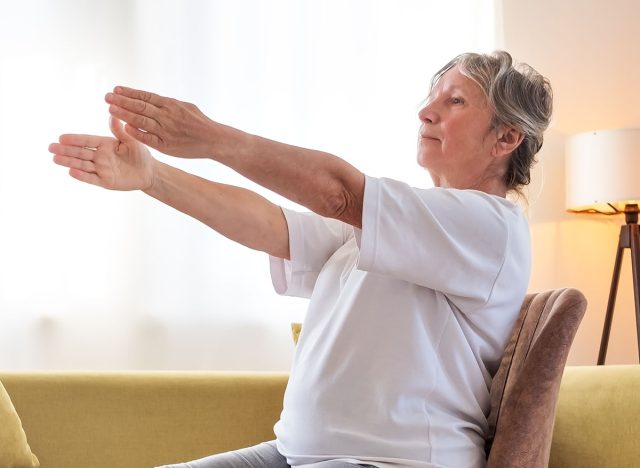
- Begin in a seated position.
- Place your arms ahead of you on a table and your knees and ankles at 90 degrees.
- Stretch your arms out as far as you’re able to, dropping your head down between your shoulders, bending at the waistline.
- Keep your arms and shoulders relaxed as you hold the position for 30 to 60 seconds.