8-Minute Chair Exercises That Strengthen Hips Better Than Squats After 60

Hip strength is one of the most underestimated factors in how well we age. As a personal trainer and director of fitness education company TRAINFITNESS, I’ve been helping older adults with their fitness for almost 40 years. One thing people regularly underestimate is how important mobility and strength are in their hips. Making our hips stronger and more mobile is a massive benefit as we get older.
The good news is you don’t need a gym, special equipment, or even to stand up to start rebuilding hip strength. The following 8-minute chair routine targets the exact muscles that weaken with age—and you can do it in your living room starting today.
Why Your Hips Are Holding You Back

Throughout my entire career, I’ve seen the same hip problems showing up again and again. The hips get tight, weak, and lose their range of motion—often without people realising it’s happening until something forces them to notice.
Getting in and out of cars becomes awkward. You start having to swing both legs out together instead of stepping out naturally. Putting on socks and shoes turns into a real struggle—you might find yourself sitting on the bed edge, pulling your foot up onto your opposite knee because you can’t lift it comfortably anymore. Stairs get harder, not just because of your knees, but because your hips aren’t generating the power they used to.
The real problem isn’t just one thing—it’s three things happening at once. First, the muscles at the front of your hips get shorter and tighter from all the sitting we do. Second, your bottom muscles get weaker because we’re not using them properly. Third, the small muscles that let you turn your legs in and out lose their strength and flexibility.
This combination creates a perfect storm. Tight front hip muscles pull your pelvis forward, which puts pressure on your lower back. Weak bottom muscles mean your body starts compensating with other muscles that weren’t designed for the job. Limited rotation makes it harder to turn, change direction, or step to the side without your whole body having to twist.
Walking gets affected too. Your stride length shortens because your hips can’t extend properly. You might notice you’re taking more steps to cover the same distance you used to manage easily. Balance suffers because your hips aren’t stabilising you as effectively as they should.
The frustrating part is that most people accept this as normal ageing. It’s not. Yes, some changes happen with age, but the majority of hip problems I see come from lack of use, not inevitable decline. Your hips are designed to move in multiple directions—forward, back, side to side, and rotating. When you stop using those movements regularly, you lose them.
Seated Knee Lifts
This works because it directly strengthens the muscles at the front of your hips while keeping your core engaged. Unlike standing versions, the seated option gives you better control and removes balance concerns, letting you focus purely on the hip movement.
Muscles Trained: Hip flexors, core
How to Do It:
- Sit towards the front of your chair with your feet flat on the floor, hip-width apart.
- Keep your back straight—imagine a string pulling the top of your head toward the ceiling.
- Place your hands on the sides of the chair for light support.
- Slowly lift your right knee up towards your chest, going as high as you comfortably can.
- Hold for two seconds at the top, really feeling the muscles at the front of your hip working.
- Lower your foot back down with control—don’t just drop it.
- Repeat with your left leg. That’s one rep.
Common Mistakes to Avoid:
- Leaning back as you lift your knee. This takes the work away from your hips and puts it into your lower back instead. Keep your body upright throughout.
- Lifting too fast. You want slow, controlled movements that make your muscles work, not momentum doing the job for you.
- Gripping the chair hard. Your hands are just there for light balance, not to help you lift.
Recommended Sets and Reps: 20 reps each leg (2 minutes total)
Seated Leg Pushes
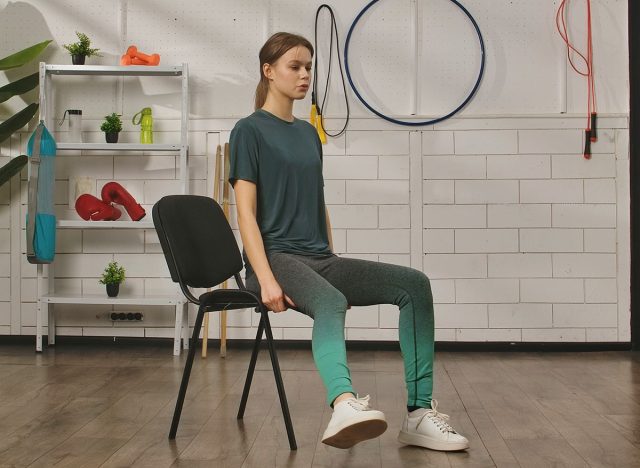
This targets the outer hip and bottom muscles, which are critical for side-to-side stability. These muscles stop you from swaying when you walk and help you step to the side safely. They’re also the first to weaken when we stop moving sideways regularly.
Muscles Trained: Outer hip (abductors), glutes
How to Do It:
- Sit upright with your feet together, knees bent.
- Keep your hands on the chair seat beside your hips.
- Slowly move your right knee out to the side, keeping your foot on the ground.
- Go as far as you can while keeping your hips still—you should feel this working on the outside of your hip and bottom.
- Hold for two seconds, then bring your knee back to centre with control.
- Switch sides.
Common Mistakes to Avoid:
- Letting your hips tilt or your upper body lean to compensate. Your torso should stay completely still—all the movement comes from your hip.
- Allowing your foot to lift off the ground, which shifts the work away from your hip muscles.
- Going too fast. This isn’t a race. Slow, deliberate movements work the muscles properly.
Recommended Sets and Reps: 15 reps each side (2 minutes total)
Seated Hip Press Backs
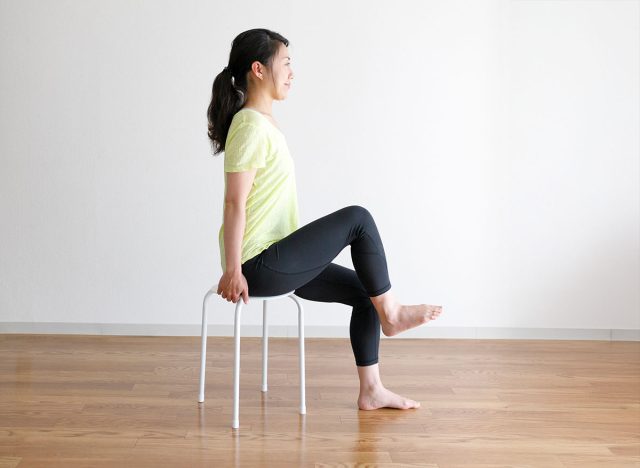
This exercise wakes up your bottom muscles and trains the backward hip movement you need for walking, standing up, and climbing stairs. Most people’s bottom muscles have basically gone to sleep from sitting too much. This gets them firing again.
Muscles Trained: Glutes, hip extensors
How to Do It:
- Sit towards the front of your chair with your feet flat.
- Keep your back straight and hands resting on your thighs.
- Lift your right foot slightly off the ground, then press your leg back behind you as far as you can, squeezing your bottom as you do.
- You’re not trying to get your leg high—you’re trying to feel your bottom muscles working.
- Hold for two seconds, then bring your leg back to the starting position.
- Switch legs.
Common Mistakes to Avoid:
- Arching your back to get your leg further back. This defeats the purpose and can strain your lower back. Keep your back straight and let your bottom muscles do the work, even if that means your leg doesn’t go very far back at first.
- Leaning forward. Stay upright.
- If you’re not feeling it in your bottom, you’re probably moving from your back instead of your hip.
Recommended Sets and Reps: 15 reps each leg (2 minutes total)
Seated Hip Rotations
This restores rotation in your hips, which most people lose completely over time. Hip rotation is what lets you turn smoothly, get in and out of cars easily, and step in different directions without your whole body having to compensate.
Muscles Trained: Internal and external hip rotators
How to Do It:
- Sit upright and lift your right foot slightly off the ground, knee bent.
- Slowly rotate your whole leg inward (like you’re trying to point your knee toward your other knee).
- Then rotate it outward (like you’re trying to point your knee away from your body).
- The movement is small—you’re rotating from your hip socket, not swinging your leg around.
- Do 10 rotations, then switch legs.
Common Mistakes to Avoid:
- Moving from your knee instead of your hip. Your knee should stay relatively still—the rotation happens at your hip.
- Forcing the range of motion. Many people have lost a lot of hip rotation, so start small and let it improve over time.
- Rushing through these. Slow, controlled rotation is what creates change.
Recommended Sets and Reps: 10 reps each direction, each leg (1 minute 30 seconds total)
Seated Hip Circles
This combines all the movements we’ve worked on and trains your hips to move smoothly through their full range. It’s also the best exercise for finding areas where you’re stiff or restricted.
Muscles Trained: All hip muscles (full range of motion)
How to Do It:
- Sit upright and lift your right foot off the ground.
- Move your knee in a smooth circle—forward, out to the side, back, and around.
- Think of drawing a circle with your knee.
- Do 5 circles in one direction, then reverse and do 5 the other way.
- Switch legs.
Common Mistakes to Avoid:
- Making the circles too big and losing control. Small, smooth circles work better than large, wobbly ones.
- Letting one hip lift up as you circle. Keep your hips level.
- If you find certain parts of the circle feel sticky or restricted, that’s normal. Those are the exact areas these exercises will improve over time.
Recommended Sets and Reps: 5 circles each direction, each leg (30 seconds total).
When to Check With Your Doctor First

If you’ve had a hip replacement, it’s really important to speak to your doctor first. While some of these movements might be absolutely fine, others could interfere with your surgery and recovery timeline. Your doctor or surgeon will know what’s safe for you.
If you’ve had a hip injury recently or you’re suffering hip pain that’s ongoing and getting worse, you need to get assessed by a professional before you start any exercise programme. The exercises above are designed to address general hip weakness and stiffness—not acute injuries. If you experience any sharp pain, swelling, or have pain that’s waking you up at night, then you need to get it checked out.
If you have severe osteoarthritis in your hips, you might need modifications. These exercises can actually help with arthritis symptoms, but if your arthritis is severe, you’ll want your doctor’s input on what’s appropriate. They might suggest starting with even gentler versions or refer you to a physiotherapist.
People with balance issues or vertigo should be extra cautious. While these are seated exercises, some of the movements can temporarily affect your balance when you stand up afterwards. If you have significant balance problems, make sure you’ve got something stable to hold onto when you finish.
If you’re on blood thinners or have a bleeding disorder, check with your doctor. It’s unlikely these gentle exercises would cause problems, but it’s better to confirm. Same goes if you’ve got any pelvic or lower back conditions—get the all-clear first.
Choosing the Right Chair
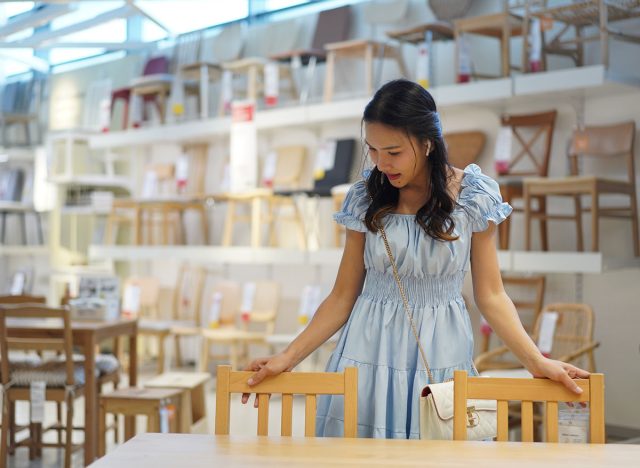
The chair needs to be stable so it won’t slide around or tip over—a sturdy dining chair is usually best. It needs to be firm (an armchair or sofa won’t work) as you need to feel your sitting bones on the seat. Also, the chair shouldn’t move—so no wheels or rockers.
When you’re sitting with your feet flat on the floor, the knees should be at a 90-degree angle (roughly), so the height of the chair matters too. If it’s too high and your feet don’t comfortably touch the floor, put something like a book or step under your feet. If it’s too low and your knees are up near your chest then you’ll need to find a different one.
You don’t need a back on the chair for these exercises since you’re sitting towards the front edge, but having one behind you can be reassuring. Just make sure you’re not leaning against it—you want to sit upright under your own control.
No other equipment needed. No weights, no bands, no special gear. Your body weight provides all the resistance you need to start building hip strength. Later on, once these feel easy, you could add a resistance band around your knees for the leg pushes, but that’s months down the line. For now, just you and a chair.
Make sure you’ve got enough space around the chair to move your legs freely in all directions. You don’t need much—about an arm’s length on each side and in front is plenty.
What to Expect After 4-6 Weeks
First of all, the exercises will get easier. You’ll probably notice this within the first week. Movements that started out feeling stiff or awkward will start to feel smoother. You’ll see differences like the ability to lift your knee a bit higher or rotate your leg further. This is because your nervous system is getting better at firing your muscles in the right order.
After two weeks, everyday movements start to change. Getting out of your chair feels less effortful. You’re not having to push yourself up quite as hard. Putting on your socks and shoes becomes less of a production. You might notice you’re not gripping the bannister quite as tightly on stairs.
By four weeks, if you’ve been doing this routine three to four times a week, you’ll see real improvements. Your walking will feel more fluid—your stride length increases because your hips can extend further. Getting in and out of the car gets noticeably easier. You’ll probably find you can turn and change direction more smoothly without having to move your whole body.
At the six-week mark, other people might start commenting that you’re moving better. Your hip strength will have improved enough that activities you’d been avoiding or struggling with become manageable again. Your balance improves too because your hips are doing a better job of stabilising you.
The flexibility gains can be significant. Many people regain 20-30 degrees of hip rotation they’d lost. That might not sound like much, but it’s the difference between being able to cross your legs comfortably or not, between stepping sideways easily or having to shuffle your whole body around.
Pain often decreases if you’ve been dealing with hip discomfort or lower back pain caused by tight, weak hips. Your body stops compensating with the wrong muscles because your hips are actually doing their job properly again.
Here’s what won’t happen—your hips won’t suddenly be as mobile as they were when you were 30. These exercises work with where you are now and make steady, realistic improvements. You’re looking at getting back function you’ve lost recently, not reversing decades in six weeks.
The most important thing is consistency. You should be aiming for three to four times a week, every single week. Missing a week here and there will not ruin your progress, but sporadic effort gets sporadic results. Eight minutes three times a week is 24 minutes total—less time than one episode of a TV show. That small investment builds up into real, lasting change in how your hips work and how you move through daily life.