4 Chair Exercises That Restore Hip Mobility Faster Than Yoga After 60
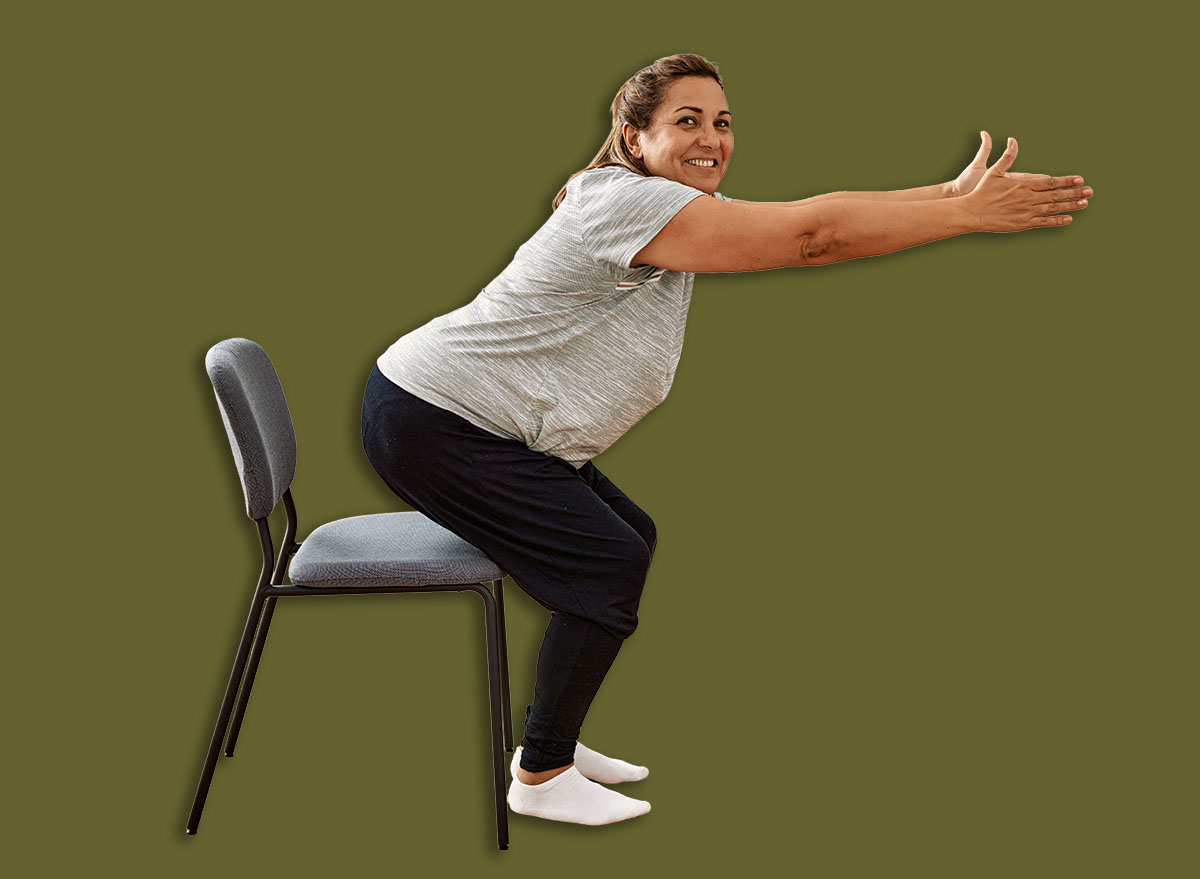

Hip mobility is essential if you want to maintain an active, independent life. It can help you remain flexible and balanced while avoiding falls. Healthy, mobile hips also prevent your knee joints and lower back from overworking. As you age, it’s important to maintain hip mobility, and we spoke with an expert to learn exactly how. Dr. Jaime Bayzick, Associate Professor of Practice in Physical Therapy at Arcadia University in Glenside, PA, who is an expert on this topic, shares four stellar chair exercises that restore hip mobility faster than yoga after 60.
“Hip mobility loss is not simply caused by ‘getting older.’ Aging does contribute to changes in cartilage, connective tissue elasticity, muscle stiffness, and joint hydration, but movement habits matter just as much. Even active adults often lose hip mobility because modern movement patterns become repetitive. Many people continue walking or exercising but stop training rotation, deep squatting, floor transfers, and lateral movement patterns that help preserve full hip function,” explains Dr. Bayzick.
Sitting for an extended period of time also keeps your hips in a flexed position, resulting in hip flexor stiffness, decreased pelvic mobility, and glute weakness. As time passes, your body gets used to moving less.
“Physical therapists often use the phrase ‘motion is lotion,’ because joints and connective tissues tend to function better when they move regularly. Gentle, consistent movement helps maintain mobility, reduce stiffness, and improve confidence with movement—even later in life,” Dr. Bayzick shares.
For many adults in their 60s and older, chair-based training provides a safe, more approachable option that delivers results.
“Mobility after 60 is not just about flexibility—it’s about maintaining the strength and confidence to keep moving independently,” Dr. Bayzick adds.
Below, Dr. Bayzick shares four chair exercises to add to your hip mobility routine.
Seated March
“Seated marches are one of the most effective foundational exercises for restoring hip mobility because they actively train hip flexion while improving circulation, coordination, and trunk stability,” Dr. Bayzick tells us.
- Begin seated on a chair with your feet placed hip-width apart on the floor.
- Lift your left knee up to hip height.
- Lower.
- Then, lift your right knee up to hip level.
- Lower.
- Maintain solid posture as you continue to “march.”
- Perform 2 to 3 sets of 10 to 15 marches on each leg once daily.
Seated Figure-4 Stretch
“The seated figure-4 stretch is excellent for improving rotational hip mobility, which is often one of the first movements adults lose with age,” Dr. Bayzick points out. “This stretch also tends to feel more accessible and less intimidating than getting down onto the floor for traditional yoga poses.”
- Begin sitting tall on a chair.
- Cross one ankle over the opposite knee.
- Gently lean forward while maintaining a straight back until you feel a stretch in your hips and glutes.
- Hold for 20 to 30 seconds before releasing.
- Perform 2 to 4 reps on each side, once daily.
Sit-to-Stands
“If I could only prescribe one lower-body exercise for older adults, sit-to-stands would be at the top of the list,” says Dr. Bayzick. “This movement strengthens the glutes, quadriceps, core, and hips while simultaneously improving balance and mobility. More importantly, it directly trains one of the most essential daily movement patterns: standing up independently and safely. That matters tremendously for long-term function and fall prevention.”
- Begin seated at the front of a sturdy chair, feet under your knees.
- Lean forward just a bit.
- Try to stand up without using your knees, hands, or additional support.
- Use control to slowly sit back down.
- Perform 2 to 3 sets of 8 to 12 reps with rest as needed between sets.
Seated Hip Abduction Presses
“Seated hip abduction presses target the lateral hip muscles that stabilize the pelvis during walking and standing,” Dr. Bayzick points out. “These muscles, especially the gluteus medius, are critical for balance, walking efficiency, and reducing stress on
the knees and lower back. When they weaken, people often compensate with shorter steps, slower walking speeds, and reduced confidence in movement. This is one reason many older adults feel ‘stiff’ even if flexibility is not severely limited.”
- Begin sitting tall on a chair.
- Place a resistance band around your thighs, or gently press your knees out into your hands.
- Slowly return to neutral.
- Perform 2 to 3 sets of 10 to 15 repetitions with a 1 to 2-second hold at the end of each press, three to five times a week.