6 Chair Exercises That Trim Belly Overhang Faster Than Gym Sessions After 60

Most people hear “belly overhang” and immediately think abs. In coaching, I like to take a broader approach with clients. A chair can help create a full-body workout that engages the legs, upper body, and core in the same session, giving the routine far more purpose than a few seated crunches.
Belly overhang changes with overall body composition habits, not by isolating one part of the waist. Strength training helps preserve and build lean muscle, while regular movement raises daily energy use. Bringing larger muscle groups into the workout makes the session more productive and supports the changes people want to see in their midsection.
A chair works especially well because it provides a stable reference point without taxing the muscles. It can guide a squat, support a lunge, elevate a push-up, or create a comfortable setup for rows and core work. That makes it easier to focus on clean reps and steady progress at home.
This routine uses the chair as part of a full-body circuit, not just a seat. The goal is to build stronger legs, a more capable upper body, and a core that supports movement from start to finish.
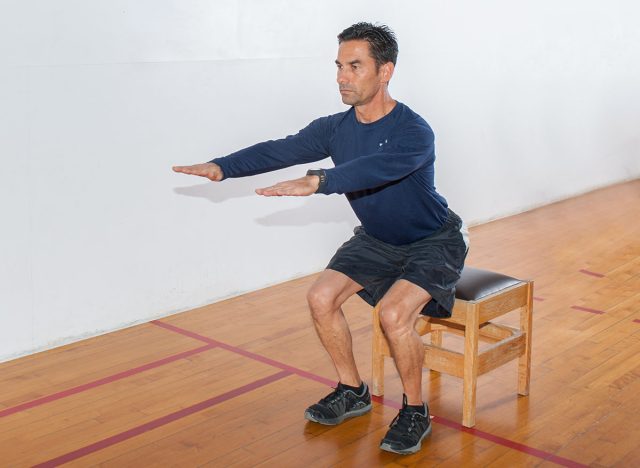
Chair Squat
Chair squats train your thighs, glutes, hamstrings, and core through a movement you use all day. The chair gives you a clear depth target, while the stand builds lower-body strength that carries into stairs, walking, and getting up from lower seats. Because your legs contain some of the largest muscles in the body, this exercise also adds more total work to the routine than isolated ab exercises alone.
Muscles Trained: Quadriceps, glutes, hamstrings, core.
How to Do It:
- Stand in front of a sturdy chair with your feet about shoulder-width apart.
- Brace your core and keep your chest lifted.
- Push your hips back toward the chair.
- Lower with control until your hips lightly touch the seat.
- Press through your whole foot to stand tall.
- Repeat with a smooth, steady tempo.
Recommended Sets and Reps: Perform 3 sets of 10 to 15 reps. Rest for 45 to 60 seconds between each set.
Best Variations: Sit-to-stands, hover squats, tempo chair squats.
Form Tip: Tap the chair lightly instead of fully relaxing at the bottom.
Chair-Supported Reverse Lunge
Chair-supported reverse lunges train your quads, glutes, hamstrings, hips, and core while giving each leg focused work. The chair provides a stable point of contact, allowing you to focus more on your front leg, posture, and control. This exercise also adds a balance element that helps make the routine feel more athletic and useful.
Muscles Trained: Quadriceps, glutes, hamstrings, hips, core.
How to Do It:
- Stand beside a sturdy chair with one hand lightly resting on the back.
- Set your feet about hip-width apart.
- Step one foot back into a lunge.
- Lower your back knee toward the floor with control.
- Press through your front foot to return to standing.
- Complete all reps, then switch sides.
Recommended Sets and Reps: Perform 3 sets of 8 to 10 reps per side. Rest for 45 to 60 seconds between each set.
Best Variations: Assisted split squats, shorter-range reverse lunges, tempo reverse lunges.
Form Tip: Let the chair guide your balance while your front leg creates the lift.
Incline Chair Push-Up
Incline chair push-ups train your chest, shoulders, triceps, and core. Elevating your hands makes the push-up easier to scale while still giving your upper body a real strength challenge. Pressing movements also engage your core because your body has to stay aligned from the shoulders through the hips.
Muscles Trained: Chest, shoulders, triceps, core, glutes.
How to Do It:
- Place a sturdy chair against a wall.
- Put your hands on the chair seat or back.
- Step your feet back until your body forms a straight line.
- Brace your core and squeeze your glutes.
- Lower your chest toward the chair with control.
- Press through your hands to return to the starting position.
Recommended Sets and Reps: Perform 3 sets of 6 to 12 reps. Rest for 45 to 60 seconds between each set.
Best Variations: Wall push-ups, counter push-ups, lower-incline push-ups.
Form Tip: Keep your elbows angled slightly back as you lower.
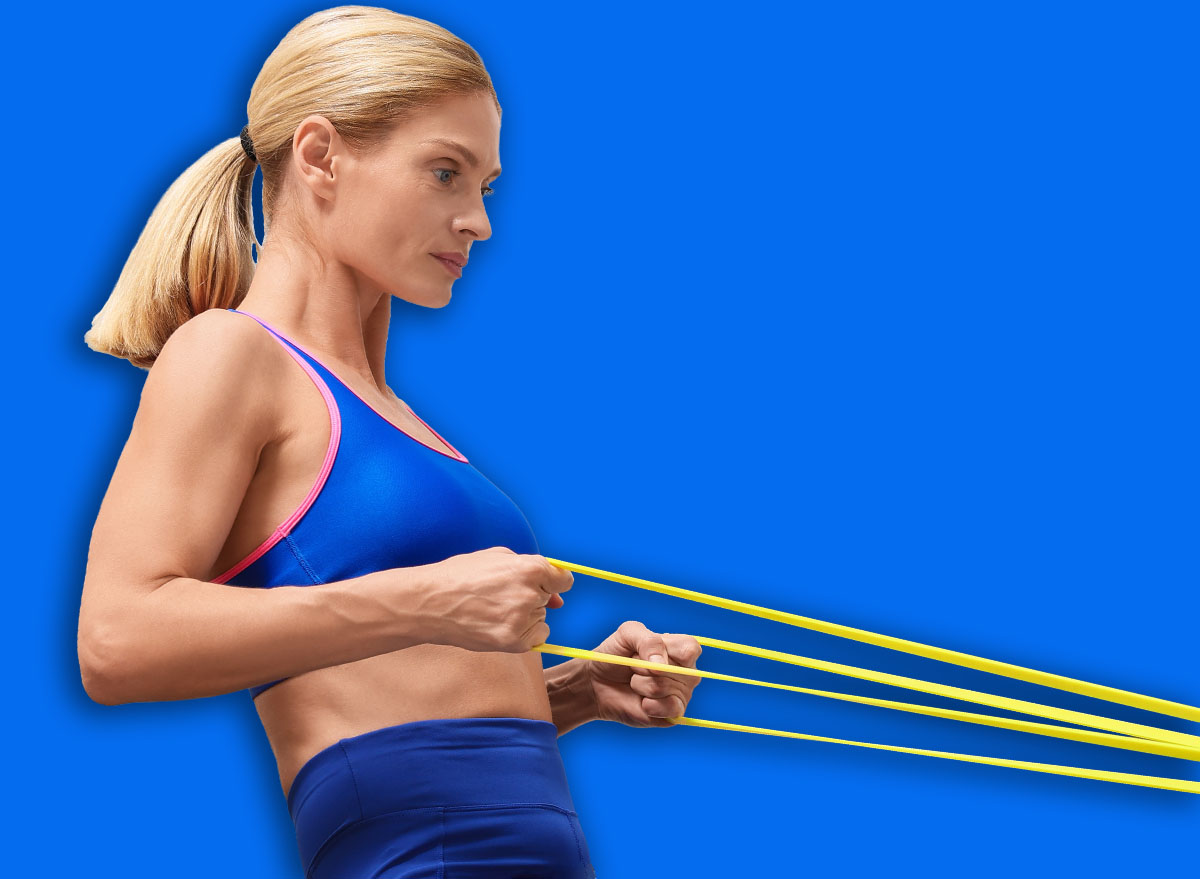
Seated Band Row
Seated band rows train your upper back, lats, rear shoulders, biceps, and core. A strong back supports an upright posture and balances the pressure of push-ups. The seated setup lets you focus on pulling with control, squeezing your upper back, and keeping your torso tall throughout the set.
Muscles Trained: Upper back, lats, rear delts, biceps, core.
How to Do It:
- Sit tall near the front edge of a sturdy chair.
- Loop a resistance band around the soles of your feet.
- Hold one end of the band in each hand.
- Brace your core and keep your chest lifted.
- Pull your elbows back toward your ribs.
- Return your hands forward with control.
Recommended Sets and Reps: Perform 3 sets of 10 to 15 reps. Rest for 45 seconds between each set.
Best Variations: Single-arm band rows, paused band rows, lighter-band rows.
Form Tip: Pull through your elbows and keep your shoulders relaxed away from your ears.
Seated Knee Tucks
Seated knee tucks train your abs, hip flexors, and deep core while keeping you supported by the chair. Pulling your knees toward your chest puts direct work on your midsection, and the chair keeps the exercise accessible for people who prefer to stay off the floor. Move slowly and keep your torso steady so your abs control the rep.
Muscles Trained: Abs, hip flexors, deep core.
How to Do It:
- Sit near the front edge of a sturdy chair.
- Hold the sides of the chair lightly for support.
- Lean back slightly while keeping your chest lifted.
- Lift both knees toward your chest.
- Pause briefly at the top.
- Lower your feet with control and repeat.
Recommended Sets and Reps: Perform 3 sets of 8 to 12 reps. Rest for 30 to 45 seconds between each set.
Best Variations: Alternating knee tucks, single-knee drives, tempo knee tucks.
Form Tip: Keep your shoulders relaxed and avoid swinging your legs.
Elevated Mountain Climbers
Elevated mountain climbers bring together core work, shoulder stability, hip movement, and light conditioning. Using the chair raises your hands off the floor, making the position easier to manage while your abs stay active and your legs keep moving. This is a strong finisher because it lifts the pace of the workout without requiring jumping.
Muscles Trained: Abs, shoulders, hip flexors, glutes, quadriceps.
How to Do It:
- Place a sturdy chair against a wall.
- Put both hands on the seat or back of the chair.
- Step your feet back into an incline plank.
- Brace your core and keep your hips level.
- Drive one knee toward your chest.
- Step it back and alternate sides with control.
Recommended Sets and Reps: Perform 3 sets of 20 to 30 seconds. Rest for 30 to 45 seconds between each set.
Best Variations: Slow mountain climbers, incline knee drives, elevated cross-body mountain climbers.
Form Tip: Keep your shoulders over your hands and move your knees without letting your hips bounce.
How to Use Chair Exercises to Support a Leaner Waistline After 60
This routine works best as a full-body circuit. The chair helps make the movements approachable, while the exercises still challenge your legs, upper body, and core.
- Move through the exercises in order: Complete one set of each move, then rest for 60 to 90 seconds before starting the next round.
- Aim for 2 to 4 rounds: Start with two rounds and add a round as your strength and conditioning improve.
- Prioritize bigger movements: Chair squats, reverse lunges, push-ups, and rows engage more muscle and form the foundation of the session.
- Use the core work as support: Knee tucks and elevated mountain climbers strengthen the abs while adding more movement and total effort.
- Pair the routine with daily walking: Regular walks, protein-rich meals, adequate hydration, and consistent sleep help support the body composition changes you’re working toward.
A chair can give you a complete workout without making your routine feel complicated. Build strength through the big movements, keep the pace steady, and use the consistency of short home sessions to support a stronger, leaner body over time.
References
- Paoli A, Casolo A, Saoncella M, Bertaggia C, Fantin M, Bianco A, Marcolin G, Moro T. Effect of an Endurance and Strength Mixed Circuit Training on Regional Fat Thickness: The Quest for the “Spot Reduction”. Int J Environ Res Public Health. 2021 Apr 6;18(7):3845. doi: 10.3390/ijerph18073845. PMID: 33917584; PMCID: PMC8038840.
- Klempel N, Blackburn NE, McMullan IL, Wilson JJ, Smith L, Cunningham C, O’Sullivan R, Caserotti P, Tully MA. The Effect of Chair-Based Exercise on Physical Function in Older Adults: A Systematic Review and Meta-Analysis. Int J Environ Res Public Health. 2021 Feb 16;18(4):1902. doi: 10.3390/ijerph18041902. PMID: 33669357; PMCID: PMC7920319.