5 Kitchen-Counter Exercises That Rebuild Knee Strength Faster Than Leg Presses After 60
Leg presses can build lower-body strength in a controlled path. Knee strength after 60 also needs practice in positions that feel closer to daily movement. A kitchen counter gives you support while your legs relearn how to bend, step, hold steady, and push through the floor with more confidence.
That support can make a big difference. When the counter is right in front of you, the workout feels easier to start and less intimidating to repeat. You can adjust your range, slow the pace, and give your knees enough structure to build strength without turning the session into a full gym trip.
When I coach clients who feel unsure about their knees, I’ll often use a counter before loading the movement heavily. The support helps them relax into better reps. Once the movement feels smoother, they usually start trusting their legs more, and that confidence changes how they train.
The exercises below use the counter as a steady base for lower-body strength and full-body stability. You’ll train knee control, single-leg strength, quad support, and the bracing that helps your whole body move better.
Counter-Supported Squat
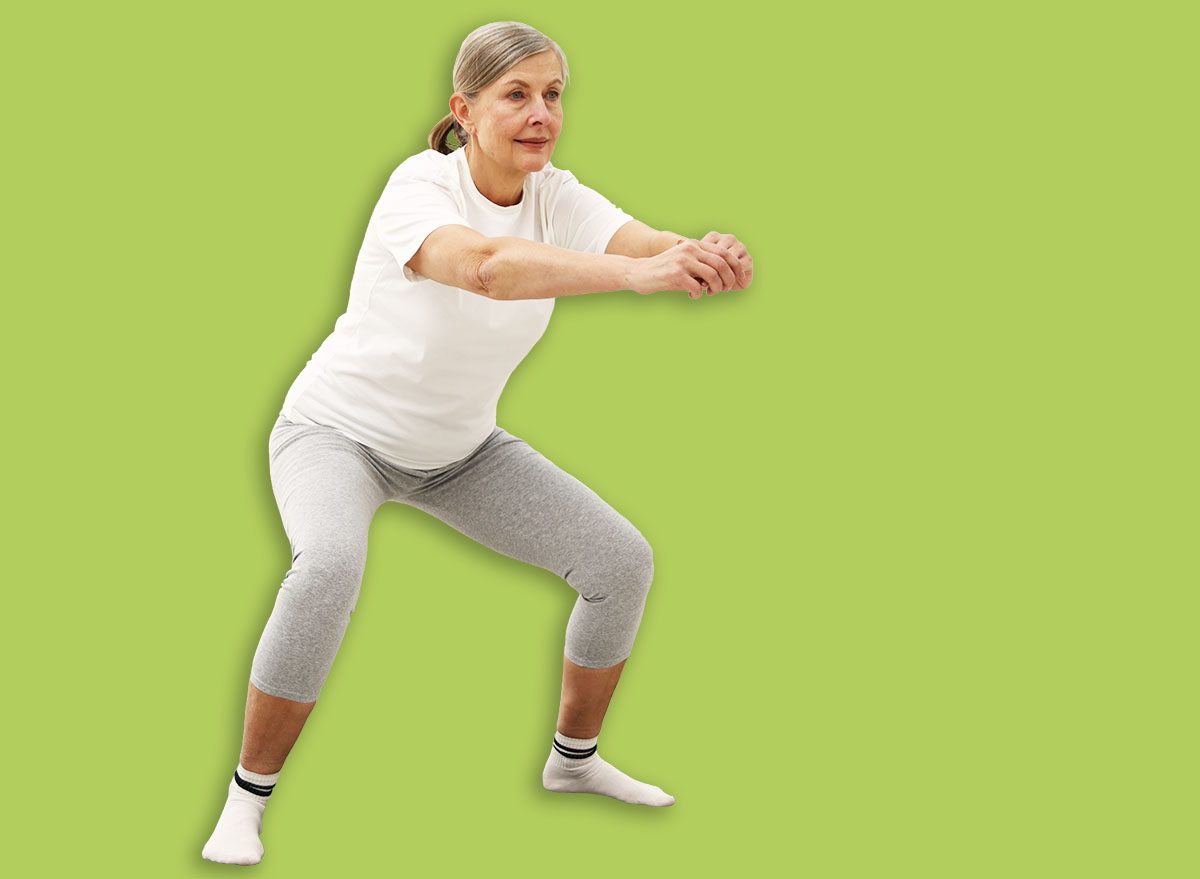
The counter-supported squat helps rebuild knee strength through one of the most useful lower-body patterns. You’re training your knees to bend and straighten while your quads, glutes, and hips share the work. The counter adds confidence, which can help you get more quality reps without feeling like balance is the limiting factor. Over time, this exercise can make standing from a chair or moving up steps feel more controlled.
Muscles Trained: Quadriceps, glutes, hamstrings, core.
How to Do It
- Stand facing a sturdy kitchen counter.
- Place both hands lightly on the counter.
- Set your feet about shoulder-width apart.
- Bend your knees and lower into a comfortable squat.
- Press through your feet to stand tall.
- Repeat with steady control.
Recommended Sets and Reps: Perform 2 to 3 sets of 8 to 12 reps.
Best Variations: Smaller-range counter squats, slow-tempo counter squats, counter squat with a pause.
Form Tip: Keep your feet planted and use the counter for balance, not to pull yourself up.
Counter-Supported Reverse Lunge
The counter-supported reverse lunge gives each leg focused strength work. That matters after 60 because one side often feels more reliable than the other, especially when the knees feel stiff or guarded. Stepping backward keeps the movement controlled, and the counter helps you stay steady while the front leg handles most of the effort. This move builds strength around the knee while also improving confidence with stepping patterns.
Muscles Trained: Quadriceps, glutes, hamstrings, calves, core.
How to Do It
- Stand facing the counter with both hands resting lightly on it.
- Stand tall with your feet about hip-width apart.
- Step one foot back.
- Bend both knees to a comfortable depth.
- Press through your front foot to return to standing.
- Alternate sides or complete all reps on one leg before switching.
Recommended Sets and Reps: Perform 2 to 3 sets of 6 to 10 reps per side.
Best Variations: Step-back taps, smaller-range reverse lunges, reverse lunge with a pause.
Form Tip: Keep most of your weight in the front leg as you return to standing.
Counter-Supported Split Squat
The counter-supported split squat builds knee strength by keeping one leg in a working position for the full set. That gives your front thigh steady tension and helps your hips support the movement. The counter makes the exercise easier to control, which is helpful when you’re building strength through a range that still feels new. It’s a strong bridge between basic squats and more demanding single-leg work.
Muscles Trained: Quadriceps, glutes, hamstrings, core.
How to Do It
- Stand beside or facing the counter.
- Step one foot back into a split stance.
- Hold the counter lightly for balance.
- Bend both knees and lower a few inches.
- Press through your front foot to rise.
- Complete all reps, then switch sides.
Recommended Sets and Reps: Perform 2 to 3 sets of 6 to 10 reps per side.
Best Variations: Smaller-range split squats, supported split squat holds, slow-tempo split squats.
Form Tip: Keep your front heel down through the full rep.
Counter-Supported Standing Leg Extension
The counter-supported standing leg extension gives your quadriceps direct work, which is important for knee support after 60. Stronger quads can help the knee feel steadier during walking, stairs, and standing movement. This version keeps the setup simple because the counter handles balance while the working leg focuses on straightening and controlling the knee. It’s a useful way to train the front of the thigh without needing a leg-extension machine.
Muscles Trained: Quadriceps, hip flexors, core.
How to Do It
- Stand beside the counter and hold it lightly with one hand.
- Shift your weight onto one leg.
- Lift the opposite knee in front of you to a comfortable height.
- Straighten that knee until your leg extends forward.
- Bend the knee again with control.
- Complete all reps, then switch sides.
Recommended Sets and Reps: Perform 2 to 3 sets of 8 to 12 reps per side.
Best Variations: Smaller-range leg extensions, seated leg extensions, band-resisted leg extensions.
Form Tip: Keep the lifted thigh steady as the lower leg moves.
Incline Counter Plank
The incline counter plank helps rebuild knee strength by improving full-body stability. Your knees work better when your core, hips, and shoulders help you stay organized during movement. This exercise gives your midsection a steady job while keeping the position more approachable than a floor plank. It also reinforces the kind of bracing that supports squats, lunges, and split squats.
Muscles Trained: Abs, shoulders, chest, glutes.
How to Do It
- Stand facing the counter.
- Place both hands on the counter about shoulder-width apart.
- Step your feet back until your body forms a straight line.
- Brace your core.
- Hold the position while breathing steadily.
- Step forward to come out of the plank.
Recommended Sets and Reps: Perform 2 to 3 holds of 20 to 40 seconds.
Best Variations: Wall plank, higher-counter plank, counter plank with shoulder taps.
Form Tip: Keep your ribs pulled down so your lower back stays steady.
Best Tips for Rebuilding Knee Strength After 60

Rebuilding knee strength works best when the routine feels steady enough to repeat. The kitchen counter gives you a familiar setup, which can make the first few sessions feel less guarded. Start with the range of motion that feels smooth, then let your knees earn more depth and control over time. Strength gains often show up first as better confidence, cleaner reps, and less hesitation during daily movement. Keep the routine simple, stay patient, and let consistency do a lot of the work.
- Use the counter as a guide: Let it help your balance while your legs handle the movement.
- Start with a smaller range: A comfortable squat or lunge gives your knees a better place to build from.
- Train both legs evenly: Give the less confident side the same attention without rushing the reps.
- Keep walks in your week: Walking supports circulation, stamina, and daily confidence on your feet.
- Support recovery with protein: Protein helps maintain the muscle that supports stronger knees.
- Progress gradually: Add reps, time, or a little more depth only when the movement feels controlled.
References
- Sadeghi, Alireza et al. “Effectiveness of muscle strengthening exercises on the clinical outcomes of patients with knee osteoarthritis: A randomized four-arm controlled trial.” Caspian journal of internal medicine vol. 14,3 (2023): 433-442. doi:10.22088/cjim.14.3.433
- Küçük, Hamza et al. “Strength training intervention for adult individuals with knee osteoarthritis: Establishing fidelity.” Frontiers in physiology vol. 16 1583153. 18 Jun. 2025, doi:10.3389/fphys.2025.1583153