5 Morning Standing Exercises That Flatten Your Stomach Before Breakfast After 40

While turning 40 has many upsides, waking up typically means more soreness and less excitement for morning workouts compared to when you were younger. And the idea of getting down on the floor for crunches or grinding through a lengthy cardio session before breakfast can feel more draining than energizing.
The good news is you don’t need intense morning workouts or hour-long cardio sessions to tighten your midsection. Instead, all you need are standing exercises to boost your body composition as you age.
While no exercise can literally “spot reduce” belly fat, studies show that daily movement and strength training exercises combined with light-to-moderate cardio performed consistently can improve insulin sensitivity, preserve lean muscle, and support fat loss. Additionally, morning exercise can help combat overnight stiffness, enhance blood flow, and boost your metabolism.
To learn more, we chatted with James Brady, a personal trainer at OriGym, who shares his top five morning standing exercises for those 40-plus to flatten your stomach before breakfast. Read on for the exercises and detailed instructions.
(And when you’re done, don’t miss these 5 Chair Exercises That Shrink Belly Pooch Better Than Planks After 50.)
Bodyweight Squats
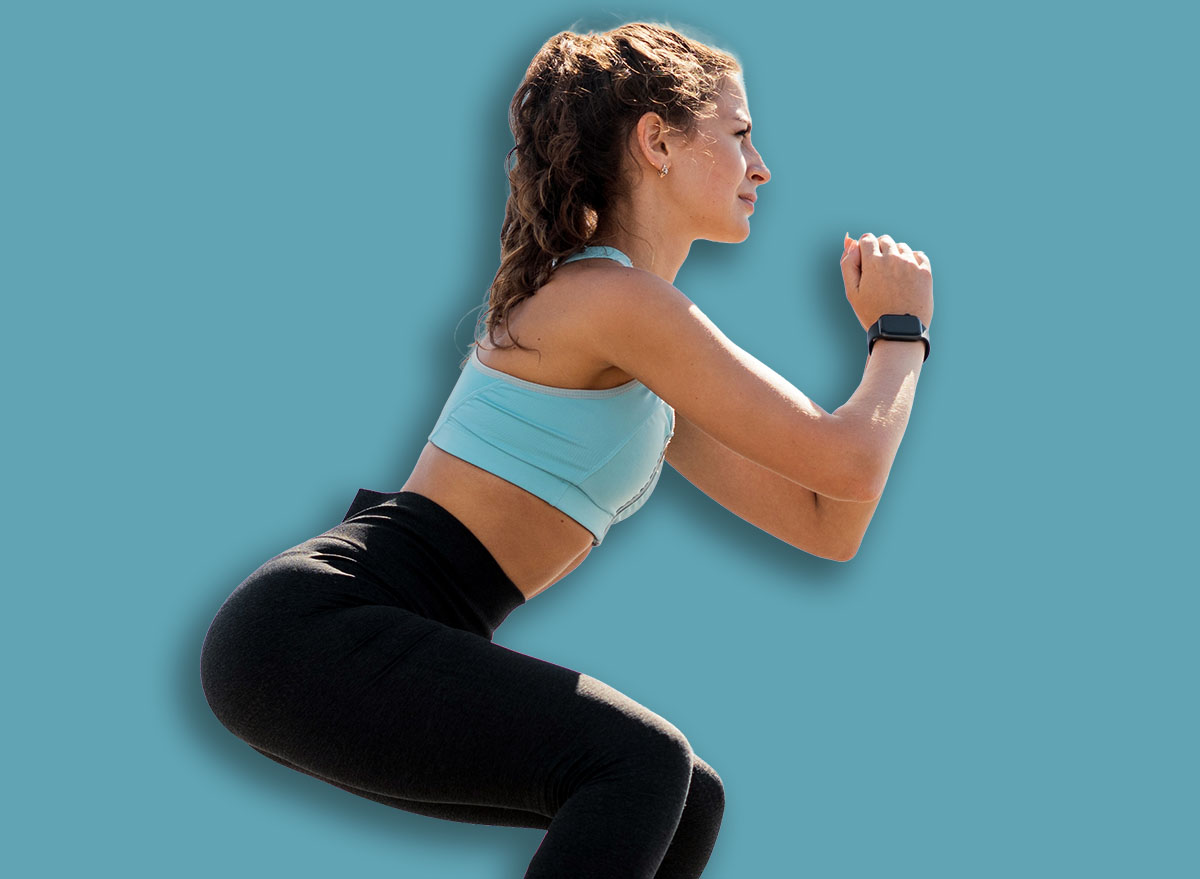
Squats are king when it comes to compound exercises. That’s because this classic move engages multiple large muscle groups at once. “Bodyweight squats activate the largest muscle groups in the body and quickly raise the heart rate,” explains Brady. “This helps increase calorie burn early in the day while building lean muscle that supports long term weight loss.”
How to do it:
- Stand with your feet about shoulder-width apart and your toes slightly turned outward.
- Engage your core while keeping your chest upright and your shoulders relaxed.
- Push your hips back as if sitting into a chair while bending your knees.
- Lower until your thighs are roughly parallel to the floor (or as far as you can go comfortably).
- Drive through your heels to stand back up while squeezing your glutes at the top.
- Perform three to four sets of 10 to 12 reps. Rest for 60 to 90 seconds between sets.
Standing Knee Drives
Unlike high-impact exercises, standing knee raises increase your heart rate gradually while reinforcing coordination and stability, both of which tend to decline without regular practice after 40.
“Standing knee drives combine gentle cardio with core engagement, helping to improve balance while encouraging blood flow and energy production,” explains Brady. “This exercise supports weight loss by increasing movement efficiency and metabolic activity without feeling overwhelming in the morning.”
How to do it:
- Stand tall with your feet hip-width apart and your hands resting lightly at your sides or on your hips.
- Lift one knee toward your chest while keeping your torso upright.
- Engage your core to control the movement rather than swinging your leg.
- Lower your foot back to the floor with control.
- Alternate sides while moving smoothly and rhythmically.
- Aim for three to four sets of 12 to 15 reps per side. Rest for 60 to 90 seconds between sets.
Jumping Jacks
Jumping jacks often get overlooked because they seem basic, but they’re undeniably one of the most efficient full-body movements you can do. “Jumping jacks are a simple but powerful exercise that elevate the heart rate and get your full body moving,” Brady says. “From a weight loss perspective, they’re great as they burn calories and improve cardiovascular fitness with minimal setup.”
How to do it:
- Stand with your feet together and your arms relaxed at your sides.
- Step or jump your feet out wide while raising your arms overhead.
- Keep your core engaged and your chest lifted throughout the movement.
- Return to the starting position with control.
- Continue at a steady, comfortable pace rather than rushing the reps.
- Jump for 30 to 45 seconds without stopping. Rest for 90 seconds and repeat two to three more times.
Standing Torso Twists
Morning stiffness in the spine is common after 40, especially after hours of sleep. Fortunately, this movement can help restore mobility while lightly engaging your obliques (side abs) and deep core muscles that support posture and rotation.
“Standing torso twists focus on the core and obliques while promoting spinal mobility, which is particularly beneficial after sleep,” explains Brady. “Although lower impact, they support weight loss by making other physical activity feel easier throughout the day.”
How to do it:
- Stand with your feet shoulder-width apart and your knees slightly bent.
- Bring your arms out in front of you or place your hands across your chest.
- Rotate your torso slowly to one side while keeping your hips facing forward.
- Return to center, then rotate to the opposite side.
- Move in a controlled, fluid motion without forcing the range of motion.
- Complete 15 to 20 reps per side, resting for 60 to 90 seconds between sets.
Marching in Place With Arm Swings
Marching in place may look simple, but it’s a powerful way to wake up the nervous system and reinforce coordination between the upper and lower body. “Marching in place with arm swings gently raises the heart rate while encouraging coordination and full body circulation,” Brady tells us. “This movement supports fat loss by helping people ease into activity and build consistency, which is one of the biggest drivers of sustainable weight loss.”
How to do it:
- Stand tall with your arms relaxed at your sides.
- Lift one knee while swinging your opposite arm forward.
- Lower your foot and repeat on the other side.
- Keep your movements smooth and controlled rather than rushed.
- Maintain steady breathing and upright posture throughout.
- Perform this movement nonstop for three to four sets of 30 to 45 seconds. Rest for 60 to 90 seconds between sets.