The 4 Best Quad Exercises for Men To Build Muscle & Strength

Let’s be honest: Leg day at the gym isn’t exactly a crowd favorite. Most of us (men in particular) would much rather do some bicep curls or bench presses to become Chris Bumstead-level jacked. But leg day cannot and should not be neglected in your fitness routine. Incorporating lower-body exercises in your workouts will help you develop and maintain lower-body strength, providing a solid foundation for daily activities and increasing overall strength. That’s why we’ve rounded up some of the best expert-approved quad exercises for men to build muscle and boost strength.
When it comes to leg workouts, focusing on your quads (quadriceps femoris) is one of the best ways to build sculpted, strong leg muscles. That’s because your quads, which are located along the top of your thighs, have the greatest amount of mass compared to all the muscle groups in your body, the Cleveland Clinic explains. Plus, your quads are essential for several functional movements, such as walking, running, jumping, and kicking.
For the most effective moves, we chatted with TJ Mentus, CPT, a certified personal trainer at Garage Gym Reviews, who shares four top-notch quad exercises for men that’ll help you develop strong, muscular upper legs. If you’re ready, let’s dive in!
Read on to learn more about how to build ripped legs, and next, check out these 9 Best Exercises for Men To Get Bigger, Stronger Legs.
Front Squats
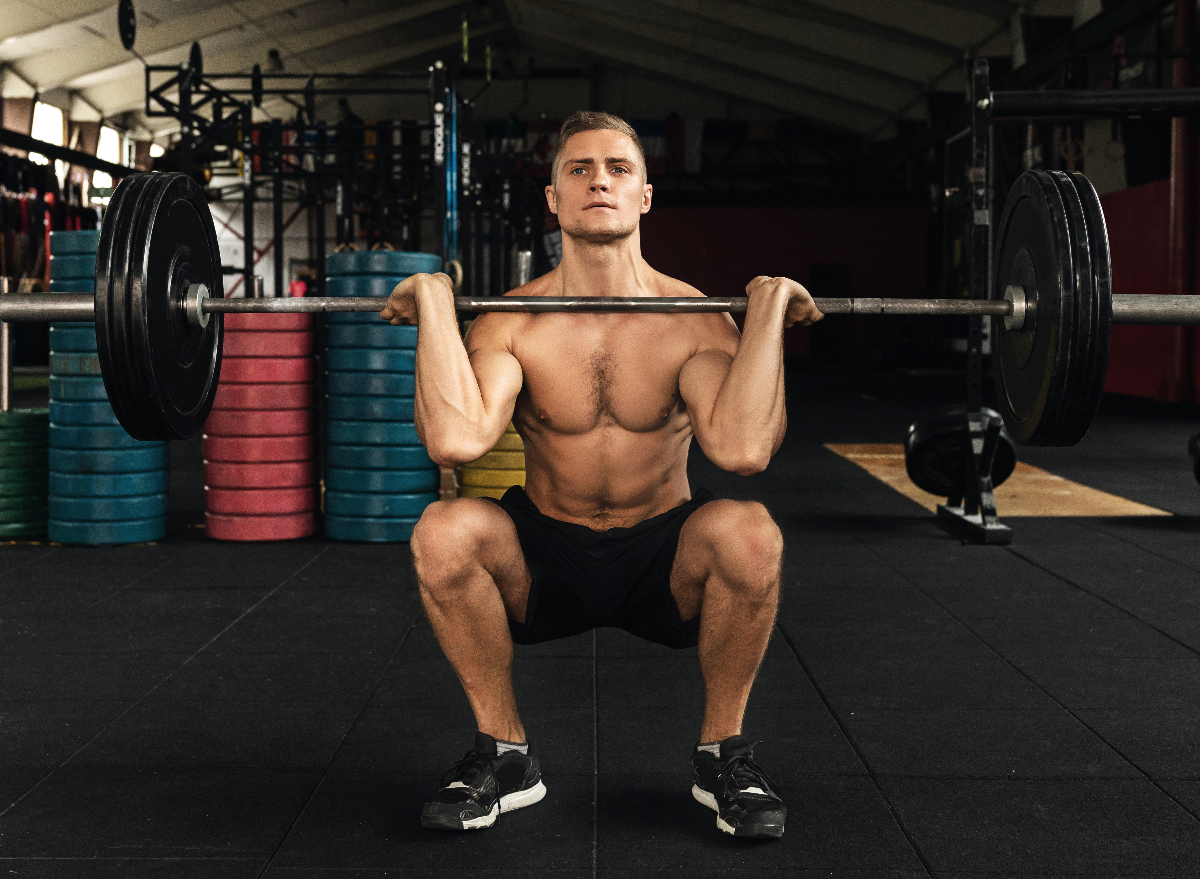
The front squat is one of the most effective exercises for activating your quads. Compared to traditional back squats, front squats require you to keep up a more “upright torso position” that places more load on your quads, The Muscle PHD explains.
“To do this exercise, place a barbell across your shoulders with your arms crisscrossed over one another, holding the bar in place with your hands. Keep your elbows high and squat with an upright torso, knees forward, and glutes towards your heels,” says Mentus.
Heel-Elevated Goblet Squats
“This exercise is a killer quad workout because raising your heels places the body at an angle that allows your knees to come forward, placing more tension on the quads,” explains Mentus. “You’ll need a slant board or weight plates to put your heels on to get started. To do this, get a dumbbell and hold it vertically, grabbing the top head of the dumbbell with your hands and placing it in front of your chest. Next, lower into a squat with an upright torso, go as low as possible, and press through your heels to stand up.”
Elevating your heels while maintaining proper form during squats can reduce strain on your lower back, increase squat depth, enhance stability, and strengthen your ankles, according to a 2022 study.
Split Squats
Split squats are a fantastic leg-strengthening exercise. Compared to a standard double-leg squat, research shows that isolating one leg at a time elicits greater quad activation by placing more load on a single leg.
“Split squats are great because they isolate one quad at a time to help balance the development of the legs,” says Mentus. “To do these, get in a split stance with your feet about three feet apart. Keep an upright torso, and bend your back knee to lower to the ground, forming a 90-degree angle with your knees. Then, press through the front foot and return to the starting position.”
Single-Leg Squat to a Bench
Single-leg squats are among the most challenging squat variations since they rely heavily on the quads for strength, stability, and balance. According to a 2019 study, this exercise has also been shown to activate and strengthen quad muscles and help rebuild quad muscle symmetry after knee surgery.
“To get in the correct position for this exercise, sit on a bench and then stand up. Where you end up is exactly how close you should be to the bench. Once you are in the correct position, balance on one leg with the other extended out in front of you. Then, set your hips back and squat down until you lightly touch the bench,” instructs Mentus. “Once you touch the bench with your glutes, press through the foot and return to standing while still on one leg. Once you finish your reps, you will repeat standing on the opposite leg.”