5 Standing Exercises That Restore Posture Faster Than Floor Exercises After 60


After 60, posture can start to shift in ways that feel subtle at first — a little more rounding in the upper back, a head that drifts forward, shoulders that seem harder to pull back. As a fitness professional, I see this pattern constantly in the women I work with, and the good news is that it’s not inevitable. The body is remarkably adaptable, and with the right daily habits, you can genuinely restore alignment and feel taller, looser, and more confident in how you move. These five standing exercises take about 10 minutes a day and can help you rebuild that posture without getting down on the floor.
Why Posture Breaks Down After 60

After 60, a few different things tend to happen in the body that affect posture — and for women, hormonal shifts make it more pronounced than it is for men.
One of the biggest factors is menopause. As estrogen declines, women lose bone density faster, which contributes to rounding in the upper back. At the same time, muscle mass decreases with age, particularly in the upper back and core muscles that help keep the spine upright. And because stiffness and joint pain can make women less physically active over time, those muscles weaken even further.
The result is a pattern where the back muscles get weaker while the chest and shoulder muscles get tighter — and over time, that imbalance creates the hunched or rounded look many women want to reverse.
Why Standing Exercises Work Best

Standing exercises are especially important for older women because they mirror the movements you actually do every day. When you’re standing, your body has to use multiple systems at once — balance, core stability, hip control, and spinal alignment — all working together. That’s the same coordination required for cooking, walking, carrying groceries, or simply getting up from a chair without help.
Floor-based exercises have their place, but for women dealing with stiffness or difficulty getting up and down, standing work is more accessible and arguably more functional. It also puts load through the bones, which helps maintain bone density, and it trains the balance systems that reduce fall risk over time.
Why Daily Consistency Beats Harder Workouts
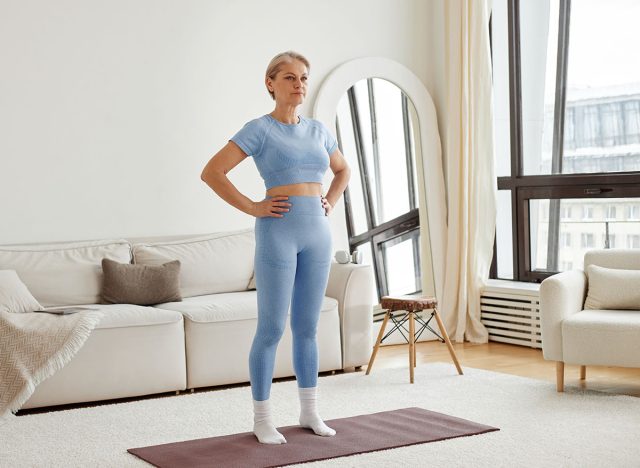
Posture problems aren’t just about weak muscles — they’re also about how the brain and body coordinate alignment throughout the day. Posture is really a habit the nervous system learns over time.
That’s why everyday consistency matters more than doing a longer or harder workout once or twice a week. Short daily exercises retrain movement patterns and consistently override the chronic habits (like sitting for hours) that pull posture out of alignment in the first place. Over time, the body learns — like muscle memory — and starts to default to the better position. About three weeks of consistency is usually when women first notice a difference: less neck or shoulder tension, easier breathing, and a sense of standing taller.
Wall Stand
This exercise teaches your body what a neutral spine actually feels like. The wall acts as physical feedback so the nervous system can learn what stacked, aligned posture feels like — which makes it easier to find that position on your own throughout the day.
Muscles Trained: Core, spinal extensors, postural stabilizers
How to Do It:
- Stand with your back, shoulders, and head against a wall
- Engage your core to flatten your lower back against the wall
- Hold for 5–10 seconds
- You should feel your core slightly activate without forcing your back flat
Avoid These Mistakes:
- Don’t arch the lower back — the goal is a flat, neutral spine against the wall
- Don’t hold your breath; keep breathing normally throughout the hold
- Don’t press too aggressively into the wall — this is a gentle feedback drill, not a strength push
Recommended Sets and Reps: 5–8 holds of 5–10 seconds
Form Tip: Think of lengthening through the crown of your head rather than just pushing your back flat.
Variation: Easier — hold for a shorter duration. Harder — raise arms slightly while maintaining full alignment.
Shoulder Blade Squeezes
This move strengthens the muscles between the shoulder blades — the ones responsible for pulling the shoulders back and keeping the chest open. Weakness here is one of the primary drivers of rounded shoulders, so working these muscles daily makes a real difference.
Muscles Trained: Rhomboids, mid-trapezius, rear deltoids
How to Do It:
- Stand tall with your feet hip-width apart
- Pull your shoulders back and down, squeezing the shoulder blades together
- Think about sliding the shoulder blades slightly down toward your back pockets
- Hold for 5 seconds, then release
- Repeat 8–10 times
Avoid These Mistakes:
- Don’t shrug the shoulders upward — the movement is back and down, not up
- Don’t lean backward to compensate; your torso stays upright
- Don’t tense the neck; keep it long and relaxed throughout
Recommended Sets and Reps: 2–3 sets of 8–10 reps
Form Tip: The “back pockets” cue is the key one here — it keeps the shoulders from hiking up while you squeeze.
Variation: Easier — perform seated. Harder — add a light resistance band.
Chin Tucks
Chin tucks strengthen the deep neck muscles that bring the head back into alignment over the shoulders. This is especially important because “tech neck” — where the head drifts forward from looking down at phones and screens — is one of the most common posture problems I see, and it puts significant strain on the upper back and neck.
Muscles Trained: Deep cervical flexors, upper trapezius (lengthening)
How to Do It:
- Stand or sit tall
- Pull your chin straight back, as if you’re making a double chin
- Your eyes should stay level — don’t tilt the head up or down
- Hold for 3–5 seconds, then release
- Repeat 8–10 times
Avoid These Mistakes:
- Don’t look downward — the motion is straight back, not down
- Don’t let the shoulders creep up or tense during the hold
- Keep the movement small and controlled; this isn’t a large range of motion
Recommended Sets and Reps: 2–3 sets of 8–10 reps
Form Tip: Imagine someone gently pressing a finger against your chin and pushing it straight back — that’s the direction you’re moving.
Variation: Easier — perform with the back of your head against a wall for guidance. Harder — hold the tucked position longer.
Standing Cat-Cow
This exercise restores gentle mobility through the spine and builds awareness of spinal position throughout the day. Many women over 60 have lost range of motion in the spine simply from underusing it — this movement brings it back gradually and safely.
Muscles Trained: Spinal extensors, abdominals, hip flexors (mobilization)
How to Do It:
- Stand with feet hip-width apart and place your hands on your hips or thighs
- Gently arch your back while looking slightly up — this is the “cow” position
- Then round your spine while gently tucking your chin — this is the “cat” position
- Move smoothly and slowly between the two positions
- The movement should feel controlled, not forced
- Perform 8–10 reps
Avoid These Mistakes:
- Don’t rush through the movement — slow and smooth is the point
- Don’t overarch in the cow position, especially in the lower back
- Don’t strain the neck; let the head follow the spine naturally
Recommended Sets and Reps: 1–2 sets of 8–10 slow reps
Form Tip: If something feels pinched or sharp, reduce your range of motion — you’re looking for a gentle stretch, not a deep bend.
Variation: Easier — use a smaller range of motion in both directions. Harder — reach arms forward during the cow phase for added challenge.
Doorway Chest Stretch
Tight chest muscles are one of the biggest contributors to rounded posture, and stretching them consistently makes it much easier for the upper back muscles to hold an upright position. This stretch opens the front of the body so everything else can fall back into place.
Muscles Trained: Pectorals, anterior deltoids, chest fascia (lengthening)
How to Do It:
- Stand in a doorway and place your forearms on the frame at roughly shoulder height
- Gently lean your body forward until you feel a stretch across the chest
- Hold for 20–30 seconds
- Step back, rest, and repeat
Avoid These Mistakes:
- Don’t arch the lower back as you lean forward — keep the core lightly engaged
- Don’t let the shoulders rise toward the ears during the stretch
- Don’t lean too aggressively; this should be a comfortable, sustained stretch
Recommended Sets and Reps: 2–3 rounds of 20–30 seconds
Form Tip: The stretch should be felt across the chest and front of the shoulders — if you’re only feeling it in one spot, adjust your arm position slightly.
Variation: Easier — keep elbows lower on the frame. Harder — raise arms slightly higher.
Your 10-Minute Daily Routine
I’d think about the routine in three phases: alignment, activation, and mobility. Here’s the order that works best:
Phase 1 — Alignment: Wall Stand → Chin Tucks
Phase 2 — Activation: Shoulder Blade Squeezes → Standing Cat-Cow
Phase 3 — Mobility: Doorway Chest Stretch
The whole sequence takes about 10 minutes. Done consistently, most women start to notice changes around the three-week mark — less neck and shoulder tension, a sense of standing taller, and sometimes easier breathing as the chest opens up more.
Habits That Undermine Your Progress

Even with a solid daily routine, certain habits can quietly pull posture back in the wrong direction. The most common ones I see:
- “Tech neck” — looking down at phones or tablets for extended periods
- Prolonged sitting — staying in one position without breaks
- Carrying a heavy bag on one shoulder — this creates a chronic lean and imbalance
- Sleeping on your stomach — this strains the neck and lower back
- Crossing your legs while seated — shifts the pelvis over time
The adjustments that make the biggest difference: raise your screens to eye level, move for a few minutes every 30–45 minutes if you’re sitting for a stretch, and try to sleep on your back or side.
When to Check With Your Doctor First

These exercises are gentle, but there are certain conditions where it’s worth getting medical clearance before starting. I’d recommend checking with your doctor first if you have:
- Cardiovascular conditions such as heart disease, uncontrolled hypertension, arrhythmia, or angina
- Respiratory issues like COPD
- Metabolic conditions like diabetes
- A recent surgery, heart attack, or fracture
- Joint conditions like arthritis that cause significant pain with movement
- Any symptoms during activity — dizziness, shortness of breath, or sharp pain
When in doubt, a quick conversation with your physician can give you the confidence to move forward safely.