5 Classic Strength Moves That Build More Muscle Than Machines After 40

Walk into almost any commercial gym and you’ll see the same set-up—rows of machines designed to isolate individual muscles, each promising a “better” way to build strength. For many people over 40, that appeal makes sense. Your joints don’t feel as strong as they once did, recovery takes longer, and the idea of using machines seems safer than loading a barbell with heavy weight.
But here’s the truth: studies show that muscle doesn’t care whether resistance comes from a machine or free weights. What it responds to is tension, coordination, and progressive overload applied in ways that your body can adapt to.
Don’t get us wrong, machines have their place and purpose. They can stabilize the load for you, helping you guide the path and removing the need for balance and coordination. However, over time, using only machines limits how much total muscle you train. Conversely, free-weight exercises require your body to stabilize itself while producing force, which recruits greater muscle activation.
We chatted with Kris Herbert, CPT, a certified personal trainer and owner of The Gym Venice, who shares his go-to five classic strength moves that build more muscle than machines. “After 40, strength training isn’t about chasing soreness or isolating muscles one at a time,” says Herbert. “It’s about training movements that build real muscle, protect joints, and carry over to everyday life.”
Keep reading for the exercises and detailed step-by-steps. When you’re finished, don’t miss If You Can Do This Many Lunges After 50, Your Leg Strength Is Top-Tier.
Squat (Goblet or Barbell)
Few movements are as foundational as the traditional squat. This compound exercise trains your legs and hips, demands core stability, and reinforces patterns you use every single day, from standing up to climbing stairs.
“The squat builds strength through the legs and hips while reinforcing core stability, which supports bone density, joint health, and the ability to move well as you age,” explains Herbert.
How to do it:
- Stand with your feet shoulder-width apart, holding a dumbbell at chest height (goblet) or a barbell across your upper back.
- Engage your core as if getting ready to absorb a light impact.
- Sit your hips back and down while keeping your chest upright.
- Lower until your thighs are parallel to the floor (or as far as you can comfortably go).
- Drive through your heels to stand, maintaining control throughout.
- Perform three to four sets of six to 10 reps. Rest for 90 to 120 seconds between sets.
Deadlift (Trap Bar or Conventional)
If squats teach you how to sit and stand, deadlifts teach you how to lift safely and powerfully. Few exercises engage as much muscle mass in a single movement.
Herbert calls it what it is: “The deadlift is one of the most effective total-body strength builders. It trains the glutes, hamstrings, back, and grip while teaching proper hip hinge mechanics that protect the spine.”
How to do it:
- Stand with a barbell or trap bar centered over your mid-foot.
- Hinge at your hips while keeping your spine neutral and chest proud.
- Grip the bar firmly and brace your core.
- Push the floor away as you stand tall (keep the weight close to your shins).
- Stand up tall without leaning back, hold for one to two seconds, then lower with control.
- Complete three to five sets of four to eight reps, resting for two to three minutes between sets.
RELATED: 5 Daily Standing Routines That Build Strength Better Than the Gym After 50
Push-ups (or Bench Press)
Pressing strength is essential for maintaining upper-body muscle mass, and push-ups are a non-negotiable pushing movement. “This movement is a foundational upper-body press that builds the chest, shoulders, arms, and core together, reinforcing shoulder stability, which machines often remove,” says Herbert.
How to do it:
- Place your hands slightly wider than shoulder-width apart on the floor or bench.
- Extend your legs so your body forms a straight line from head to toe.
- Flex your core and glutes to prevent sagging.
- Lower your chest under control toward the ground.
- Press the floor away to return to the top position.
- Aim for three to four sets of eight to 15 reps. Rest for 60 to 90 seconds between sets.
Row (Dumbbell or Barbell)
Rows are fantastic for building muscle and improving posture. Also, since most daily movements require pressing movements, building your pulling strength becomes increasingly important for shoulder health and musculoskeletal balance.
“Rows strengthen the upper back and arms while supporting posture and shoulder health,” Herbert explains. “That balance matters more after 40, when rounded shoulders and neck tension become common.”
How to do it:
- Hold a dumbbell or barbell with a neutral spine and hinged hips.
- Let your arms hang straight down toward the floor.
- Pull your elbows toward your hips, not your shoulders.
- Squeeze your shoulder blades together at the top.
- Lower the weight slowly under control.
- Do three to four sets of eight to 12 reps, resting for 60 to 90 seconds between sets.
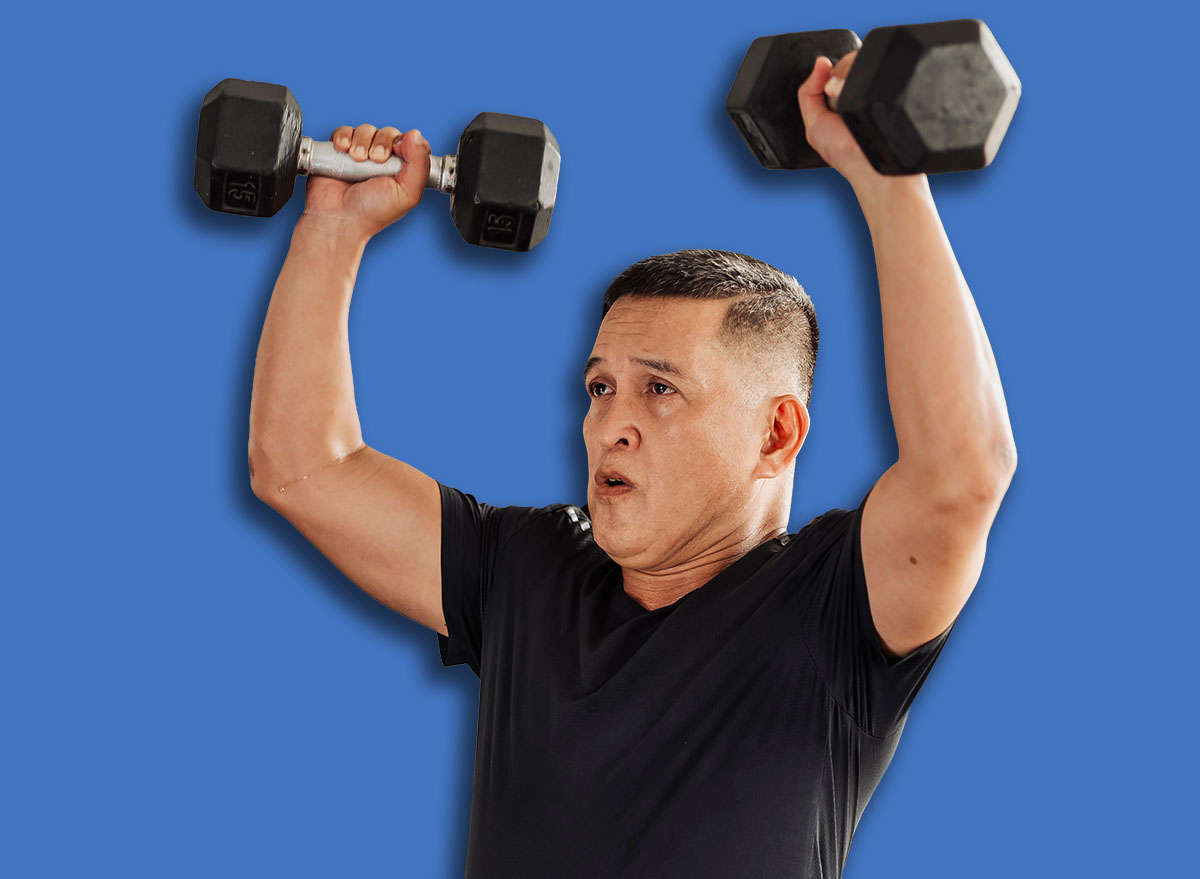
Overhead Press (Dumbbell or Barbell)
The overhead press gets a bad rap for being “dangerous,” but that usually comes down to poor form or trying to lift too much weight, not the movement itself. When done properly, the overhead press is one of the most valuable strength builders after 40.
“Pressing overhead builds strong shoulders and arms while demanding core stability,” says Herbert. “It improves shoulder function instead of breaking it down.”
How to do it:
- Stand tall holding dumbbells or a barbell at shoulder height.
- Brace your core and squeeze your glutes.
- Press the weight straight overhead in a controlled path.
- Finish with your biceps near your ears, not flared forward.
- Lower back to shoulder height with control.
- Perform three to four sets of six to 10 reps, resting for 90 to 120 seconds between sets.