If You Can Hold a Wall Sit This Long After 60, Your Leg Strength Is Top-Tier

Whether you enjoy walking, running, golfing, or simply staying in stellar shape, leg strength is key. Not only are strong legs important to perform leisurely activities, but they’re also essential to stay balanced and decrease your chance of falling as you age.
Getting into strength training is important—and helpful. But are you getting enough to compensate for the natural loss of muscle that begins as early as your 30s? We spoke with Jaqueline Gavino, MPH, CHES® & Director of Fitness at Pritikin, who shares how you can test yourself—and it has to do with wall sits.
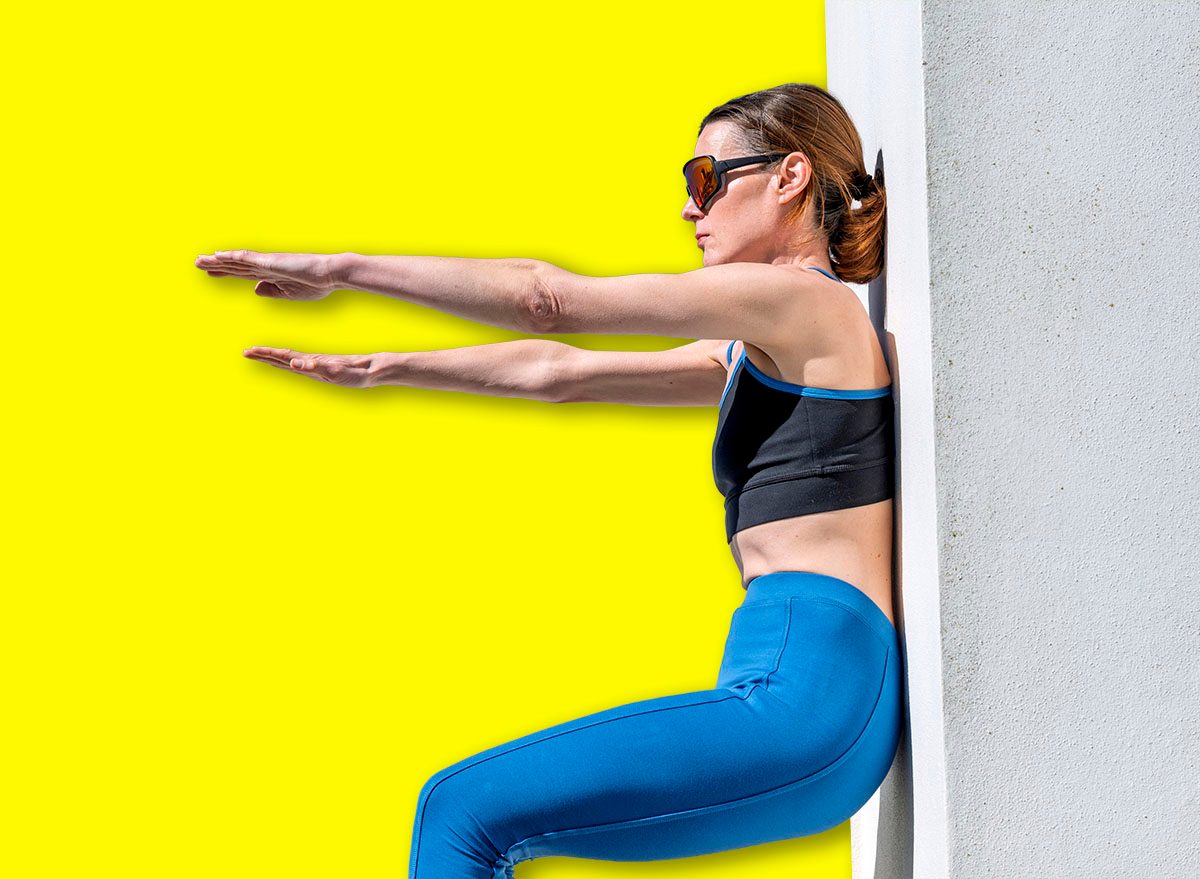
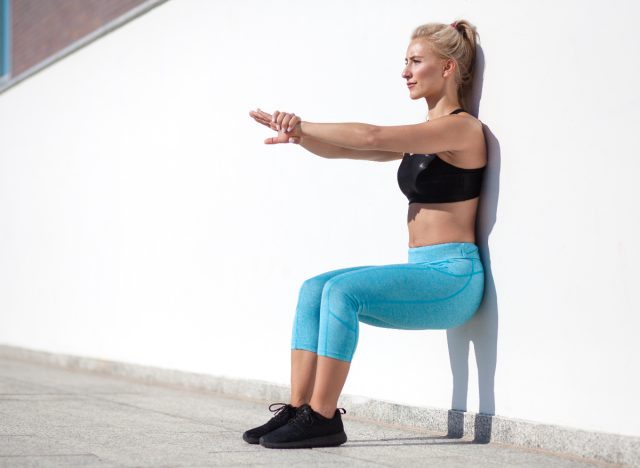
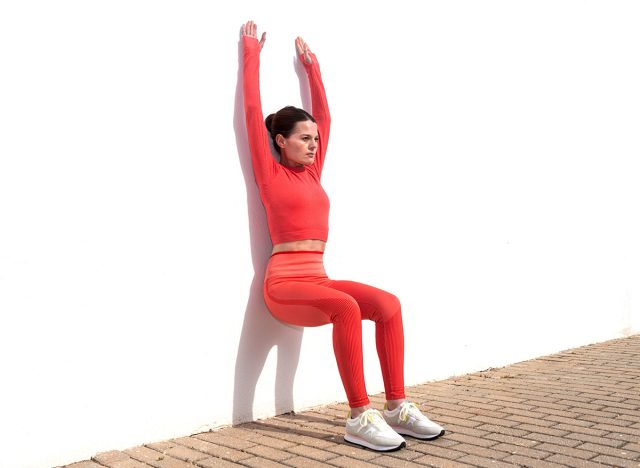
A wall sit, also known as a wall squat, is a bodyweight exercise where you push your back against a wall to form a sitting position. You bend your knees at a 90-degree angle and hold the position. By doing so, you force your muscles to contract under tension.
According to Gavino, if you can hold a wall sit this long after 60, your leg strength is top-tier.
Are Wall Sits Safe for Most Adults Over 60?
Let’s begin with safety. According to Gavino, wall sits are generally safe for adults in the 60+ population. This exercise is a closed-chain, low-impact move that puts minimal shear force on your knee joints compared to more dynamic movements like squats or lunges.
“A 2023 meta-analysis published in the British Journal of Sports Medicine, analyzing 270 randomized controlled trials with nearly 16,000 participants, found that isometric exercise produced the greatest reductions in resting blood pressure of any exercise modality tested, including aerobic training, high-intensity interval training (HIIT), and dynamic resistance training, with the wall sit ranking as the single most effective individual exercise for reducing systolic blood pressure,” Gavino says. “However, individuals with severe knee osteoarthritis, recent joint replacement, or uncontrolled hypertension should consult a physician before beginning.”
What Makes the Wall Sit a Solid Indicator of Lower-Body Strength and Endurance After 60?

The wall sit is an isometric exercise that puts your muscles to the test to generate and sustain force without changes in joint angle or muscle length. This is what makes it uniquely telling of true functional capacity, Gavino says.
“A study published in Aging Clinical and Experimental Research found that quadriceps strength is the sole predictor of how long older adults can sustain multi-joint functional tasks like sit-to-stand repetitions, with older adults already beginning those tasks closer to their maximal voluntary contraction capacity than younger adults,” she explains. “A cross-sectional study in PLOS ONE further confirmed that quadriceps strength is the strongest correlate of independence in activities of daily living among older adults. Compounding this, research shows that lower limb strength declines by roughly 10–15% per decade after age 40, with the rate accelerating after 60, making a timed isometric hold, such as the wall sit, a sensitive and practical screening tool.”
How Does Wall Sit Performance Translate to Daily Life?
The connection between wall sit performance and completing daily tasks is strong. Simple tasks like climbing a flight of stairs, rising from a chair, and walking all engage the same muscle groups that a wall sit does.
“From a neuromuscular standpoint, a 2026 study published in the International Journal of Environmental Research and Public Health found that isometric lower limb training in older adults produced significant improvements in strength, balance, mobility, and functional outcomes, including meaningful gains on the clinical 6-Minute Walk Test and the 5 Times Sit-to-Stand test, both of which directly reflect real-world movement capacity,” Gavino points out.
How Often To Practice Wall Sits
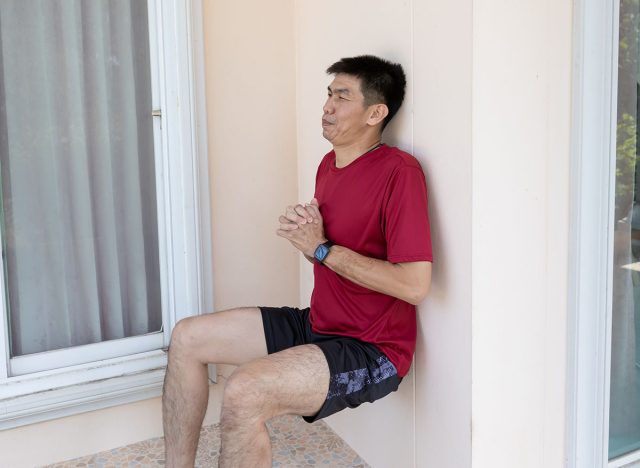
For those just starting out, Gavino recommends doing wall sits two to three times a week is a solid goal to aim for. Begin with shorter hold times—20 to 30 seconds—and progress from there.
“A feasibility trial of isometric wall squats published in the Journal of Cardiopulmonary Rehabilitation and Prevention found no serious side effects, with high participant satisfaction and strong intention to continue, supporting its safety as a regular practice. The key principle is progressive overload: gradually increasing hold time rather than forcing maximum effort,” Gavino stresses.
A “Top-Tier” Wall Sit Time
According to Gavino, trainer guidelines and age-related charts typically show a decline with age, with the average performance being roughly 20 to 40 seconds for those 60+.
“That said, multiple studies confirm high test-retest reliability for the wall sit and strong associations with functional outcomes and fall risk,” Gavino adds. “For adults over 60, holding 60 to 90 seconds with proper form, knees at 90 degrees, back flat, no arm support, is generally considered strong. Holding over 60 seconds is a meaningful signal of quadriceps endurance and functional reserve.”