5 Standing Exercises That Restore Quad Strength Faster Than Gym Machines After 60

Quad strength becomes a non-negotiable of mobility and quality of life after 60, yet it’s often one of the first physical qualities to decline with age. Your quads are the large muscles at the front of your thighs and are essential for standing up, climbing stairs, walking, and maintaining balance. When they weaken, common daily tasks that once felt effortless can quickly become challenging.
Many older adults turn to gym machines like the leg extension or leg press to rebuild strength, but those exercises don’t always translate to real-life movement. Machines stabilize your body for you, which means many of the smaller stabilizing muscles responsible for balance and coordination remain undertrained. That can limit improvements in functional strength, which is the kind of strength you actually use during daily life.
So how do you go about strengthening your quads? According to a 2025 study, functional standing exercises help improve balance, mobility, and lower-body coordination better than isolated machine exercises alone. Additionally, other research has found that compound lower-body movements can improve muscular endurance and movement quality in older adults while enhancing joint health.
To find out which standing exercises you should do for restoring quad strength after 60, we chatted with James Brady, CPT, a certified personal trainer at OriGym, who shares his top five standing exercises. Read on for the movements and detailed instructions. Then, when you’re done, be sure to check out these 5 Standing Exercises That Shrink Belly Pooch Faster Than Gym Classes After 60.
Sit-to-Stand Squats
Sit-to-stand squats are one of the most practical lower body exercises older adults can perform. The movement directly trains the muscles involved in standing up, sitting down, and climbing stairs.
How to do it:
- Sit upright on a sturdy chair with your feet hip-width apart.
- Position your feet flat on the floor beneath your knees.
- Lean slightly forward from your hips.
- Drive through your heels to stand up.
- Keep your chest lifted throughout the movement.
- Fully extend your hips and knees at the top.
- Slowly lower yourself back into the chair with control.
- Avoid dropping down quickly or collapsing into the seat.
- Complete two to three sets of 10 to 15 reps. Rest for 45 to 60 seconds between sets.
Split Squats
“Split squats are excellent for strengthening each leg individually while improving knee stability and balance,” says Brady. And since the movement works one leg at a time, it can help address strength imbalances between sides.
How to do it:
- Stand with one foot forward and the other behind you.
- Keep your feet about hip-width apart for stability.
- Engage your core and maintain upright posture.
- Slowly lower your back knee toward the floor.
- Keep your front knee aligned over your ankle.
- Lower only as far as comfortable.
- Push through your front heel to return to standing.
- Perform 2 to 3 sets of 8 to 10 reps per leg, resting for 45 to 60 seconds between sets.
Step-ups
“Step-ups help restore quad strength in a highly functional way because they replicate climbing stairs,” explains Brady. This movement also improves coordination and balance.
How to do it:
- Stand in front of a low step or stair.
- Place one foot firmly on the step.
- Engage your core and keep your chest upright.
- Push through the working leg to lift your body upward.
- Bring your opposite foot up to meet it.
- Step back down slowly with control (avoid pushing excessively off the trailing leg).
- Aim for two to three sets of 10 reps per leg. Rest for 45 to 60 seconds between sets.
Wall Sits
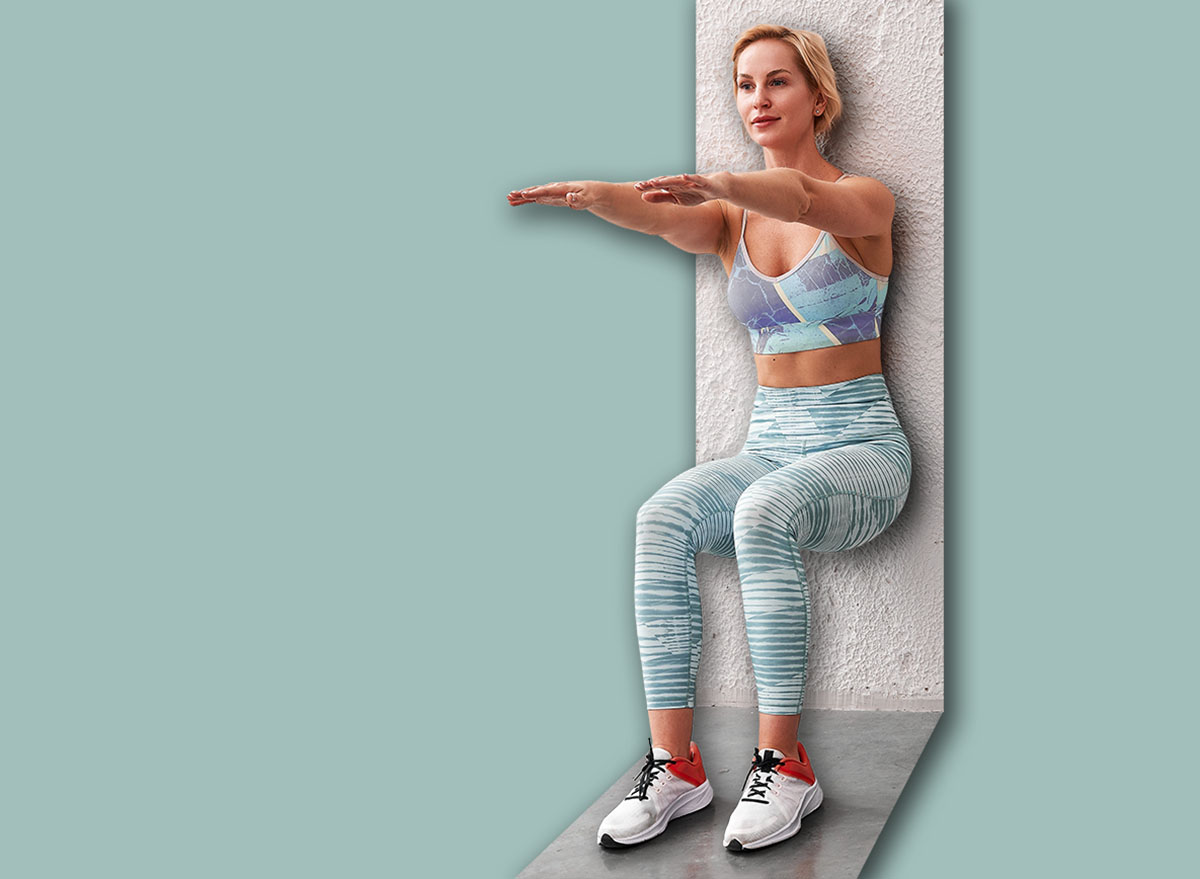
“Wall sits are ideal for building quad endurance without placing excessive strain on the joints,” Brady says. Because the movement is isometric, the muscles remain under continuous tension during the hold.
How to do it:
- Stand with your back flat against a wall.
- Walk your feet forward slightly.
- Slowly slide your back down the wall.
- Lower until your knees are comfortably bent.
- Keep your knees aligned over your ankles.
- Engage your core and maintain steady breathing.
- Distribute your weight evenly through both feet.
- Hold for 20 to 45 seconds across three rounds. Rest for 60 to 90 seconds between rounds.
Reverse Lunges
Reverse lunges strengthen your quads and glutes while reducing stress on your knees compared to forward lunges. Plus, the backward stepping motion will challenge your balance and coordination.
How to do it:
- Stand tall with your feet hip-width apart.
- Engage your core and maintain upright posture.
- Step one leg backward into a lunge position.
- Lower until both knees are bent comfortably.
- Keep your front knee aligned over your ankle (avoid leaning forward too far).
- Push through your front heel to return to a standing position.
- Complete two to three sets of 8 to 10 reps per leg, resting for 45 to 60 seconds between sets.