The 10-Minute Morning Routine That Restores Muscle Tone Faster Than Lifting Weights After 60


Muscle tone after 60 comes from giving your muscles a consistent reason to work. That doesn’t always require a full lifting session, especially first thing in the morning. A short routine can create enough tension, control, and effort to help the body feel stronger before the day gets moving.
The key is choosing exercises that train more than one area at a time. A squat pattern works the legs and hips. A push-up variation trains the upper body. A marching plank challenges the shoulders, core, and hips while adding a little pace. Together, they create a compact routine that feels more complete than a few isolated moves.
I’d use this kind of routine with clients who need something repeatable. Ten minutes is short enough to fit into the morning, but long enough to make the muscles work when the reps are controlled. The goal is steady effort, clean positions, and enough challenge to build consistency.
You’ll perform three exercises for three rounds. The timed work adds up to about nine minutes, and the extra minute gives you room to move between exercises, reset your position, and keep the routine flowing.
How to Do the 10-Minute Morning Routine

Set a timer for 45 seconds of work and 15 seconds of rest. Complete the three exercises below in order, then repeat for three total rounds.
- Chair Sit-to-Stand: 45 seconds.
- Incline Push-Up: 45 seconds.
- Elevated Mountain Climber: 45 seconds.
Use the 15-second rest to reset and move to the next exercise. Keep the pace controlled during the first round, then increase effort slightly if your form still feels strong.
Chair Sit-to-Stand
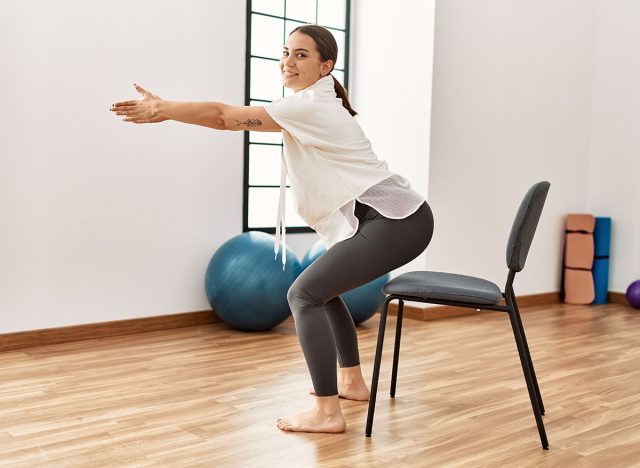
Chair sit-to-stands train the thighs, glutes, hamstrings, and core with a movement you use every day. The chair gives you a clear target, which helps keep the reps consistent as fatigue builds. Stand all the way up at the top and lower with control to make the set count.
Muscles Trained: Quadriceps, glutes, hamstrings, core.
How to Do It:
- Sit near the front edge of a sturdy chair.
- Place your feet flat on the floor about hip-width apart.
- Brace your core and lean your chest slightly forward.
- Press through your whole feet to stand tall.
- Push your hips back and lower toward the chair.
- Tap the seat lightly and repeat.
Recommended Sets and Reps: Perform 45 seconds of work for 3 rounds.
Best Variations: Higher-chair sit-to-stands, pause sit-to-stands, slow-tempo sit-to-stands.
Form Tip: Tap the chair without fully relaxing into the seat.
Incline Push-Up
Incline push-ups build chest, shoulder, triceps, and core strength from a more accessible angle than the floor. A counter, sturdy bench, or secured chair lets you adjust the difficulty. Keep your body long and move your chest toward the surface with control.
Muscles Trained: Chest, shoulders, triceps, core, glutes.
How to Do It:
- Place your hands on a sturdy, elevated surface slightly wider than shoulder-width.
- Step your feet back until your body forms a straight line.
- Brace your core and lightly squeeze your glutes.
- Bend your elbows and lower your chest toward the surface.
- Press through your palms to return to the starting position.
- Repeat with a smooth, steady tempo.
Recommended Sets and Reps: Perform 45 seconds of work for 3 rounds.
Best Variations: Wall push-ups, counter push-ups, slow-tempo incline push-ups.
Form Tip: Keep your elbows angled slightly back and avoid letting your hips sag.
Elevated Mountain Climber
Elevated mountain climbers add a controlled conditioning element while your upper body and core stay active. The elevated angle makes the plank position easier to manage, and the knee drive keeps the routine moving. Use a brisk pace that still lets you keep your hips steady.
Muscles Trained: Abs, shoulders, hip flexors, glutes, quadriceps.
How to Do It:
- Place your hands on a sturdy counter, bench, or secured chair.
- Step your feet back into an incline plank.
- Brace your core and keep your shoulders over your hands.
- Drive one knee toward your chest.
- Step that foot back.
- Alternate sides for the full interval.
Recommended Sets and Reps: Perform 45 seconds of work for 3 rounds.
Best Variations: Slow knee drives, cross-body mountain climbers, slow-tempo mountain climbers.
Form Tip: Keep your hips level and shorten the range if your lower back starts to arch.
How to Progress This Morning Routine After 60
Use this routine three to five mornings per week. Keep the effort moderate at first, then build the challenge once the three rounds feel controlled.
- Start with clean reps: The first goal is steady movement through all three rounds. Keep your pace smooth before trying to move faster.
- Make the exercises harder gradually: Use a lower incline for push-ups, add a pause to sit-to-stands, or increase the pace of mountain climbers once your form holds up.
- Keep the rest honest: The 15-second break should give you enough time to reset, not fully recover. That keeps the routine active without rushing the movements.
- Use support when needed: A sturdy chair, counter, or bench can make the routine safer and easier to repeat.
- Track one simple marker: Count your quality reps during the first round and compare them week to week. More clean reps in the same time window show progress.
A 10-minute morning routine can give your body a strong daily training signal. Keep the movements simple, make each rep count, and let the consistency build better muscle tone over time.
References
- Schumacher, Leah M et al. “Consistent exercise timing as a strategy to increase physical activity: A feasibility study.” Translational journal of the American College of Sports Medicine vol. 8,2 (2023): e000227. doi:10.1249/tjx.0000000000000227
- Kirk, Benjamin J C et al. “Effects of a daily, home-based, 5-minute eccentric exercise program on physical fitness, body composition, and health in sedentary individuals.” European journal of applied physiology vol. 125,8 (2025): 2241-2255. doi:10.1007/s00421-025-05757-7