4 Daily Exercises That Build More Strength Than Weight Training After 50

Strength after 50 shows up in how easily you move through your day. Getting out of a chair without momentum, carrying groceries without bracing yourself, and walking upstairs without that familiar hesitation. These moments reflect usable strength, the kind that supports joints, balance, and confidence far more than a single heavy lift ever could.
Daily bodyweight training delivers a powerful stimulus because it forces your muscles to control your body through space. Every rep demands coordination, stability, and time under tension. That combination challenges muscle fibers, connective tissue, and the nervous system together. Over time, this approach builds strength that carries over to real-world situations faster than isolated weight-training sessions.
Research supports this shift. A recent peer-reviewed paper in the Journal of Yoga and Physiotherapy found that structured bodyweight training significantly improves muscular strength and endurance when exercises are performed with progressive difficulty and consistent volume.
The exercises below form a simple daily framework. Each move trains multiple muscle groups, reinforces joint integrity, and scales easily as your strength improves. Together, they create a full-body stimulus that adds up fast.
Split Squats
Split squats build unilateral leg strength while challenging balance and hip stability. This forces each leg to work independently, exposing and correcting side-to-side strength differences that traditional squats often hide. The staggered stance places sustained tension on the quads and glutes, while the rear leg stretches the hip flexors, helping restore stride length and posture. Over time, this improves knee resilience, walking mechanics, and lower body power.
Muscles Trained: Quadriceps, glutes, hamstrings, adductors, core stabilizers
How to Do It:
- Step one foot forward and lower your rear knee toward the floor.
- Keep your torso tall and your front heel planted.
- Lower until your front thigh approaches parallel with the ground.
- Drive through your front foot to return to standing.
- Complete all reps before switching sides.
Recommended Sets and Reps: Knock out 3 sets of 8 to 10 reps per side. Rest for 45 to 60 seconds between each set.
Best Variations: Rear foot elevated split squat, slow tempo split squat, split squat with pause at the bottom.
Form Tip: Think about dropping straight down instead of drifting forward.
Push-Ups
Push-ups build upper-body strength while engaging your core to stabilize your body. Unlike machines or benches, your shoulders must control both movement and joint position on every rep. This improves pressing strength while reinforcing shoulder health. Push-ups also train trunk stiffness, which helps protect your spine during daily lifting and reaching tasks.
Muscles Trained: Chest, shoulders, triceps, core, upper back stabilizers
How to Do It:
- Place your hands slightly wider than shoulder width on the floor.
- Extend your legs and brace your core.
- Lower your chest toward the floor under control.
- Press the ground away to return to the top position.
- Maintain a straight line from head to heels throughout the set.
Recommended Sets and Reps: Perform 3 to 4 sets of 6 to 12 reps. Rest for 45 to 60 seconds between each set.
Best Variations: Incline push-ups, tempo push-ups, pause push-ups
Form Tip: Screw your hands into the floor to create shoulder tension before you descend.
Glute Bridge
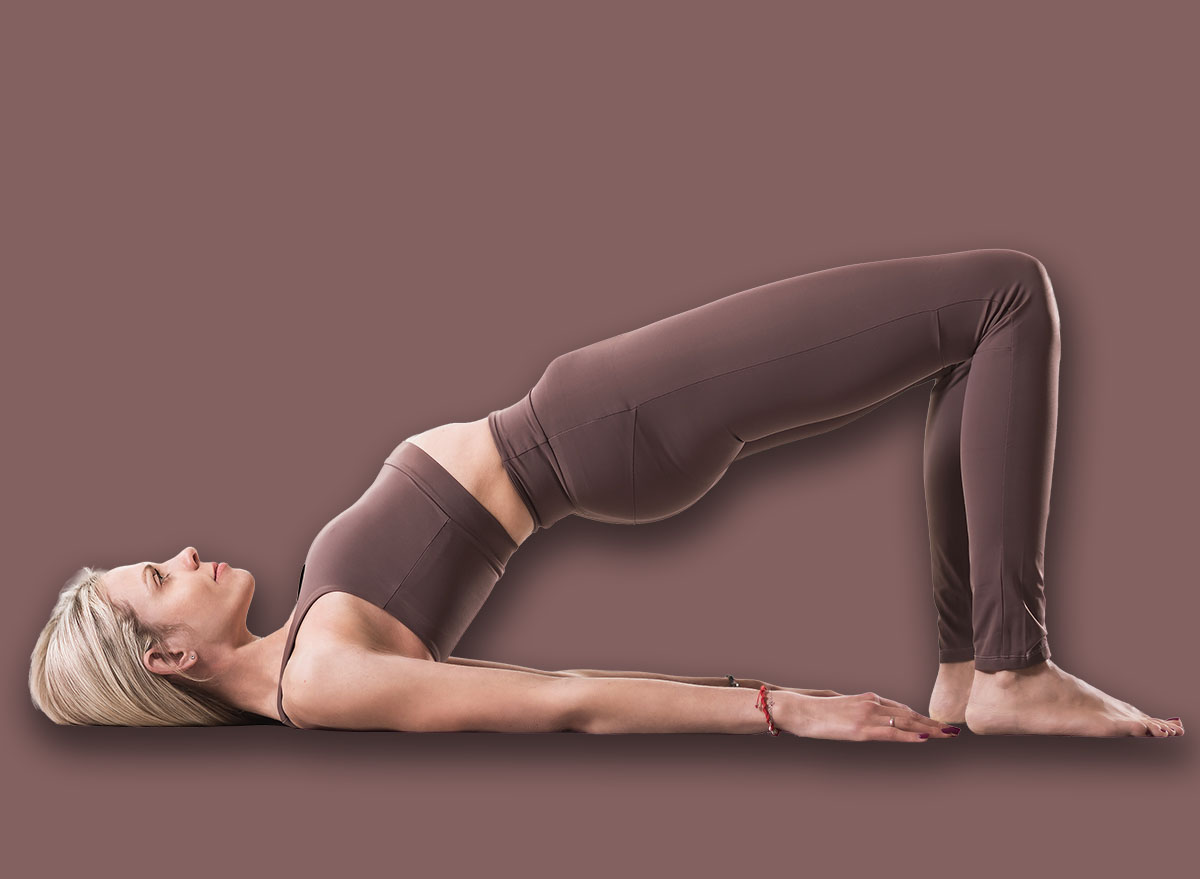
Glute bridges directly target the muscles responsible for hip extension, which drives walking speed, posture, and lifting mechanics. Many adults over 50 rely too heavily on their lower backs rather than their hips, leading to stiffness and discomfort. This exercise retrains proper firing patterns by isolating the glutes while keeping spinal stress low. Stronger glutes also support knee health and reduce fall risk.
Muscles Trained: Glutes, hamstrings, core, lower back stabilizers
How to Do It:
- Lie on your back with your knees bent and feet flat on the floor.
- Brace your core and press your heels into the ground.
- Drive your hips upward until your body forms a straight line.
- Squeeze your glutes at the top for a brief pause.
- Lower under control and repeat.
Recommended Sets and Reps: Knock out 3 sets of 10 to 15 reps. Rest for 45 seconds between each set.
Best Variations: Single-leg glute bridge, elevated glute bridge, long pause glute bridge
Form Tip: Stop the rep if you feel your lower back taking over the movement.
Bodyweight Renegade Rows
Bodyweight renegade rows combine upper body pulling with intense core stabilization. Supporting your weight on one arm while resisting rotation trains deep trunk muscles that protect your spine. The rowing action strengthens the upper back, which improves posture and shoulder mechanics. This exercise delivers full-body tension with minimal joint strain.
Muscles Trained: Lats, upper back, shoulders, core, arms
How to Do It:
- Start in a high plank position with your feet slightly wider than hip width.
- Shift your weight onto one arm while keeping your hips level.
- Pull your opposite elbow toward your ribs.
- Lower your hand back to the floor under control.
- Alternate sides while maintaining plank alignment.
Recommended Sets and Reps: Perform 3 sets of 6 to 8 reps per side. Rest for 60 seconds between each set.
Best Variations: Knee-supported renegade rows, slow tempo rows, extended plank rows
Form Tip: Widen your stance if your hips begin to sway.
Smart Strength Rules That Matter More After 50

Building strength daily works best when recovery, intent, and progression stay aligned. These principles keep progress moving forward without straining your joints.
- Prioritize quality reps: Slow down the lowering phase and control every position. This increases muscle engagement without adding load.
- Progress difficulty, not fatigue: Add pauses, tempo changes, or single limb variations before increasing volume.
- Train joints through full ranges: Deep, controlled movement supports connective tissue health and long-term mobility.
- Keep sessions short and consistent: Ten to twenty focused minutes performed daily outperforms sporadic long workouts.
- Listen to soreness signals: Mild muscle fatigue works. Lingering joint pain means you need to adjust volume or range.
When practiced consistently, these four exercises build strength where it counts most. Each rep reinforces control, resilience, and confidence that carry into every decade ahead.
References:
- Luke Del V, Shannon G, Hays D. Bodyweight Training for Muscular Strength & Endurance. J Yoga & Physio. 2022; 10(2): 555783. DOI: 10.19080/JYP.2022.10.555783
- Source: https://www.researchgate.net/publication/364308569_Bodyweight_Training_for_Muscular_Strength_Endurance/fulltext/65be3067790074549760bace/Bodyweight-Training-for-Muscular-Strength-Endurance.pdf
- Source: https://www.researchgate.net/publication/364308569_Bodyweight_Training_for_Muscular_Strength_Endurance/fulltext/65be3067790074549760bace/Bodyweight-Training-for-Muscular-Strength-Endurance.pdf