If You Can Do This Many Squats in 60 Seconds After 60, You’re in Great Shape


A 60-second squat test gives you a quick look at how well your lower body handles repeated effort. You lower, stand, breathe, and keep moving. The clock adds pressure fast, and your legs have to keep producing without losing control. After 60, this becomes a useful marker for conditioning, strength endurance, and how well your body moves under fatigue.
Muscle endurance plays a big role in staying active as you age. Strength helps you stand, climb, lift, and move with confidence. Endurance helps you keep doing those things without wearing down too quickly. That shows up during long walks, stairs, yard work, travel days, hikes, and busy days where you’re on your feet more than expected.
I often use squat-based tests with clients because they show a lot without requiring equipment. A few reps tell me how someone moves. A timed set tells me how well they maintain depth, posture, pace, and breathing as fatigue builds. That’s usually where the real information shows up.
A strong lower body gives you more than better workouts. Your quads, glutes, hamstrings, hips, and calves support nearly every step, stand, climb, and transition you make. The 60-second squat test gives you a simple way to check your lower-body conditioning and see how well your legs can keep working. Below, we’ll break down why this test works, how to perform it correctly, what your score means, and how to improve your squat endurance after 60.
Why the 60-Second Squat Test Works After 60

The 60-second squat test combines lower-body strength, muscular endurance, coordination, and conditioning into a single, simple challenge. Your legs drive each rep, your core keeps your torso steady, and your breathing has to support the pace. Since the test lasts a full minute, you get a better look at repeated effort than you would from a short set of five or 10 reps.
Squats also reflect a movement pattern you use every day. Standing up from a chair, climbing stairs, lowering to pick something up, and moving over uneven ground all require your hips and legs to work together. Repeating that pattern for 60 seconds demonstrates how well your body can maintain force production while staying organized.
The timed format also makes consistency important. You’re not just counting reps. You’re trying to keep the same depth, posture, and rhythm from start to finish. A strong score shows that your legs can handle fatigue, your core can support the movement, and your conditioning can keep the set moving without a major drop-off.
How to Perform the 60-Second Squat Test
A clean setup gives you a better score and a more accurate test. You want every rep to look the same, even as the clock runs. Set your stance, control your depth, and keep your pace steady from the first rep to the last.
How to Do It:
- Stand with your feet about shoulder-width apart, and your toes slightly turned out.
- Brace your core before starting the timer.
- Sit your hips back and down while bending your knees.
- Lower until your thighs reach at least parallel or your deepest controlled position.
- Drive through your feet to stand tall.
- Repeat as many clean reps as possible in 60 seconds.
Movement standard: A squat counts when your thighs reach at least parallel, with your feet planted and your torso controlled. Use a chair, box, or supported squat variation if you’re building toward that depth.
Best Variations: Box Squat, Chair Squat, Goblet Squat, Heels-Elevated Squat, Supported Squat.
Squat Test After 60: What Your 60-Second Score Means
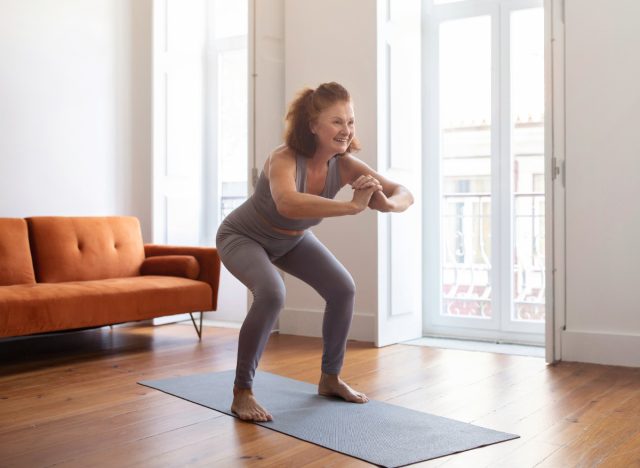
Your score should come from clean reps. Keep your depth, posture, and pace consistent. Once you start cutting depth, shifting your weight, or losing control, count the reps you completed with solid form.
- Under 15 reps: You’re building the base. Focus on clean depth, steady pacing, and maintaining consistent posture through each rep.
- 15 to 25 reps: This is a solid range after 60. Your legs can handle repeated effort, and your conditioning supports a full minute of movement with good control.
- 26 to 35 reps: You’re in great shape. Your lower body keeps producing force, your breathing stays organized, and your reps remain steady as fatigue builds.
- 36+ reps: This is an excellent score. Completing 36 or more clean squats in 60 seconds demonstrates strong lower-body endurance, coordination, and conditioning.
How to Improve Your Squat Score After 60
Improving your 60-second squat score comes down to building strength you can repeat. The goal is to make each rep smooth, controlled, and efficient so you don’t waste energy as the test goes on. Some of that comes from stronger legs, and some of it comes from better pacing. You’ll also improve by building confidence at depth, especially if parallel squats feel challenging right now. A few focused sessions each week can make the movement feel smoother and help your score climb.
- Practice squats consistently: Start with two to three squat sessions per week. Keep the reps clean and stop before your form changes.
- Build volume gradually: Use sets of 8 to 15 reps before moving to longer-duration sets.
- Use chair or box squats: A chair or box gives you a consistent depth target and helps build control.
- Add tempo reps: Lower for three seconds, stand tall, and reset. Slower reps build strength and better positioning.
- Train your glutes and hamstrings: Bridges, step-ups, hip thrusts, and deadlifts support stronger squat mechanics.
- Strengthen your quads: Split squats, step-ups, and controlled squats help your legs handle repeated effort.
- Practice your breathing: Exhale as you stand and settle into a rhythm you can maintain for the full minute.
- Retest every few weeks: Use the same depth, setup, and timer so your progress stays easy to track.
A strong 60-second squat score says your legs can work, recover, and repeat under pressure. If you can complete 26 to 35 clean squats after 60, you’re in great shape. If you’re above 36, your lower-body conditioning sits in an excellent range.
References
- Hong S, Oh M, Oh CG, Lee HD, Suh SH, Park H, Lalande S, Tanaka H, Jeon JY. Cardiorespiratory and aerobic demands of squat exercise. Sci Rep. 2024 Aug 8;14(1):18383. doi: 10.1038/s41598-024-68187-z. PMID: 39117711; PMCID: PMC11310470.
- Yeh CP, Huang HC, Chang Y, Chen MD, Hsu M. The Reliability and Validity of a Modified Squat Test to Predict Cardiopulmonary Fitness in Healthy Older Men. Biomed Res Int. 2018 Jan 2;2018:4863454. doi: 10.1155/2018/4863454. PMID: 29487868; PMCID: PMC5816896.