4 Chair Exercises That Restore Shoulder Strength Faster Than Gym Machines After 60


Strong shoulders don’t come from one lift or one piece of equipment. They come from how well the major and smaller muscles around the joint do their job while your arms move through different positions. Your upper back, rotator cuff, and shoulders all work together here, and when they’re in sync, everything feels smoother and more controlled.
Over time, that connection can fade a bit. You spend more time in forward positions, less time pulling things back, and the muscles that support your shoulders start to get a little quiet. That’s usually when stiffness shows up, or movements start to feel less natural. I see this pretty often. It’s not that people aren’t trying. They just haven’t been training the pieces that matter most.
Using a chair gives you a simple way to clean that up. You’re supported enough to stay stable, but still in a position where your body has to move and control itself. It lets you slow things down, feel what’s working, and build strength that actually carries over into everyday movement. These four exercises focus on the areas your shoulders rely on most, without overcomplicating it.
Seated Band Pull-Aparts
This is one of the easiest ways to wake up the muscles that support your shoulders from the back side. As you pull the band apart, your upper back and rear shoulders have to engage to move your arms while keeping your shoulder blades controlled. When you keep it smooth and don’t rush, you’ll feel those muscles start to take over instead of your shoulders doing everything on their own. It sets the tone for how your shoulders should move.
Muscles Trained: Rear deltoids, rhomboids, middle traps, and rotator cuff
How to Do It:
- Sit tall on a chair with your arms extended straight in front of you, holding a resistance band.
- Keep your chest up and shoulders relaxed.
- Pull the band apart by moving your arms out to your sides.
- Squeeze your shoulder blades together at the end of the movement.
- Return to the starting position with control.
Recommended Sets and Reps: Perform 3 sets of 12 to 15 reps. Rest for 45 to 60 seconds between each set
Best Variations: Overhand grip pull-aparts, underhand grip pull-aparts, pause reps
Form Tip: Keep your shoulders down so your upper traps don’t take over.
Seated Band Face Pulls
This movement brings everything together through your upper back and rear shoulders, helping your joints stay in a better position. As you pull toward your face, your elbows lead, and your shoulder blades move with control, which is where a lot of people tend to lose connection. When it clicks, you’ll feel this more between your shoulder blades than in your arms, and that’s exactly what you want.
Muscles Trained: Rear deltoids, traps, rhomboids, and rotator cuff
How to Do It:
- Sit upright, holding a resistance band anchored in front of you at chest height.
- Grip the band with both hands and extend your arms forward.
- Pull the band toward your face while leading with your elbows.
- Squeeze your shoulder blades together at the end of the movement.
- Return to the starting position with control.
Recommended Sets and Reps: Perform 3 sets of 10 to 12 reps. Rest for 45 to 60 seconds between each set
Best Variations: High anchor face pulls, external rotation finish, slower tempo reps
Form Tip: Lead with your elbows and let your hands follow.
Seated I-Y-T Raises
Running through these three positions gives your shoulders a bit more range of motion, which helps build strength without locking you into one pattern. Each position hits your upper back and shoulders a little differently, and when you move with control, you’ll start to feel where you’re strong and where things need a bit more attention. It’s a simple way to build more balanced strength without overthinking it.
Muscles Trained: Rear deltoids, traps, rotator cuff, and upper back stabilizers
How to Do It:
- Sit tall, holding light weights, a band, or no weight at all.
- Raise your arms straight overhead to form an “I.”
- Lower your arms, then raise them at an angle to form a “Y.”
- Lower again, then raise your arms out to your sides to form a “T.”
- Move through each position with control.
Recommended Sets and Reps: Perform 3 sets of 6 to 8 reps in each position. Rest for 45 to 60 seconds between each set
Best Variations: Lighter weights, pause at the top, band-assisted versions
Form Tip: Keep your movements smooth and avoid shrugging.
Seated Dumbbell Lateral Raise
This one brings more direct focus to your shoulders, but doing it seated keeps things honest. Without momentum, your shoulders have to do the work from start to finish. When you keep the weight manageable and stay controlled, you’ll feel a cleaner contraction without putting extra stress on your joints. It’s straightforward, but it works.
Muscles Trained: Lateral deltoids, anterior deltoids, and upper traps
How to Do It:
- Sit upright, holding a dumbbell in each hand at your sides.
- Keep a slight bend in your elbows.
- Raise your arms out to your sides until they reach shoulder height.
- Pause briefly at the top.
- Lower the weights back down with control.
Recommended Sets and Reps: Perform 3 sets of 10 to 12 reps. Rest for 45 to 60 seconds between each set
Best Variations: Single-arm raises, slower tempo, partial reps
Form Tip: Think about lifting through your elbows instead of your hands.
The Best Tips for Building Shoulder Strength After 60
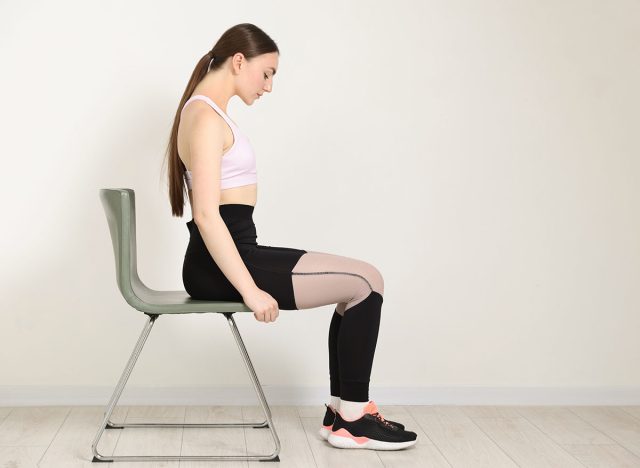
Getting your shoulders feeling strong again usually comes back to how you move, not how much weight you use. When the right muscles start doing their share of the work, everything starts to feel smoother without forcing it. Most of the progress here comes from staying consistent and paying attention to how each rep feels, rather than just getting through it.
- Slow things down: Controlled reps help you feel the right muscles working.
- Give your upper back some attention: That support goes a long way for shoulder health.
- Keep the weight manageable: You should feel the movement, not fight through it.
- Stay aware of your posture: It carries over more than people think.
- Be consistent with it: A few solid sessions each week will add up quickly.
Stick with these for a bit, and you’ll notice your shoulders start to feel more stable and easier to move without that same stiffness.
References
- Schory, Abbey et al. “A Systematic Review Of The Exercises That Produce Optimal Muscle Ratios Of The Scapular Stabilizers In Normal Shoulders.” International journal of sports physical therapy vol. 11,3 (2016): 321-36.
- Wu, Dianxuan et al. “Specific modes of exercise to improve rotator cuff-related shoulder pain: systematic review and meta-analysis.” Frontiers in bioengineering and biotechnology vol. 13 1560597. 8 Apr. 2025, doi:10.3389/fbioe.2025.1560597