5 Chair Exercises That Undo 10 Years of Sitting Faster Than Yoga After 55

Prolonged sitting has been called “the new smoking” because of its independent impact on health. A large meta-analysis published in the Annals of Internal Medicine found that extended sedentary time is associated with increased risk of cardiovascular disease, cancer, and all-cause mortality, even in people who exercise regularly. You can work out for an hour, but if you sit the rest of the day, your health risk still goes up. Research from the American Journal of Epidemiology found that people who sit more than six hours per day have a significantly higher risk of early death compared to those who sit less than three hours per day. Some analyses suggest that excessive sitting can reduce life expectancy by several years, on par with major lifestyle risk factors like obesity and inactivity.
As a movement specialist, I work with clients every day whose bodies have reorganized around stillness. The good news is you don’t need an hour and you don’t need to get on the floor. These five chair exercises target the hips and spine to improve circulation, restore space, and begin reversing the long-term effects of sitting.
Why Sitting Reshapes Your Body

If you think about the body like a system of rivers, movement is what keeps everything alive. Not just muscles moving, but fluids moving. Blood, lymph, cerebrospinal fluid, all of it depends on space and motion. When your fluids are flowing consistently, tissues receive oxygen, waste is cleared, and the nervous system stays regulated. But when that flow slows down, everything begins to change.
Now imagine a river that no longer moves. It becomes stagnant. The environment shifts. What once supported life starts to break it down. That’s what prolonged sitting does to the body. Not overnight, but over years and decades.
If your body spends hours each day in a seated position, it doesn’t just get tight. It reorganizes around stillness. The hips begin to lose their relationship with the rest of the body. They’re no longer part of a dynamic system; they become a point of restriction. That affects how the pelvis moves, which directly affects how forces travel into the spine.
Why General Stretching Isn’t Enough
The spine is not just a stack of bones. It’s a conduit for nerves, for fluid exchange, for communication between systems. When sitting compresses the spine over time, you don’t just lose movement. You reduce the body’s ability to circulate fluids through that system. Discs don’t hydrate the same way. Blood flow becomes less efficient. Lymphatic drainage slows down. And the nervous system begins to operate with less clarity.
Research published in the American Journal of Epidemiology and the Journal of the American College of Cardiology has shown that prolonged sitting is associated with reduced vascular function, slower metabolic activity, higher risk of cardiovascular disease, and increased overall mortality. So this isn’t just about posture. It’s about the internal environment of your body.
Most people try to fix this by stretching randomly or just moving more in general. But if the relationships in the body have changed, if space has been lost, then general movement won’t fully restore that system. You need something more specific, something that reintroduces space and restores flow.
That’s where ELDOA and myofascial stretching come in. ELDOA creates space in very precise areas of the spine. When you create space, you allow fluid to move again. You improve circulation at a local level, and you give the nervous system better input to reorganize the body. Myofascial stretching works with that same idea. It restores continuity. So instead of thinking about one tight muscle, we restore how the hips, pelvis, and spine work together as a system.
T8/T9 ELDOA (Chair Version)
The T8/T9 junction sits right about the middle of your upper back. This ELDOA targets the space between those two vertebrae, helping restore fluid exchange and circulation in an area that gets compressed from hours of sitting.
Muscles Trained: Deep spinal stabilizers, thoracic extensors, shoulder external rotators
How to Do It:
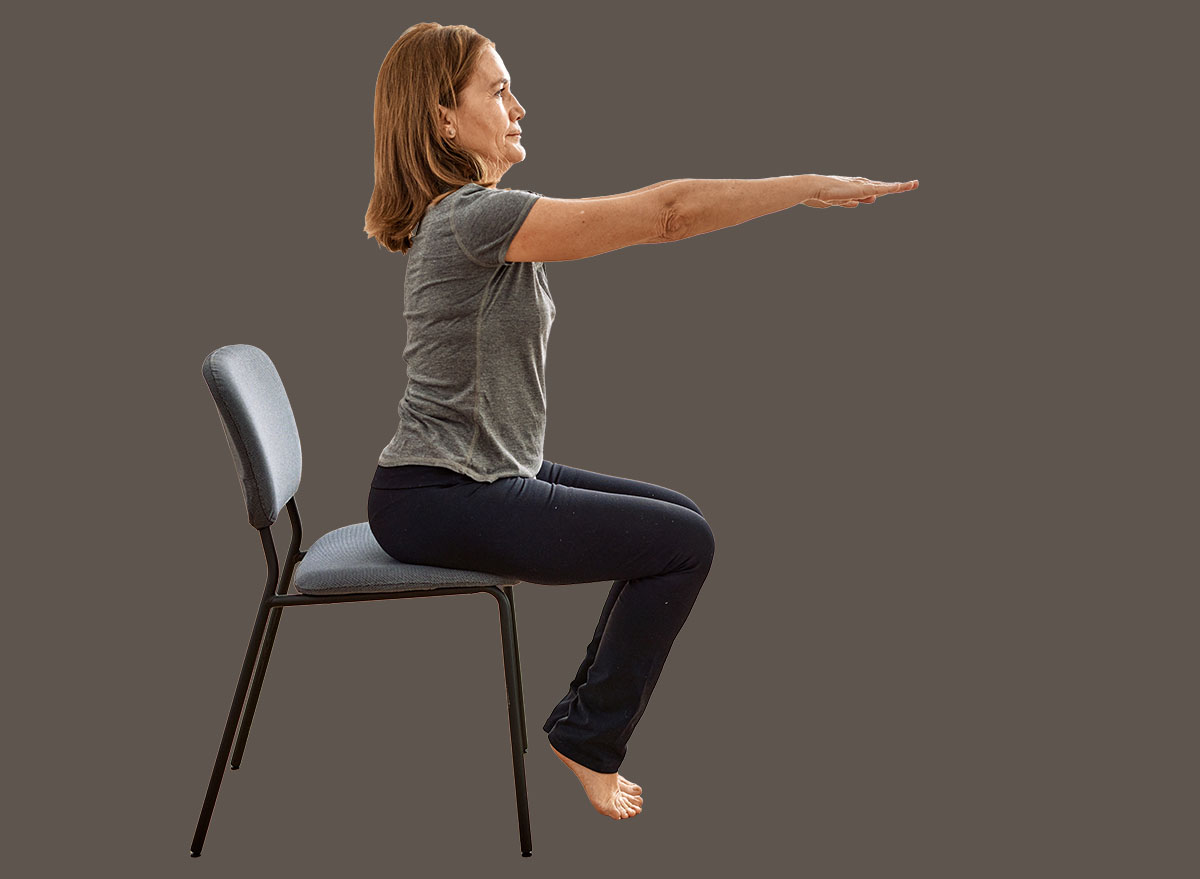
- Sit near the edge of the chair so your back isn’t resting against it.
- Establish your gravity line: ear, shoulder, and hip all in line.
- Keep your toes, knees, hips, and shoulders roughly stacked.
- Gently tuck your chin and lengthen the back of your neck.
- Bring your arms out in front of you, spread the fingers, bend the wrists back, and spiral your arms open (external rotation).
- Look down at the floor about one to two feet in front of you.
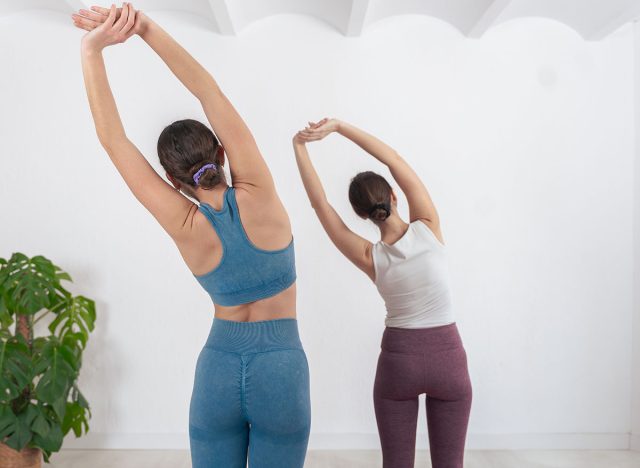
- Slowly raise your arms up until they’re parallel to your ears, then reach as high as you can toward the ceiling.
- Breathe from your belly for 60 seconds while maintaining that reach.
- Don’t let a big curve develop in your lower back. Keep that gravity line with your ear, shoulder, and hip staying aligned.
- At the end of 60 seconds, gently relax one arm, then the other, then your spine.
Form Tip: You’re not sucking your belly in or contracting your abs. Keep your abdominals relaxed so your diaphragm can function properly while you breathe.
Rib 10 ELDOA (Chair Version)
This ELDOA targets the 10th rib, opening up the lateral line of the body that gets locked down from sitting. It restores the relationship between the ribs, spine, and pelvis on each side.
Muscles Trained: Lateral trunk stabilizers, intercostals, quadratus lumborum, obliques
How to Do It:
- Keep your left leg in line so your foot, knee, and hip are stacked.
- Scoot your right leg out to the side, straighten it completely, and place your right heel in line with your left big toe (right leg slightly in front of left).
- Establish your gravity line: ear, shoulder, hip all in line.
- Bring your arms in front, spread the fingers, bend the wrists, and spiral open.
- Glide your torso to the side. Don’t bend or flex the spine like a leaning tower. You’re shifting laterally, aiming for a clean line from ear to shoulder to rib to hip to knee to ankle.
- Take the top arm and reach it past your head, stretching as far as you can. The bottom arm pushes toward the front of the room.
- Don’t rotate the spine. Keep everything straight and in line.
- Hold for 60 seconds, breathing from your belly while stretching as far as you can.
- Gently relax one arm, then the other, return your spine, then return your leg.
Recommended Sets and Reps: 60 seconds per side. Make sure you do both sides.
Form Tip: From the side, your body should look like a flat, straight line. You’re not arching and you’re not rounding.
L2/L3 ELDOA (Chair Version)
The L2/L3 junction is on your spine just a little bit above where your belly button would be. This is a common area of compression from sitting and a key spot for restoring lower back circulation.
Muscles Trained: Deep lumbar stabilizers, hip adductors, thoracolumbar fascia
How to Do It:
- Sit near the edge of the chair.
- Bring both legs out in front of you, bend your ankles back, and turn your feet inward.
- Keep your knees straight and take your legs as wide as you can.
- Spread your fingers, bend your wrists, spiral open, and bring your arms straight up overhead.
- Reach to the ceiling and breathe from your belly for 60 seconds.
- Keep your toes spread, ankles pulled back, legs turned in, fingers spread, wrists back, elbows straight, spiraling and reaching upward the entire time.
- Don’t suck your belly in or contract your abs. Let your diaphragm work freely.
- Don’t let your butt stick out or your spine round. Maintain that gravity line: ear, shoulder, hip.
- At the end of 60 seconds, relax one arm, then the other, one leg, then the other, then relax the spine.
Form Tip: Your abdominals stay relaxed throughout. If you’re bracing or holding your breath, you’re limiting the very fluid exchange this exercise is designed to restore.
Myofascial Hamstring Stretch (Chair Version)
This stretch works the middle of the hamstring and restores the connection between the hips, pelvis, and spine. Tight hamstrings from sitting don’t just affect your legs; they pull on the pelvis and change how forces move through your entire trunk.
Muscles Trained: Hamstrings, posterior chain fascia
How to Do It:
- Sit near the edge of the chair so you’re not tempted to lean back. Maintain a nice tall posture.
- Take your non-working leg, turn it out, and let it relax with the heel in line with your glute. This leg just hangs out.
- Straighten your working leg, spread your toes, and bend your ankle back.
- Bring both arms up overhead: spread the fingers, bend the wrists, spiral open.
- Hinge forward from the hips. Don’t round your back. You’re leaning forward, not flexing the spine.
- Keep your working leg straight and your spine flat as you continue to pull your ankle back and reach as far as you can with your arms.
Recommended Sets and Reps: Hold for 30 to 90 seconds per leg. If you hold for 30 seconds, alternate legs for three sets per side. If you hold for 90 seconds, one set per leg is enough.
Form Tip: If there’s any flexion in your spine, you’ve gone too far forward. Pull back slightly until your back is flat, then hold. The stretch should be in the hamstring, not in your lower back.
Myofascial Abdominal Stretch (Chair Version)
This stretch targets the external obliques, but you’re actually able to stretch the entire abdominal wall with this single movement. When the abdominal fascia gets locked short from sitting, it limits rib movement, breathing capacity, and spinal rotation.
Muscles Trained: External obliques, internal obliques, full abdominal wall
How to Do It:
- Take your left hand, spread the fingers, bend the wrist, spiral open, and push this arm gently down toward the floor.
- Place your right hand in the middle of your back, above the shoulder blades.
- Take your right elbow and reach it up toward the ceiling.
- Bend your torso to the left, then twist back to the right.
- Look up at your right elbow. Your elbow pushes to the ceiling while your ribs are bent left and twisted right, creating a big stretch through the right side of the abdominal wall.
Recommended Sets and Reps: Hold for 90 seconds per side (one set), or hold for 30 seconds and do three sets per side. Make sure you do both sides.
Form Tip: Your eyes follow the elbow. If you lose that visual connection, you’ll likely lose the rotation, and the stretch won’t reach the full abdominal wall.
- Source: https://www.acpjournals.org/doi/abs/10.7326/M14-1651?journalCode=aim
- Source: https://pmc.ncbi.nlm.nih.gov/articles/PMC6454412/
- Source: https://www.acc.org/about-acc/press-releases/2024/11/15/16/33/sitting-too-long-can-harm-heart-health-even-for-active-people
- Source: https://pmc.ncbi.nlm.nih.gov/articles/PMC10042610/