4 Simple Exercises That Strengthen Your Muscles More Than Lunges After 50

There’s no denying that lunges are a lower body blaster. They work your quads, glutes, hamstrings, and core, all while boosting your balance and coordination. However, lunges aren’t the most comfortable or practical choice after 50.
Many older adults begin dealing with knee discomfort, reduced balance, hip stiffness, or lack of mobility that can make traditional lunges feel awkward or challenging. But that doesn’t mean you should forgo strength training. Quite the opposite, actually. According to the National Institute of Health, maintaining muscle mass becomes even more important with age.
But with the wide variety of options available, it can feel daunting knowing where to start. The good news? We spoke with James Bickerstaff, CPT, a personal trainer at OriGym, who shares his top four exercises designed specifically to help strengthen your lower body muscles better than lunges. “These exercises are more joint-friendly for adults over 50 and can replicate everyday movements like climbing stairs,” says Bickerstaff.
Whether your goal is improving mobility, building strength, or simply moving more comfortably, these exercises deserve a place in your routine. Keep reading for the detailed step-by-step instructions. Then, when you’re finished, be sure to check out these 5 Morning Exercises That Restore Knee Strength Faster Than Squats After 60.
Step-ups
Step-ups are one of the most functional lower-body exercises available. Because they mimic climbing stairs, they build strength that transfers directly to everyday life while improving your balance and coordination.
“Step-ups train many of the same muscles as lunges, including your glutes, quads, and calves,” explains Bickerstaff.
How to do it:
- Stand facing a sturdy step, platform, or bottom stair.
- Plant one foot firmly on the elevated surface.
- Keep your chest lifted and your core engaged.
- Drive through the heel of your working leg.
- Lift your body onto the step.
- Bring your opposite foot up to meet the first foot.
- Pause for one to two seconds at the top of the movement.
- Step back down slowly with control.
- Complete all reps on one side before switching.
- Complete two to three sets of 8 to 12 reps per leg. Rest for 45 to 60 seconds between sets.
Glute Bridges
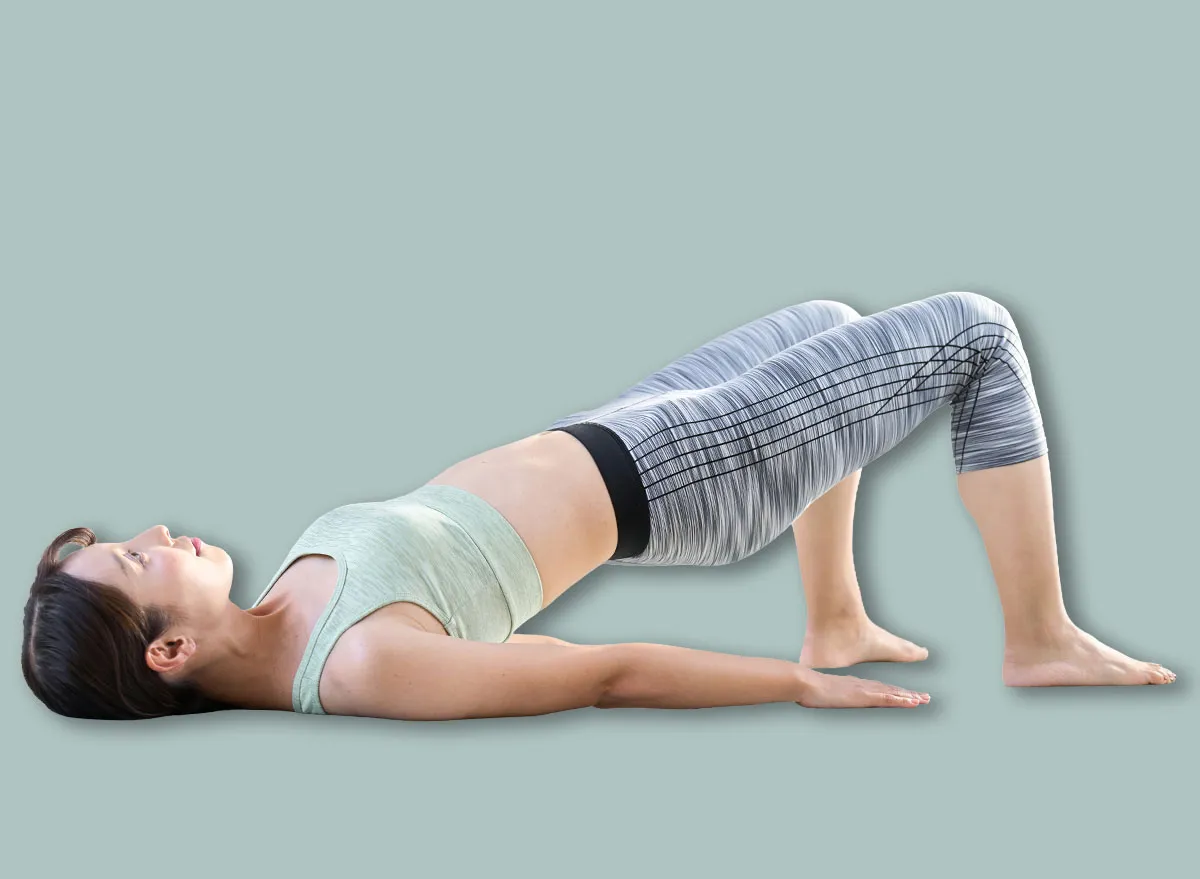
Many older adults spend hours sitting every day, which research shows can lead to weaker glutes and reduced hip function. Fortunately, glute bridges target these muscles while also strengthening your hamstrings and core. “Strong glutes are essential for maintaining good posture, walking efficiently, and supporting your lower back,” says Bickerstaff.
How to do it:
- Lie on your back with your knees bent.
- Place your feet flat on the floor about hip-width apart.
- Rest your arms comfortably at your sides.
- Brace your core before beginning the movement.
- Press through your heels.
- Lift your hips until your body forms a straight line from shoulders to knees.
- Squeeze your glutes at the top of the movement.
- Pause for one to two seconds before lowering.
- Return to the starting position with control.
- Perform two to three sets of 10 to 15 reps, resting for 45 to 60 seconds between sets.
RELATED: 5 Chair Exercises That Restore Knee Strength Faster Than Gym Sessions After 60
Sit-to-Stands
Few exercises are more practical than sit-to-stands. They mirror getting up from a chair, which is one of the most common activities of daily living. Plus, they help develop lower body power that helps support independence as you age.
How to do it:
- Sit on a sturdy chair with your feet flat on the floor.
- Position your feet about hip-width apart.
- Sit near the front edge of the chair.
- Lean slightly forward at your hips.
- Push firmly through your heels.
- Stand up without using your hands if possible.
- Fully straighten your hips and knees.
- Slowly lower yourself back to the chair.
- Maintain control throughout the movement.
- Aim for two to three sets of 8 to 12 reps. Rest for 45 to 60 seconds between sets.
Romanian Deadlifts
“Romanian deadlifts strengthen the entire posterior chain,” explains Bickerstaff. “THey target your glutes, hamstrings, and lower back while also improving hip strength and movement patterns that decline with age.” These muscles often weaken with age yet are crucial for maintaining good posture, lifting mechanics, and lower back support.
How to do it:
- Stand holding a pair of light dumbbells or a kettlebell.
- Position your feet about hip-width apart.
- Maintain a slight bend in your knees.
- Keep your chest lifted and your shoulders back.
- Push your hips backward slowly.
- Lower the weights down the front of your legs.
- Continue until you feel a gentle stretch in your hamstrings.
- Keep your back straight and chest up throughout the entire movement.
- Drive your hips forward to return to a standing position.
- Complete two to three sets of 8 to 12 reps, resting for 45 to 60 seconds between sets.