5 Slow Exercises That Restore Lower Back Strength Better Than Deadlifts After 60

Slow reps have a way of humbling you in the best possible way. You take away the rush, stop bouncing through the easy parts, and suddenly the muscles around your hips, core, and lower back have to stay engaged for the whole rep. That’s the point here. Slow doesn’t mean dragging through the workout. It means lowering with control, feeling the stretch, pausing where the exercise gets tough, and finishing the movement without letting momentum do the work.
Deadlifts are great when they’re coached well and loaded correctly, but they’re not the only path to a stronger lower back. After 60, many people do better when they first rebuild the pieces that make a good hinge possible: stronger glutes, more active hamstrings, better pelvic control, and a core that knows how to brace. Tempo work gives you room to practice those pieces without feeling like every rep has to be heavy.
I use slow lower-back and hip work all the time because it tells the truth quickly. If your hips shift around, your lower back takes over, or your abs can’t hold position, the tempo exposes it. That’s useful. Reverse crunches, good mornings, back extension holds, glute bridges, and Pallof presses all build support around the lower back from different angles. Keep the reps smooth, own the lowering phase, and let time under tension make lighter movements feel like real strength work.
Reverse Crunch
Reverse crunches train your lower abs and deep core while teaching your pelvis to move with control. That’s huge for lower-back strength because your core helps maintain pelvic position rather than letting your spine do all the adjusting. The slow version works best when you curl your hips up with control, pause briefly, and lower down without swinging your legs. This gives your abs a cleaner job and helps build the kind of control your lower back appreciates during walking, standing, and getting up from the floor.
Muscles Trained: Lower abs, deep core, hip flexors.
How to Do It:
- Lie on your back with your knees bent and your feet lifted.
- Place your arms at your sides for support.
- Brace your core and keep the movement small.
- Curl your hips slightly off the floor.
- Pause briefly at the top.
- Lower your hips with control.
Recommended Sets and Reps: Perform 3 sets of 8 to 12 reps. Use a 2-second curl, 1-second pause, and 3-second lowering phase. Rest for 30 to 45 seconds between each set.
Best Variations: Bent-knee reverse crunches, paused reverse crunches, heel-tap reverse crunches.
Form Tip: Curl your pelvis rather than swing your legs.
Tempo Good Mornings
Tempo good mornings train your hamstrings, glutes, lower back, and core while teaching your hips to hinge with patience. The slow lowering phase gives your hamstrings time to lengthen under tension, and that’s where the exercise starts to pay off. Instead of folding forward quickly and popping back up, you’re teaching your hips to control the movement and your core to hold your spine steady. That makes this a great drill for rebuilding the hinge pattern before heavier deadlift work enters the picture.
Muscles Trained: Hamstrings, glutes, lower back, core.
How to Do It:
- Stand with your feet hip-width apart.
- Place your hands behind your head or across your chest.
- Brace your core and soften your knees.
- Push your hips back as your torso leans forward.
- Lower for 3 to 4 seconds until you feel your hamstrings working.
- Drive your hips forward to return to standing.
Recommended Sets and Reps: Perform 3 sets of 8 to 10 reps. Use a 3 to 4-second lowering phase and a controlled 2-second return to standing. Rest for 45 to 60 seconds between each set.
Best Variations: Banded good mornings, hands-on-hips good mornings, staggered-stance good mornings.
Form Tip: Keep your spine long and make your hips lead the movement.
Back Extension Holds
Back extension holds train your glutes, hamstrings, and spinal support muscles without requiring a full range of motion. Holding the top position builds endurance through the backside of your body, which helps your lower back stay supported longer during daily movement. The key is keeping the effort spread through your glutes and upper back instead of cranking through your neck or pinching through your lower back. A strong hold should feel controlled, steady, and purposeful.
Muscles Trained: Lower back, glutes, hamstrings, upper back.
How to Do It:
- Lie on your stomach with your legs extended behind you.
- Place your arms at your sides or lightly behind your head.
- Brace your core and squeeze your glutes.
- Lift your chest a few inches off the floor.
- Hold the top position while breathing steadily.
- Lower your chest with control.
Recommended Sets and Reps: Perform 3 sets of 15 to 25-second holds. Rest for 45 seconds between each set.
Best Variations: Prone cobra holds, short-range back extensions, alternating arm and leg lifts.
Form Tip: Lift through your glutes and upper back instead of yanking through your neck.
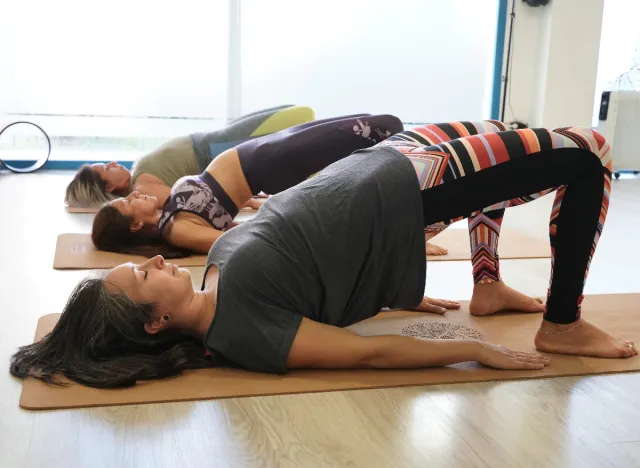
Tempo Glute Bridges
Tempo glute bridges train your glutes and hamstrings while your core keeps your ribs and pelvis in a strong position. Slowing the lift and lowering phases keeps the glutes engaged longer, and the pause at the top helps you feel whether the right muscles are finishing the rep. Stronger glutes give your lower back more help during standing, walking, stairs, and lifting. Take your time here. A clean bridge done slowly can do more than a rushed set of heavy reps that barely find the glutes.
Muscles Trained: Glutes, hamstrings, core.
How to Do It:
- Lie on your back with your knees bent and your feet flat on the floor.
- Place your arms at your sides.
- Brace your core and press through your heels.
- Lift your hips for 2 to 3 seconds.
- Pause at the top and squeeze your glutes.
- Lower your hips for 3 seconds with control.
Recommended Sets and Reps: Perform 3 sets of 10 to 12 reps. Use a 2 to 3-second lift, 2-second hold, and 3-second lowering phase. Rest for 45 seconds between each set.
Best Variations: Mini-band glute bridges, feet-elevated glute bridges, and single-leg glute bridge holds.
Form Tip: Keep your ribs down and finish each rep with your glutes.
Tempo Pallof Press
The tempo Pallof press trains your core to brace and resist rotation, which matters more for lower-back strength than most people realize. The band wants to pull your torso sideways, and your midsection has to keep you square. Slowing down the press makes the exercise tougher because your abs and obliques have to control every inch of the movement. This helps your lower back because a stronger core gives your spine more support when you carry, reach, turn, or move under load.
Muscles Trained: Core, obliques, shoulders, glutes.
How to Do It:
- Anchor a resistance band at chest height.
- Stand sideways to the anchor with your feet shoulder-width apart.
- Hold the band at your chest with both hands.
- Brace your core and keep your torso square.
- Press your hands forward for 2 to 3 seconds.
- Pause briefly, then return your hands with control.
Recommended Sets and Reps: Perform 3 sets of 8 to 10 reps per side. Use a 2 to 3-second press, 1-second hold, and 3-second return. Rest for 30 to 45 seconds between each set.
Best Variations: Pallof press holds, split-stance Pallof presses, half-kneeling Pallof presses.
Form Tip: Keep your ribs down and resist the band as it pulls you toward the anchor.
How to Make Slow Strength Work Help Your Lower Back
Slow lower-back training works best when the reps stay clean, and the effort stays in the right places. You want your hips, glutes, hamstrings, and core doing their share instead of letting your lower back become the default worker. Tempo gives you time to notice what’s happening, fix your position, and build strength with more control.
- Own the lowering phase: Good mornings, reverse crunches, and glute bridges get more effective when you lower slowly. The lengthening part of the rep builds control and keeps the muscles working longer.
- Use pauses on purpose: A short hold at the top of a bridge, back extension, or Pallof press gives your body time to create tension. Pauses also help you feel the target muscles more clearly.
- Keep your core connected: Reverse crunches and Pallof presses help train your abs to support your pelvis and spine. That support matters during bending, lifting, reaching, and carrying.
- Let your hips help: Tempo good mornings and glute bridges teach your glutes and hamstrings to contribute. Strong hips can make your lower back feel more supported during everyday movement.
- Stay smooth from start to finish: Slow work loses value when the rep gets jerky. Keep the movement controlled, breathe through the effort, and stop the set before your form turns sloppy.
Deadlifts can still have a place, but they don’t need to be the only lower-back strength tool in the box. Slow reps build awareness, control, and strength in the muscles that support your spine. Give these exercises a few focused sessions each week, and your lower back will have a stronger team around it.
References
- Gordon R, Bloxham S. A Systematic Review of the Effects of Exercise and Physical Activity on Non-Specific Chronic Low Back Pain. Healthcare (Basel). 2016 Apr 25;4(2):22. doi: 10.3390/healthcare4020022. PMID: 27417610; PMCID: PMC4934575.
- Martins-Costa HC, Lacerda LT, Diniz RCR, Lima FV, Andrade AGP, Peixoto GH, Gomes MC, Lanza MB, Bemben MG, Chagas MH. Equalization of Training Protocols by Time Under Tension Determines the Magnitude of Changes in Strength and Muscular Hypertrophy. J Strength Cond Res. 2022 Jul 1;36(7):1770-1780. doi: 10.1519/JSC.0000000000004004. Epub 2021 Mar 16. PMID: 34932279.