4 Standing Exercises That Flatten Belly Pooch Faster Than Weight Training After 50

That lower belly doesn’t just show up out of nowhere. It usually builds over time as movement slows down a bit, the muscle isn’t trained as consistently, and calorie intake doesn’t always adjust to match. Once you’re past 50, your body also tends to store fat a little differently, and a lot of that ends up settling around the midsection.
You’ve probably heard that you can’t target fat loss to one specific area, and that still slightly holds true. There isn’t a single exercise that’s going to strip fat straight off your stomach. The most proven method is to create a steady calorie deficit and consistently burn more energy throughout the day, because when that starts to happen, your body leans out overall, and your midsection follows along.
That’s where standing exercises start to make a lot of sense. You’re on your feet, supporting your bodyweight, and moving naturally brings more muscle into play, which quietly boosts your overall energy output without requiring long workouts or a complicated setup.
Progress really comes from pairing strength work with cardio that you can repeat often. Strength training helps you hold onto muscle and keeps your metabolism in a good place, while steady, repeatable cardio helps you chip away at calorie burn over time. The focus here is on movements you can come back to regularly, recover from without feeling beat up, and fit into your routine without overthinking, while keeping your effort within a range that lets you stay consistent and build momentum week after week.
Jump Rope
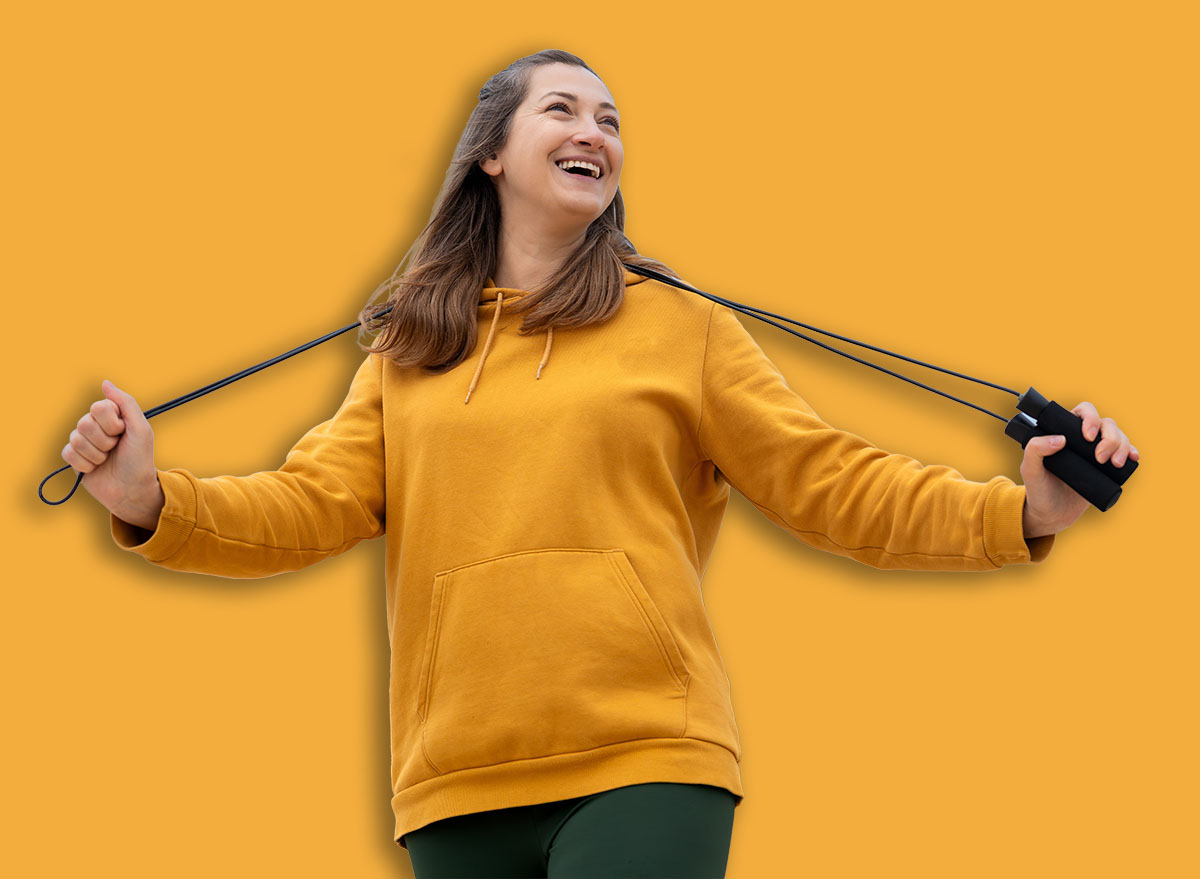
Jump rope brings a level of efficiency that’s tough to match. You get your heart rate up quickly, your coordination improves, and your lower body handles repeated elastic loading that carries over into everything from walking to running. It’s also one of the easiest ways to sneak in short bursts of work throughout the day. A couple of minutes here and there adds up fast. From a coaching standpoint, it’s one of those tools that help people stay consistent because it feels engaging rather than repetitive.
Muscles Trained: Calves, quadriceps, hamstrings, shoulders, and core
How to Do It:
- Grab a jump rope that matches your height and step into the center to check the handle height.
- Stand tall with your elbows close to your sides and your hands slightly in front of your hips.
- Rotate the rope with your wrists rather than your shoulders.
- Jump just high enough to clear the rope while staying light on your feet.
- Keep your core engaged and your gaze forward as you find a steady rhythm.
Recommended Sets and Reps: Perform 5 sets of 60 seconds. Rest for 30 seconds between each set.
Best Variations: Single-leg jumps, alternating foot steps, high-knee jump rope
Form Tip: Stay relaxed through your shoulders and let your wrists do the work.
Running or Jogging Intervals
Intervals give you a simple way to increase calorie burn without running long distances. You can control the pace, adjust the intensity, and build your conditioning at a steady rate. Short bursts of faster running, followed by easier recovery periods, challenge your heart and lungs while keeping the overall session manageable. This approach also tends to feel more engaging, which makes it easier to stick with it week after week.
Muscles Trained: Quadriceps, hamstrings, glutes, calves, and core
How to Do It:
- Start with a 5-minute easy walk or jog to warm up.
- Pick up your pace and run at a moderate effort for a set period.
- Slow down to a walk or easy jog to recover.
- Repeat the cycle of faster running and recovery intervals.
- Finish with a short cooldown walk.
Recommended Sets and Reps: Perform 6 to 8 intervals of 30 seconds running and 60 seconds walking. Rest as needed between intervals.
Best Variations: Hill intervals, treadmill incline intervals, timed distance repeats
Form Tip: Keep your stride smooth and land softly under your hips.
Walking
Walking often gets overlooked, but it’s one of the most reliable ways to stay active and burn calories consistently. It’s easy on your joints, requires no equipment, and fits into just about any schedule. Over time, daily walks can make a noticeable difference in overall energy expenditure. It also helps reinforce better posture and keeps your body moving throughout the day, which adds up to more than most people expect.
Muscles Trained: Glutes, hamstrings, calves, hip flexors, and core
How to Do It:
- Stand tall with your shoulders relaxed and your chest slightly lifted.
- Step forward with a natural stride and let your arms swing at your sides.
- Keep a steady pace that allows you to maintain a conversation.
- Focus on rolling through your foot from heel to toe.
- Continue for your planned duration while staying relaxed.
Recommended Sets and Reps: Perform 1 to 2 sessions of 20 to 40 minutes. Rest as needed between sessions.
Best Variations: Incline walking, brisk walking, weighted vest walking
Form Tip: Walk with purpose and keep your posture tall from start to finish.
Jumping Jacks
Jumping jacks bring a full-body element to your routine. Your arms and legs move together, your heart rate climbs, and your coordination gets a boost. They work well as a standalone movement or as part of a quick circuit. Because they’re simple to perform, you can drop them into your day whenever you have a few minutes to move.
Muscles Trained: Shoulders, quadriceps, calves, glutes, and core
How to Do It:
- Stand with your feet together and your arms at your sides.
- Jump your feet out to the sides while raising your arms overhead.
- Land softly with your knees slightly bent.
- Jump your feet back together while lowering your arms.
- Repeat at a steady pace while keeping your core engaged.
Recommended Sets and Reps: Perform 4 sets of 30 to 45 seconds. Rest for 30 seconds between each set.
Best Variations: Low-impact step jacks, cross-body jacks, squat jacks
Form Tip: Land softly and keep your movements controlled to protect your joints.
The Best Tips for Flattening Your Belly After 50

Getting rid of a belly pooch comes down to consistency more than anything else. You don’t need a complicated plan or long workouts to see progress. What matters is how often you move, how well you recover, and how closely your daily habits support your goals. These standing exercises work because they’re easy to repeat and don’t leave you feeling wiped out. When you stack them with a few smart habits, results tend to follow.
- Stay consistent with daily movement: Short sessions done often beat longer workouts that only happen once or twice a week. Aim to move every day, even if it’s just a quick walk or a few minutes of jump rope.
- Keep most of your effort in a sustainable range: You should feel like you’re working, but still be able to hold a conversation. This helps you recover faster and come back the next day ready to go again.
- Pay attention to your calorie intake: Exercise helps create the deficit, but your nutrition drives the outcome. Focus on balanced meals with enough protein to support muscle and recovery.
- Build strength alongside your cardio: A couple of strength sessions each week will help maintain muscle and keep your metabolism working in your favor.
- Stay active outside of workouts: The more you move throughout the day, the more it adds to your total calorie burn. Small habits like walking more, taking the stairs, or standing instead of sitting can make a real difference.
References
- Beekman, Marian et al. “Lifestyle-Intervention-Induced Reduction of Abdominal Fat Is Reflected by a Decreased Circulating Glycerol Level and an Increased HDL Diameter.” Molecular nutrition & food research vol. 64,10 (2020): e1900818. doi:10.1002/mnfr.201900818
- Brobakken, Mathias Forsberg et al. “Abdominal aerobic endurance exercise reveals spot reduction exists: A randomized controlled trial.” Physiological reports vol. 11,22 (2023): e15853. doi:10.14814/phy2.15853