5 Standing Exercises That Shrink Stubborn Waist Thickening Faster Than Cardio After 60

If your waist has been expanding even though you’re walking regularly and staying active, you’re not imagining things, and it’s not a willpower problem. After 60, hormonal shifts and accelerating muscle loss change where your body stores fat and how efficiently it burns calories, making the usual approach of just adding more cardio far less effective than most people expect.
I’m a personal trainer and fitness educator at TRAINFITNESS, and I’ve been working in the fitness industry for 40 years. One of the most common concerns I hear from clients over 60 is their waist thickening and expanding, even when they’re walking regularly or doing other forms of cardio. Although frustrating, this isn’t something you have to accept as inevitable, and there are specific standing exercises that can make a real difference.
These five exercises can be done in your living room with no equipment, take 15 to 20 minutes, and target the specific muscles that shrink and define your waist over time.
Why Cardio Alone Won’t Cut It

After 60, our bodies go through hormonal shifts that change where we store fat. For women, dropping oestrogen levels mean more fat accumulates around the midsection rather than the hips and thighs. Men experience similar changes as testosterone declines. This isn’t just about gaining weight; it’s about fat redistributing itself to places it didn’t accumulate before.
Starting from age 30, we lose an average of 3 to 8% of muscle mass per decade, and that loss accelerates after 60. Muscle is essential for metabolism. The less we have, the slower our resting metabolic rate. Even if you’re eating the same as you were a decade ago, your body is likely storing more of it as fat.
Cardio doesn’t address this for two reasons. First, although it burns calories during the activity, it doesn’t preserve or build muscle. You might walk an hour a day and burn calories while you’re moving, but once you stop, your metabolism returns to its baseline. Walking is brilliant for your heart, but it won’t do much to shift your body composition.
Second, there’s the type of fat to consider. Visceral fat, which accumulates around organs and pushes your stomach out, is particularly hard to shift. Research shows resistance exercise is more effective at tackling this type of fat compared to cardio alone.
Why Standing Exercises Work
Standing exercises build muscle, and muscle is metabolically energetic tissue. Every bit of muscle you add or maintain increases the number of calories your body burns throughout the day, not just during exercise. This creates a compounding effect over weeks and months that cardio simply can’t match.
When you perform standing exercises that engage your core and work multiple muscle groups, your body has to stabilise itself constantly. Your abdominals, obliques, and deep core muscles all fire to keep you upright and balanced. This strengthens and tones the muscles around your waist in a way that walking never will.
There’s also the afterburn effect. Resistance training creates micro-tears in muscle fibres that your body then has to repair. That repair process burns calories for 24 to 48 hours after you finish exercising. Cardio doesn’t create the same level of metabolic demand once you’ve stopped moving.
Standing exercises are also practical and sustainable for older adults. You don’t need to get down on the floor and back up again repeatedly. You’re not putting stress on joints through high-impact movements. You can do these in your living room with minimal or no equipment, which means you’re more likely to stick with them long-term.
Standing Torso Rotation
This exercise directly works your obliques, the muscles on the sides of your waist that create definition and control rotation. When these muscles strengthen, they pull in your waistline and improve steadiness during everyday movements such as reaching or turning.
Muscles Trained: Obliques, deep core stabilisers
How to Do It:
- Stand with your feet hip-width apart and knees slightly bent
- Hold your arms out in front of you at chest height with your palms together
- Keep your hips facing forward
- Rotate your upper body to the right, turning as far as comfortable
- Return to centre, then rotate to the left
- Move smoothly and with control throughout
Recommended Sets and Reps: 15 to 20 rotations each side, working up to 3 sets
Common Mistakes to Avoid:
- Rotating from your hips instead of your waist; your hips should stay still and facing forward throughout
- Swinging your whole lower body, which removes the work from the obliques and risks straining your lower back.
Standing Side Bend
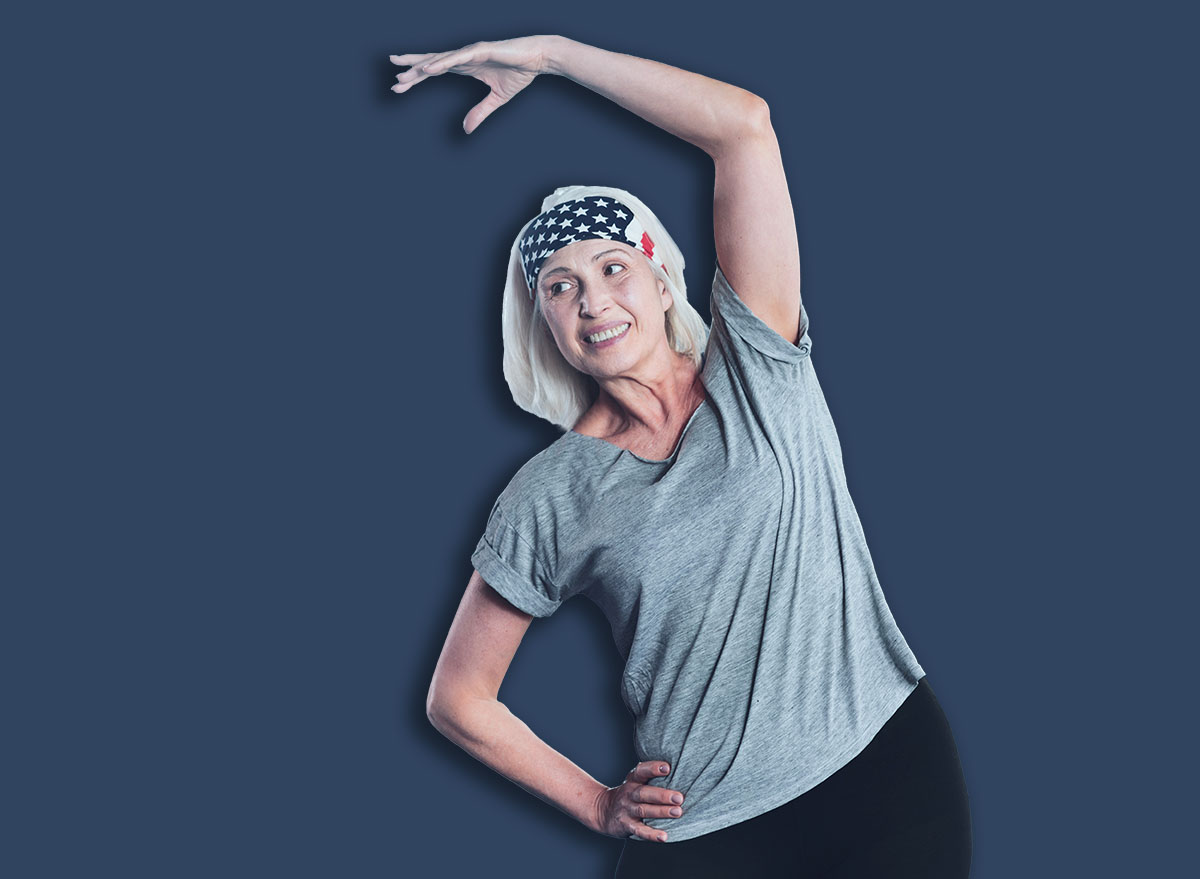
Side bends target the obliques and the muscles running along your sides. These muscles are often neglected in daily life, so strengthening them can greatly change your waist measurement and create a more defined shape.
Muscles Trained: Obliques, lateral trunk muscles
How to Do It:
- Stand with your feet shoulder-width apart
- Place your right hand on your hip and extend your left arm overhead
- Bend slowly to the right, sliding your right hand down your thigh while your left arm reaches over your head
- You should feel a stretch along your left side
- Return to the starting position and repeat on the other side
Recommended Sets and Reps: 12 to 15 bends each side for 2 to 3 sets
Common Mistakes to Avoid:
- Leaning forward or backward as you bend, which turns it into a different exercise and reduces effectiveness for the waist
- Moving out of one plane of movement; think of standing between two panes of glass and keeping your body flat against them throughout.
RELATED: The 7-Minute Standing Routine That Shrinks Hip Dip Fat After 45, According to a Trainer
Standing Knee to Elbow
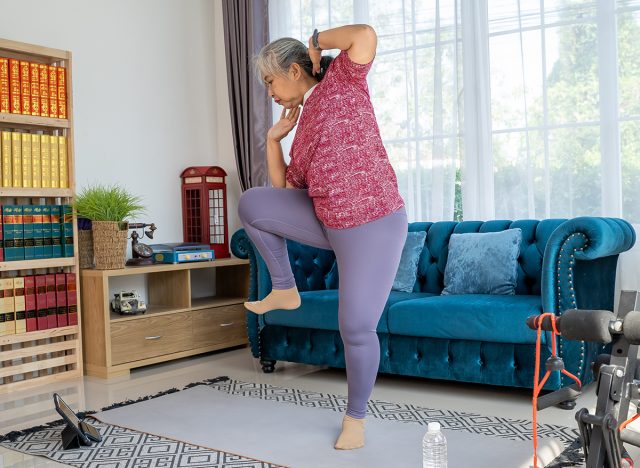
This exercise combines core rotation with hip flexion, working both your obliques and your deeper abdominal muscles. It also improves balance and coordination, which becomes increasingly important after 60.
Muscles Trained: Obliques, deep abdominals, hip flexors
How to Do It:
- Stand with your feet hip-width apart and your hands behind your head
- Lift your right knee up and across your body while bringing your left elbow down to meet it
- Return to the starting position
- Repeat on the other side (left knee to right elbow)
Recommended Sets and Reps: Start with 10 to 12 reps per side for 2 sets; work up to 15 to 20 per side for 3 sets as you get stronger
Common Mistakes to Avoid:
- Rushing through the movement and barely lifting the knee; you want to bring your knee up as high as comfortable and really contract your core as your elbow comes down
- Treating it as a speed exercise; this is about feeling your muscles work, not getting through reps quickly
Standing Wood Chop
The wood chop movement engages your entire core through a diagonal rotation that mimics real-life movements. It works your obliques, rectus abdominis, and the stabilising muscles around your spine, all which add to a tighter waist.
Muscles Trained: Obliques, rectus abdominis, spinal stabilisers
How to Do It:
- Stand with your feet slightly wider than shoulder-width apart
- Clasp your hands together, or hold a light weight if you have one
- Start with your hands up near your right shoulder
- Sweep them down diagonally across your body toward your left hip, as if chopping wood
- Keep your arms relatively straight and let your torso rotate with the movement
- Return to the starting position and complete all reps on one side before switching
Recommended Sets and Reps: 12 to 15 chops each side for 2 to 3 sets
Common Mistakes to Avoid:
- Bending your back or hunching over as you chop down; the movement should come from rotating your torso while keeping your spine neutral
- Rounding your back, which puts unnecessary strain on it and removes the core engagement that makes this exercise effective.
Standing March with Twist
This exercise combines cardio with core work, getting your heart rate up slightly while specifically targeting your waist through rotation. The marching component also improves hip mobility and balance.
Muscles Trained: Obliques, hip flexors, core stabilisers
How to Do It:
- Stand tall with your hands behind your head
- March in place, lifting your knees high
- As your right knee comes up, rotate your upper body to bring your left elbow toward that knee
- As your left knee comes up, rotate to bring your right elbow toward it
- Keep marching and twisting in a rhythmic pattern
Recommended Sets and Reps: Start with 30 seconds to 1 minute of continuous marching with twists; work up to 2 to 3 minutes as your fitness improves
Common Mistakes to Avoid:
- Dropping your elbows forward instead of rotating your torso; your hands should stay behind your head throughout, with the rotation coming from your core
- Letting your chest drop or your back round; keep your chest lifted throughout.
How to Fit These Into Your Week

Start with 2 to 3 sessions per week, leaving at least one day between sessions for recovery. You can do all five exercises in one session, or split them up throughout the week assuming that feels more manageable.
A typical session: perform each exercise for the recommended reps or time, rest for 30 to 60 seconds between exercises, then repeat the circuit 2 to 3 times. The whole session shouldn’t take more than 15 to 20 minutes once you’re familiar with the movements.
You can do these on their own or add them to your existing walking routine. Some clients do their standing exercises in the morning and walk later in the day. Others prefer a short walk as a warm-up, then the exercises. There’s no single right way, just whatever helps you stick with it.
Check with your doctor before starting if you have uncontrolled high blood pressure, recent surgery (especially abdominal surgery), severe osteoporosis, significant balance problems, or any heart condition. If you experience sharp pain, dizziness, chest pain, or severe shortness of breath during these exercises, stop immediately and get medical advice.
Anyone with lower back issues should be particularly careful with the twisting movements. Disc problems, sciatica, or chronic back pain all warrant a conversation with your doctor or physiotherapist before beginning.
What to Expect After 4 to 6 Weeks

After 4 to 6 weeks of steady training, at minimum twice a week, you can expect your waist size to drop by 1 to 2 inches. For some it will be more, for some less, depending on your fitness level, diet, and how much visceral fat you carry.
The first signs you’ll notice aren’t in the mirror. You’ll feel better posture and stronger core muscles before you see any visual change. Your clothes will fit differently before you notice a drastic decrease in your waist measurement. Trousers that are now tight around the waist will loosen. You’ll stand taller without thinking about it.
Visual results aren’t only about losing fat; you’re also toning muscles. Even if you don’t lose as much weight as you expect, you’ll notice your waist is smaller and more defined as your abdominal muscles tighten and hold everything together.
Diet Matters More Than You Think

Diet is the single biggest factor in whether you see results. You can’t out-train a bad diet, no matter how consistently you train. If you’re consuming a lot more calories than your body burns, you’ll still build muscle underneath, but you won’t be able to see it through the body fat.
Most people who succeed make small adjustments rather than dramatic ones: less processed food, more protein and vegetables, less alcohol, and more awareness of portion sizes. The exercise builds the base. Your diet determines how much of that result becomes visible.
Frequency matters more than intensity. Training twice a week for six months will give you better results than training every day for three weeks and then stopping. Be consistent, be patient, and the results will come.