5 Standing Strength Moves That Build Muscle Without Weights After 50
Staying strong after 50 depends on how well your body can generate force, maintain balance, and move with control. The most effective training reflects those demands, which is why standing strength work continues to deliver results well beyond midlife. When your feet are on the ground, more muscle gets involved, and every rep carries purpose.
Standing exercises naturally recruit your legs, hips, and core while asking your upper body to support posture and alignment. That full-body involvement increases muscle engagement and reinforces the movements you use throughout the day. Over time, this approach builds strength that feels usable rather than isolated.
There’s also a confidence factor that comes with training upright. You’re improving balance, coordination, and joint awareness while your muscles work together instead of in silos. That combination supports better movement quality and helps you stay consistent, which matters more than intensity alone.
The five standing strength moves below use bodyweight and resistance bands to stimulate muscle growth without external weights. Each exercise targets key muscle groups while keeping you stable and in control. If building muscle and staying capable after 50 is the goal, these movements belong in your routine.
Mini Band Squats
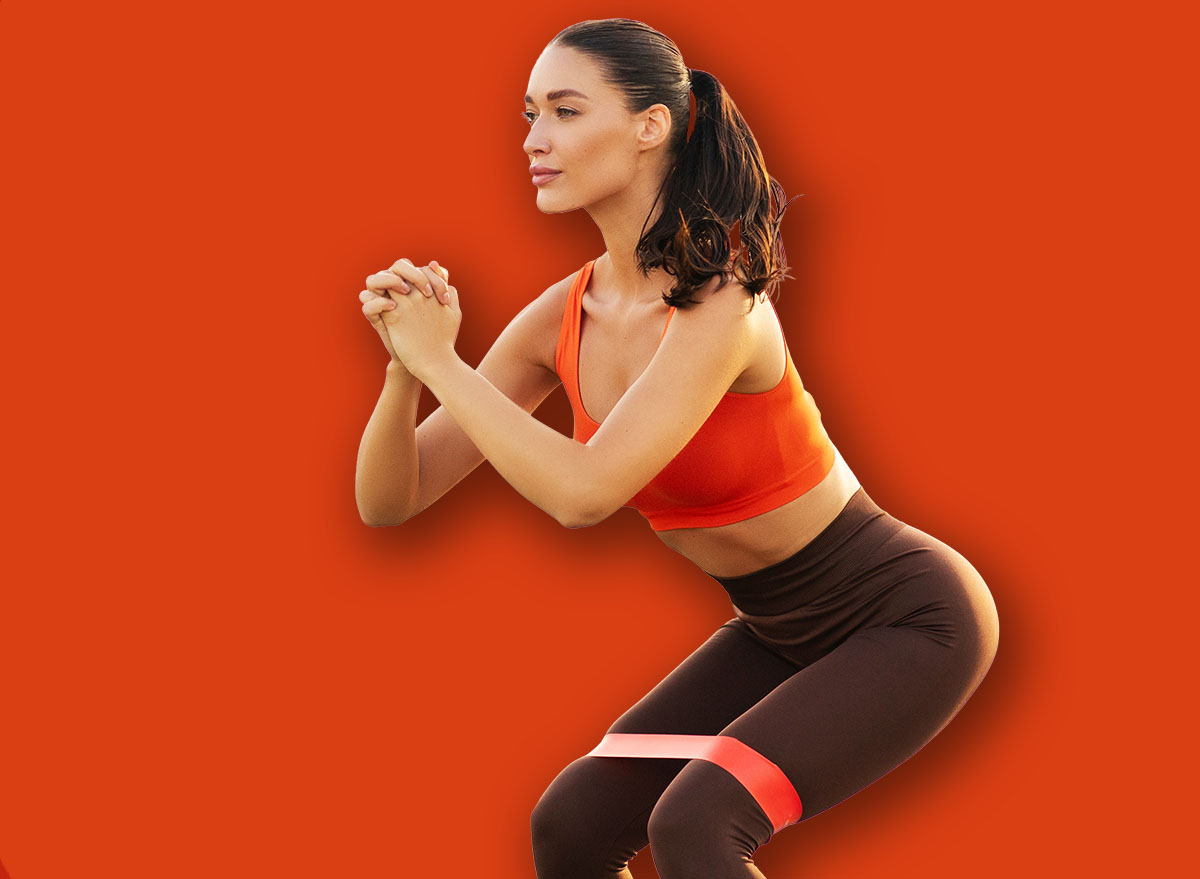
Mini band squats provide constant tension, keeping your legs and hips engaged throughout the range of motion. The band activates your glutes earlier and keeps your knees tracking properly, which improves squat mechanics over time. That extra tension increases time under load without adding weight, making it ideal for muscle building after 50. You’ll also challenge your balance and core as your body works to stay centered during every rep.
Muscles Trained: Quadriceps, glutes, hamstrings, and core.
How to Do It:
- Step into a mini band and place it just above your knees.
- Stand with your feet shoulder-width apart and brace your core.
- Push your hips back and bend your knees to lower into a squat.
- Press your knees slightly outward against the band as you descend.
- Drive through your heels to stand tall and squeeze your glutes at the top.
Recommended Sets and Reps: Knock out 3 sets of 10 to 15 reps. Rest for 45 to 60 seconds between each set.
Best Variations: Tempo squats, pause squats, banded box squats.
Form Tip: Keep your chest tall and your knees gently pressing into the band throughout.
Banded Good Morning
The banded good morning strengthens your posterior chain, which plays a major role in posture, walking speed, and lower-body power. The band provides smooth resistance that increases as you hinge forward, teaching your hips to do the work instead of your lower back. This move builds hamstring and glute strength while reinforcing proper hip hinge mechanics. It’s a powerful way to support longevity and everyday movement.
Muscles Trained: Hamstrings, glutes, erector spinae, and core.
How to Do It:
- Stand on the center of a resistance band with your feet hip-width apart.
- Loop the band around your upper back or hold it across your shoulders.
- Brace your core and keep your knees slightly bent.
- Hinge your hips back while lowering your chest toward the floor.
- Drive your hips forward to return to a tall standing position.
Recommended Sets and Reps: Perform 3 sets of 12 to 15 reps. Rest for 45 seconds between each set.
Best Variations: Single-leg banded good mornings, slow eccentric reps, pause hinges.
Form Tip: Think about pushing your hips back rather than bending at your waist.
Bodyweight Split Squats
Split squats load each leg individually, improving strength balance and reducing compensation between sides. That unilateral demand challenges your stabilizers and core while building serious leg strength without added weight. The upright position also mimics real-life movements like stepping and climbing. Over time, this move helps maintain muscle mass and coordination.
Muscles Trained: Quadriceps, glutes, hamstrings, and calves.
How to Do It:
- Take a staggered stance with one foot forward and one foot back.
- Stand tall and brace your core before lowering down.
- Bend both knees as you drop your back knee toward the floor.
- Keep most of your weight on your front leg.
- Press through your front heel to stand back up.
Recommended Sets and Reps: Knock out 3 sets of 8 to 12 reps per side. Rest for 60 seconds between each set.
Best Variations: Rear-foot elevated split squats, tempo split squats, shallow range split squats.
Form Tip: Stay upright and controlled rather than leaning forward to create momentum.
Wall Push-ups
Wall push-ups strengthen your chest, shoulders, and arms while reducing stress on your wrists and shoulders. The vertical angle allows you to gradually build pressing strength while maintaining complete control of your body position. This move also engages your core and glutes, helping you maintain a straight line from head to heels. It’s a smart way to build upper-body muscle with confidence.
Muscles Trained: Chest, shoulders, triceps, and core.
How to Do It:
- Stand facing a wall and place your hands at chest height.
- Step your feet back slightly and brace your core.
- Lower your chest toward the wall by bending your elbows.
- Keep your body in a straight line as you descend.
- Press through your palms to return to the starting position.
Recommended Sets and Reps: Perform 3 sets of 10 to 15 reps. Rest for 45 seconds between each set.
Best Variations: Incline push-ups on a bench, narrow grip wall push-ups, tempo reps.
Form Tip: Squeeze your glutes and keep your ribs down to avoid arching your back.
Resistance Band Press
The resistance band press builds upper-body strength while forcing your core to stabilize every rep. Bands provide variable resistance, meaning the press becomes more challenging as your arms extend. That tension stimulates muscle growth without joint strain. It also reinforces posture by training your shoulders and chest together.
Muscles Trained: Chest, shoulders, triceps, and core.
How to Do It:
- Anchor a resistance band behind you at chest height.
- Hold the handles and step forward to create tension.
- Stand tall with your core braced and elbows bent.
- Press your hands straight forward until your arms extend.
- Slowly return to the starting position under control.
Recommended Sets and Reps: Knock out 3 sets of 12 to 15 reps. Rest for 45 to 60 seconds between each set.
Best Variations: Single-arm band press, staggered stance press, half-range pulses.
Form Tip: Exhale as you press, keeping your ribs stacked over your hips.
The Best Strength Tips to Build Muscle After 50
Building muscle after 50 works best when you focus on quality movement, consistent effort, and recovery-friendly strategies. Standing exercises allow you to train more often without beating up your joints. When you pair exercise selection with simple habits, progress adds up fast.
- Train tension, not load: Bands and bodyweight can provide ample muscle-building stimulus when you slow your reps and control the movement.
- Stay upright whenever possible: Standing work challenges balance and coordination while strengthening more muscles at once.
- Use unilateral exercises regularly: single-leg and staggered-stance moves reduce imbalances and improve joint health.
- Recover between sessions: Muscle grows when you rest, so rotate movement patterns and allow recovery days.
- Stack consistency over intensity: Short, frequent sessions beat occasional all-out workouts every time.
These standing strength moves keep training accessible, effective, and sustainable so you can keep building muscle well into your 50s and beyond.
References
- Bloch-Ibenfeldt M, Theil Gates A, Karlog K, Demnitz N, Kjaer M, Boraxbekk C. “Heavy resistance training at retirement age induces 4-year lasting beneficial effects in muscle strength: a long-term follow-up of an RCT.” BMJ Open Sport & Exercise Medicine. 2024;10:e001899. https://doi.org/10.1136/bmjsem-2024-001899