5 Bed Exercises That Flatten Belly Overhang Faster Than Floor Workouts After 60

Flattening belly overhang after 60 comes down to consistency, smart positioning, and choosing exercises that let you train often without beating up your joints. The bed gives you a built in advantage. It elevates your body just enough to reduce spinal pressure while still challenging your core to stabilize, brace, and control movement. That combination makes it easier to train your abs with higher quality reps and better intent.
When core work feels uncomfortable on the floor, people tend to rush reps, shorten ranges of motion, or avoid training altogether. A bed changes that equation. The slight incline encourages better breathing mechanics, improved pelvic control, and more natural engagement of the deep abdominal muscles that help pull the midsection in. That matters when your goal is tightening the lower belly, not just burning calories.
The five bed exercises below focus on tension, control, and time under stress. Each move targets the muscles that support your waistline while keeping your neck, hips, and lower back comfortable. Expect smart progressions, simple coaching cues, and movements you can repeat daily without dread.
Flutter Kicks
Flutter kicks train your lower abs while forcing your core to stay engaged for extended periods. Performing them on a bed slightly elevates your torso, which reduces hip flexor strain and helps you maintain better control through each kick. This setup also encourages steady breathing, which improves abdominal tension and endurance. Over time, this combination supports better midsection firmness and improved posture.
Muscles Trained: Lower abdominals, hip flexors, transverse abdominis, and quadriceps.
How to Do It:
- Sit near the edge of your bed and lower yourself onto your back.
- Place your hands under your hips for support.
- Lift both legs slightly off the mattress.
- Kick one leg up as the other lowers, keeping both straight.
- Brace your core and breathe steadily throughout.
Recommended Sets and Reps: Knock out 3 sets of 20 to 30 total kicks. Rest for 30 seconds between each set.
Best Variations: Bent knee flutter kicks, slow tempo flutter kicks, and single leg holds.
Form Tip: Press your lower back gently into the bed to maintain abdominal tension.
Scissor Kicks
Scissor kicks challenge your core by using a longer lever arm than flutter kicks, increasing abdominal demand. The bed provides support that helps you maintain control and avoid excessive arching. This exercise builds lower belly strength while improving coordination and muscular endurance. It also reinforces proper bracing during leg movement.
Muscles Trained: Lower abdominals, hip flexors, obliques, and transverse abdominis.
How to Do It:
- Lie on your back with legs extended upward.
- Place your hands under your hips for support.
- Lower one leg toward the bed while keeping the other raised.
- Switch legs smoothly and with control.
- Keep your core tight and movements steady.
Recommended Sets and Reps: Perform 3 sets of 16 to 20 total reps. Rest for 30 seconds between each set.
Best Variations: Bent knee scissor kicks, paused scissor kicks, and alternating holds.
Form Tip: Move slowly and avoid letting your legs drop too low.
Mountain Climbers
Mountain climbers on a bed increase core engagement while reducing wrist and shoulder strain. The elevated surface positions your body slightly upright, helping maintain better spinal alignment. This version also raises your heart rate, supporting fat loss around the midsection. It’s an excellent blend of strength and conditioning.
Muscles Trained: Rectus abdominis, obliques, hip flexors, and shoulders.
How to Do It:
- Place your hands on the bed and step into a plank position.
- Brace your core and keep your shoulders stacked over your hands.
- Drive one knee toward your chest.
- Switch legs smoothly and maintain rhythm.
- Keep your hips level throughout.
Recommended Sets and Reps: Knock out 3 sets of 30 to 45 seconds. Rest for 45 seconds between each set.
Best Variations: Slow mountain climbers, cross-body mountain climbers, and alternating holds.
Form Tip: Exhale as your knee drives forward to increase core tension.
Side Plank Holds
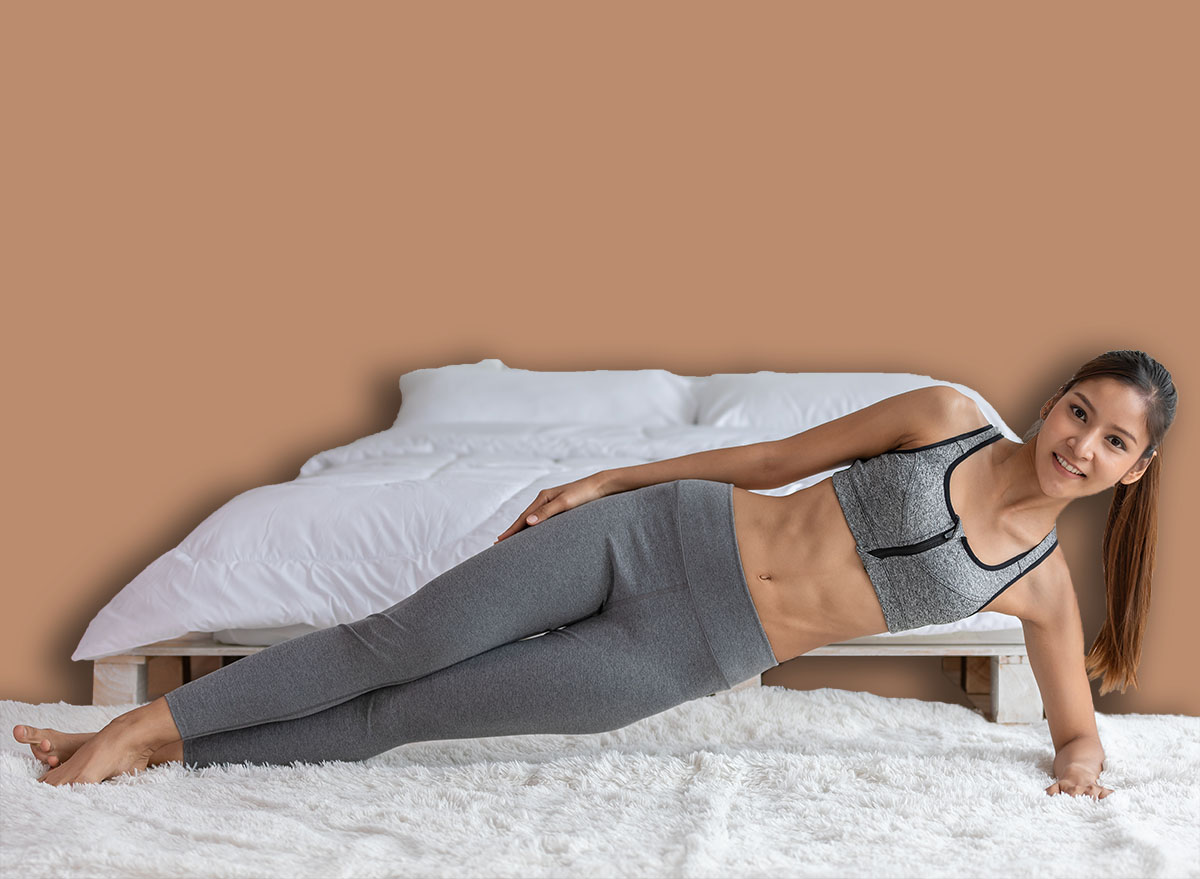
Side planks target the obliques, which play a significant role in tightening the waistline. Performing them on a bed reduces shoulder stress while still demanding full core engagement. This position also improves lateral stability, which supports balance and posture. Stronger obliques help pull the belly inward and create a more defined midsection.
Muscles Trained: Obliques, transverse abdominis, glutes, and shoulders.
How to Do It:
- Lie on your side with your elbow under your shoulder.
- Stack your legs and brace your core.
- Lift your hips off the bed.
- Hold the position while breathing steadily.
- Lower with control and switch sides.
Recommended Sets and Reps: Perform 2 to 3 sets of 20 to 40 second holds per side. Rest for 30 seconds between each set.
Best Variations: Knees down side plank, side plank leg lifts, and short range holds.
Form Tip: Pull your ribcage toward your hips.
Incline Plank Holds
Incline planks strengthen the entire core while keeping pressure off the lower back. The bed allows you to focus on quality bracing without fatigue, reducing set times. This exercise reinforces posture, breathing control, and deep abdominal activation. Over time, it builds the foundation needed to flatten the belly overhang.
Muscles Trained: Rectus abdominis, transverse abdominis, shoulders, glutes
How to Do It:
- Place your forearms on the bed and step your feet back.
- Create a straight line from head to heels.
- Brace your core and squeeze your glutes.
- Hold the position while breathing slowly.
- Finish strong and step down with control.
Recommended Sets and Reps: Knock out 3 sets of 30 to 60 second holds. Rest for 45 seconds between each set.
Best Variations: High plank holds, shoulder tap planks, and alternating leg lifts.
Form Tip: Imagine tightening a belt around your waist.
Best Tips for Flattening Belly Overhang After 60

Flattening the lower belly takes more than a few exercises. It requires smart habits that support recovery, consistency, and muscle engagement. These tips help you get more out of your bed-based core training while protecting your joints and energy levels.
- Train your core most days: Short daily sessions create better results than infrequent long workouts.
- Control your breathing: Slow exhales improve abdominal engagement and help tighten the midsection.
- Move with intention: Quality reps beat speed every time when flattening belly overhang.
- Support your training with daily movement: Walking and light activity enhance fat loss and recovery.
- Prioritize protein intake: Adequate protein supports muscle tone and tissue repair.
References
- Vissers, Dirk et al. “The effect of exercise on visceral adipose tissue in overweight adults: a systematic review and meta-analysis.” PloS one vol. 8,2 (2013): e56415. doi:10.1371/journal.pone.0056415
- Lee, Jung-Seok et al. “Effects of selective exercise for the deep abdominal muscles and lumbar stabilization exercise on the thickness of the transversus abdominis and postural maintenance.” Journal of physical therapy science vol. 27,2 (2015): 367-70. doi:10.1589/jpts.27.367